

Best Temporary Phone Number for SMS Verification in 2026: A Practical Workflow with SmsPva
A temporary phone number for SMS verification can help with a legitimate signup, test, or privacy-conscious workflow. The right choice depends on the target service, how long you need access, and whether you may need the number for account recovery later.
This guide explains how to compare options, check current listings, and respond if a code does not arrive. Availability and acceptance vary by service and time, so no listing can guarantee that verification will succeed.
What a temporary number can—and cannot—do for SMS verification
A temporary phone number for SMS verification is a virtual number you access through a provider to receive a text, often containing a one-time passcode. It can help with a legitimate task, such as testing a signup flow or keeping a personal number separate from an account. If a message arrives, the provider makes the SMS available through its service.
Access may be brief. A one-time SMS number is intended for a particular verification attempt; it is not the same as having a mobile number you control indefinitely. A longer-access option may suit a workflow that needs follow-up texts, but check the specific listing’s terms before choosing.
Verification is not ongoing access
Receiving one code may complete an initial check, but it does not ensure you can receive future codes. A platform may later ask for another SMS to sign in, change account details, or recover access. If the temporary number is no longer available, you may not receive that message. For important accounts, plan to add a recovery method the platform supports and that you control.
Virtual numbers also do not guarantee acceptance. Each service decides which numbers it allows, and requirements can vary over time. A number that works for one service—or one attempt—may not work for another. Treat SMS verification as a service-specific process, not a promise that any temporary number will pass.
Use a temporary number for the right task
This 2026 guide focuses on choosing carefully, checking live details, and having a sensible next step if a code does not arrive. A temporary number is not a way to bypass a platform’s rules or security controls. Use one only for an account you are authorized to create or manage, and follow the target service’s terms.
SmsPva provides virtual numbers for SMS verification and OTP receipt. You can review its Receive SMS online options as part of your evaluation. Check the current service listing before starting. Availability, delivery, and acceptance can vary; a temporary number should not be treated as anonymity or as your sole recovery channel.
How to choose the right temporary SMS number
The best temporary phone number for SMS verification is not simply the cheapest listing. Match the number to the task, then check whether the option fits the account’s likely lifespan and recovery needs. Availability and acceptance can vary by service and time, so treat each listing as an option to assess—not a promise that verification will succeed.
Check service support and live availability
Start with the exact app or website where you need to verify an account. Check whether it appears in the provider’s service options rather than assuming a number listed for one service will work with another. Review available countries and number details for that service immediately before you commit. Listings can change, and a country choice does not guarantee platform acceptance.
Choose a country based on the service’s requirements and your legitimate use case, not just because its listing looks inexpensive or plentiful. If the platform requires a number you personally control, or its rules do not allow virtual numbers, choose an approved alternative.
- Service: Is the intended platform explicitly listed?
- Country: Is an option currently shown for that service?
- Terms: Does the platform permit this type of number?
Match access duration to the account
A one-time SMS number is generally suited to a genuinely one-off verification attempt. Consider longer access when your use case requires another message later, but check the listing’s duration and conditions. Do not assume a single-use number will remain available after the verification flow ends, or that longer access is offered for every service.
Before paying, read the displayed price and the provider’s stated failure, refund, or cancellation terms. Confirm what the charge covers and what happens if a code does not arrive or the service rejects the number. Terms can differ between options; do not assume a failed attempt automatically qualifies for a refund.
Compare the full fit, not just the lowest displayed price. A low-cost option may be unsuitable if it is for the wrong service, offers too little access, or leaves you without a practical recovery route. Paying more does not guarantee delivery or acceptance. Use the live listing to make a specific decision rather than treating past availability or pricing as current.
Factor in future recovery
Ask whether you may need a login or recovery code weeks or months later. If the account matters and the temporary number may not be accessible again, it may be a poor choice as the only recovery channel. Where the service allows it, add another supported recovery method that you control.
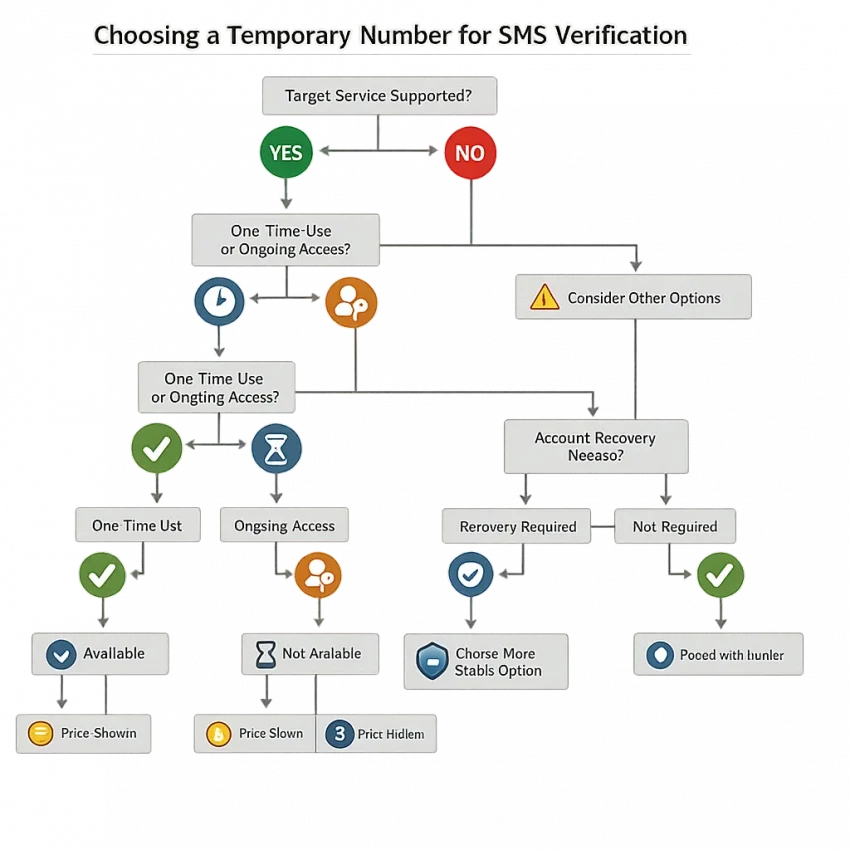
A simple rule helps: choose one-time access for a permitted, low-risk task that needs one message; consider longer access only when future SMS access is genuinely needed and the listing supports it; choose another route if lasting control of the number or dependable recovery is essential.
A step-by-step workflow for receiving a verification code
A reliable SMS verification workflow starts before you enter a number. Confirm that the task is legitimate, check the target service’s requirements, and decide whether a one-time code is enough. Then follow the current listing instructions rather than assuming every temporary number will work.
Before you request a code
- Define the task. Identify which account you are verifying and whether you may need access to that number again. A one-time SMS number may suit a single, low-risk verification. Consider future access before proceeding.
- Check the service’s rules. Review the target platform’s current requirements. Use a number only for an account you are authorized to create or manage. Some services may not accept virtual numbers, and a listing cannot guarantee acceptance.
- Inspect live options. Start at the relevant SmsPva service listing. Check whether the service and country option you need is currently shown. Read the displayed price, access type, instructions, and any failure or refund terms. Availability and terms can change.
- Make a recovery decision. If losing access to the number could lock you out of an important account, choose a recovery method you control or confirm that the platform supports another recovery option. A temporary number should not be your only plan for long-term access.
Do not choose on price alone. The lowest displayed option may not match your service, country, access duration, or future needs. Select only after checking the details for your exact task.
Request, retrieve, and close the loop
- Copy the number exactly. Use the number shown in the selected listing, including its country code and formatting requirements. Enter it in the target service’s phone-number field.
- Request one code. Submit the verification request once, then wait for the period stated in the listing and follow the target service’s flow. Keep the relevant SmsPva page open so you can check for the incoming message. Do not assume a code will arrive within a particular time.
- Retrieve and enter the message. When the SMS appears, enter the code in the target service’s verification screen. Treat it as sensitive: do not share it or enter it on an unrelated page. Follow the service’s instructions if the code expires or the flow ends.
- Pause if the code is missing. Recheck the number, selected service, and listing instructions. Allow the stated waiting period to pass. If the service rejects the number, the option is no longer suitable, or the instructions say to stop, do not keep triggering code requests.
- Finish account setup. Note whether the number remains accessible and for how long, if the listing specifies that information. Add a recovery email, authenticator, or another method the platform supports. Do not rely on future access unless the selected option clearly fits your needs.
Using SmsPva for a service-specific verification attempt
For a legitimate verification task, begin with the service you need—not with a number chosen at random. SmsPva provides virtual numbers for SMS verification and OTP receipt, with service-specific and country-specific pages to help you review relevant options. These listings can guide your selection, but they do not guarantee that a platform will accept a number or deliver a message.
Start with the service listing
Open the page for the service you intend to verify. A service-specific listing helps keep the attempt focused: check that it is the right service, then review the options currently displayed. Avoid selecting a number simply because it appears first or has the lowest displayed price.
For example, if your task involves Signal, review the Signal SMS verification page and its instructions. Check the available option’s country and whether it is intended for a single SMS or another access period. Those details matter because you may need only one code, or you may have a legitimate reason to need further access. Do not assume every service offers the same number types or access.
Before paying, compare the listing with your actual account task. Confirm that you selected the correct service and understand the displayed terms. If the account may need SMS recovery later, consider whether a temporary number suits it at all. A number used for an initial code may not remain available for future messages.
Check the country and follow the displayed flow
If you have a specific country requirement, use the relevant service-and-country listing where available. For a Signal attempt involving the United Kingdom, inspect the Signal verification in the United Kingdom listing. Treat it as a place to review current options, not as proof that a number is in stock or will work with Signal. Availability and acceptance can change.
Once you choose an option, follow its displayed instructions. Enter the number into the target service exactly as presented, including the country code if the form does not handle it automatically. Request a code only after confirming the number and service selection. Then check the SMS flow and enter the received code in the target service while it remains valid.
If no message appears within the stated flow, avoid repeatedly requesting new codes. Recheck the number and selected service, allow the indicated wait period, and consult the listing’s instructions. The issue could involve the provider flow, the target platform, or the number’s eligibility; a failed attempt alone does not identify the cause. Stop if the service rejects the number or the listing no longer fits your task.
Keep the account plan in view
After verification, note whether you will be able to access the number again. For a one-time task, that may be enough. For an account that could require later verification or recovery, use an approved method you control whenever the platform supports one.
SmsPva can help you inspect service-specific virtual-number options and their instructions before an attempt. It is not a promise of universal acceptance, guaranteed delivery, or anonymity. Check live details each time, and use the number only for an account you are authorized to create or manage.
If the SMS does not arrive: troubleshooting without wasting attempts
A missing verification code does not automatically mean the number is faulty. The message may be delayed, the target service may not accept that number, or a setup detail may need correcting. Work through a few checks before deciding whether to continue.
Check the setup and wait within the stated flow
Compare the number shown in SmsPva with the number entered on the target service. Check the country prefix and remaining digits, and confirm that you selected the correct service-specific listing. If the target service asks for a particular format, follow its instructions rather than adding or removing digits by guesswork.
Allow the waiting period stated in the SmsPva flow. Keep the verification page open if its instructions say to do so, and check the message area again. Do not assume a code will arrive instantly or that every attempt will succeed. Delivery can vary, and the target service may reject a virtual number independently of whether an SMS was sent.
If the stated wait passes without a message, review the listing’s instructions and SmsPva Help. Avoid requesting new codes repeatedly while an earlier request may still be active. Multiple requests can make it unclear which code is current, and the target service may limit further attempts.
Know when to retry—and when to stop
Make another attempt only if the current flow permits it and you have a clear reason, such as correcting a formatting mistake or choosing a different suitable option after checking its details. Before proceeding, consider whether the number is still available for the task and whether the target service allows another request.
Stop if the service explicitly rejects the number, the listing no longer appears suitable, or the instructions do not support another attempt. Repeated requests are unlikely to resolve a platform-side rejection and may trigger limits. If the SMS never appears, do not treat that outcome as proof of a specific technical cause. A provider-side delivery issue and a target-platform decision can look similar from the user’s side.
When you cannot establish a sensible next step, pause rather than spending more attempts. Check the current listing and support guidance, then choose a route that fits the target service’s rules. Neither OTP receipt nor platform acceptance is guaranteed.
Privacy, account recovery, and responsible use
A temporary number can help keep your personal number separate during a legitimate SMS verification task. But separation is not the same as anonymity. A platform may still associate an account with information you provide, device or session signals, and its own security checks. A virtual number does not remove your responsibility to follow platform rules.
Before you begin, consider what happens after the first code. If the account matters, ask whether you may need another SMS later to sign in, confirm a change, or recover access. A temporary number may not remain available, so it can be a poor sole recovery channel. Do not assume you can receive future messages on the same number.
Plan recovery before verifying
Where the platform allows it, add a recovery method you control. Depending on its settings, that might be a recovery email, authenticator app, passkey, or backup codes. Follow the platform’s instructions and confirm that each method is set up before relying on it. Keep backup codes somewhere secure and separate from the account they protect.
For a low-stakes account you can recreate, a one-time number may fit the task. For an account containing work files, purchases, or important conversations, use a number you can keep controlling if the service expects future phone verification. If that is not possible, choose another supported sign-up or recovery route rather than treating temporary access as permanent.
Protect the account itself, too. Use a unique password and store it securely. Never share verification codes or account credentials with someone who asks unexpectedly. A code confirms a step in the sign-in process; it is not a general-purpose security guarantee.
Use numbers and isolation tools responsibly
Use a number only for an account you are authorized to create or manage. Check the target platform’s terms and requirements first. If it requires a personally controlled number or does not accept virtual numbers for your intended use, do not try to work around that restriction. Acceptance can vary; privacy-conscious use does not create an entitlement to access.
Do not treat a temporary number as a way to bypass account limits, identity checks, or security controls. Keep account details accurate where required, and use the platform’s approved recovery process if access is lost. If the account is shared or managed for an organization, follow its security and retention policies.
Network isolation tools are separate from SMS receipt. Some teams use them as part of a broader, authorized testing setup, but they are not required for every verification task and do not make an account anonymous. Use them only when your workflow calls for them and the target platform permits them. For most users, the priority is to choose an appropriate verification method, secure the account, and establish a recovery option they can continue to access.
The best workflow in 2026: a decision checklist and recommendation
Choose the option that fits the account
The best temporary phone number for SMS verification depends on what happens after the first code. Check the target service’s rules, confirm the service appears in the live listing, and decide whether you may need the number again. A listed option does not guarantee that a platform will accept it or that a message will arrive.
| Your situation | Practical choice | Check before proceeding |
|---|---|---|
| One verification for a low-risk, legitimate task | Consider a one-time SMS number. | Confirm the service, current listing details, displayed price, and failure terms. |
| You expect to receive SMS again | Consider longer access only if the listing offers it. | Check the access period and whether it fits the service and future needs. |
| The account needs dependable long-term recovery | Use a personally controlled number or another supported recovery method. | Do not rely on temporary access as your only recovery channel. |
Do not choose on the lowest displayed price alone. Consider the account’s importance, access duration, and the listing’s terms. If the platform requires a personally controlled number, or its rules do not permit a virtual number, choose another route rather than trying to work around that requirement.
Final checks and quick answers
For a practical SmsPva workflow, check the live service options before you begin. Review the displayed details and instructions, then make one careful attempt. Availability, pricing, and platform acceptance can change; treat a listing as current information, not a promise of delivery.
- What is a temporary phone number for SMS verification?
- A virtual number made available to receive a verification message. Its access period depends on the option shown.
- Will every website or app accept a virtual number?
- No. Acceptance varies by service, number, and time. Check the platform’s rules and do not assume a listing ensures acceptance.
- How do I choose between a one-time SMS number and longer-term access?
- Choose one-time access for a genuinely one-off task. Consider longer access only when future SMS is needed and the listing supports it.
- What should I do if the verification code does not arrive?
- Recheck the number and service selection, wait for the stated period, and follow the provider’s instructions. Avoid repeated requests; stop if the number is rejected or unsuitable.
- Can I use a temporary number as my account’s recovery number?
- It is usually a poor sole recovery option because you may not retain access. Add a recovery method you control, where supported.
- How can I check current SmsPva service and country availability?
- Inspect the live service and country options and their displayed details before starting.
- Is using a temporary number a way to remain anonymous?
- No. It does not guarantee anonymity or bypass security controls. Follow platform rules and use numbers only for accounts you are authorized to manage.
Recommendation: Use SmsPva as a way to review service-specific options for a legitimate verification task, but check the live listing and target service rules before you start. Choose one-time access only when it fits the task, plan account recovery separately, and stop if the service rejects the number or the flow does not proceed.