

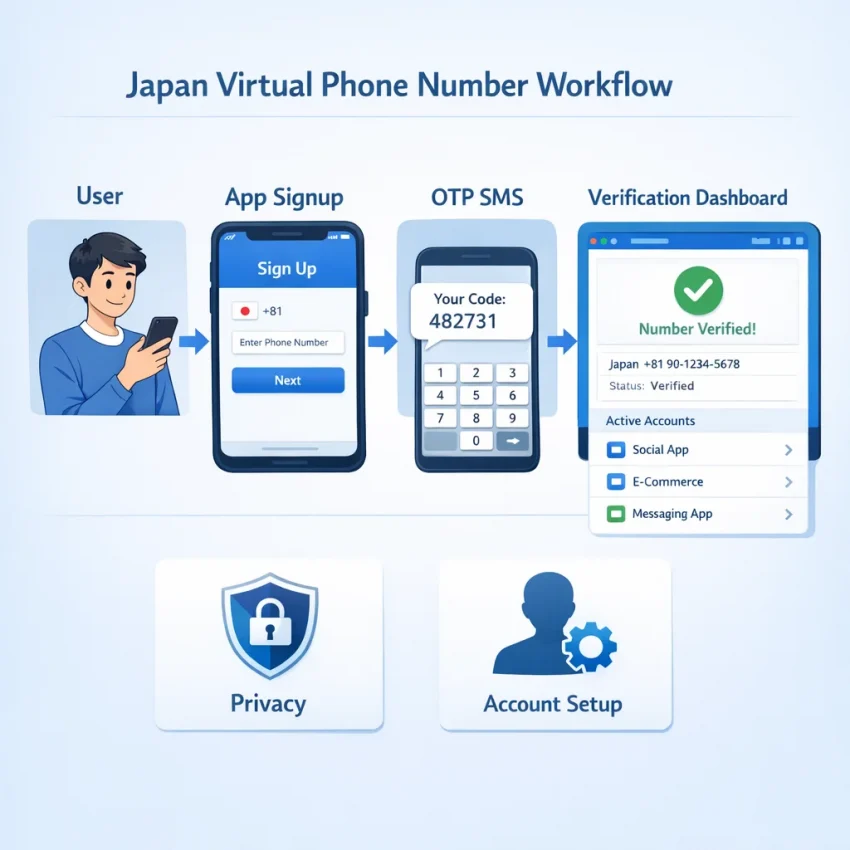
Why a Japan Phone Number Workflow Matters in 2026
In 2026, getting a japan phone number for verification is not just about finding any number that can receive a text. The real task is matching the number to the platform, the region, and the exact verification flow. Many apps now check more than basic SMS delivery. They may look at country fit, repeat attempts, timing, and whether the number seems appropriate for that specific signup or recovery step.
That is why buyers should think in terms of a workflow, not a shortcut. A solid japan phone number workflow helps you decide whether you need a Japan-based option, whether the service expects a regional number, and how to handle retries without wasting time or balance. This matters for users who want a japan virtual phone number for OTP receipt, privacy-focused account creation, or cleaner account separation.
A common mistake is treating all virtual numbers as interchangeable. They are not. One app may accept a broad country-level choice, while another works better when you select the exact service page first. Some users also move too fast. They request a number before the destination app is ready, let the OTP window expire, then blame the number. In practice, many failures come from process errors, not just number quality.
Using a structured platform like Receive SMS online with SmsPva reduces guesswork. Instead of relying on trial and error, you can start with the service or country path that best matches your goal.
What a good verification workflow includes
Start with four questions. What app are you verifying? Does that app care about Japan as the country? Is this a one-time OTP task or part of a longer setup? What will you do if the code does not arrive on the first attempt?
These questions matter because sms verification japan often succeeds when the setup is specific. If you choose the wrong country, the wrong service path, or request a code too early, you raise the chance of expiration or rejection. Good workflow design means preparing the destination app first, entering the number only when ready, watching the timer, and avoiding unnecessary resends.
Privacy is another reason workflow matters. Some users need a Japan number for account verification without exposing a personal line. Others want better separation between projects, logins, or testing environments. In both cases, the goal is not just receiving a code. The goal is completing verification cleanly, with fewer failed attempts and less account friction.
How to Choose the Right Japan Number: 6 Decision Criteria Before You Buy
Choosing a japan phone number for verification is not just about finding any available line. The better question is whether the number matches the app, the region logic, and your account workflow. That is why experienced buyers use a checklist before they spend.
1. Confirm service compatibility first
The biggest mistake is buying by country only. Many apps treat verification differently, and some work better when you choose the exact service page instead of a broad country list. If the target platform has service-specific routing, use that route. It is usually more precise than guessing with a generic number.
Before you buy, ask one simple question: is this number intended for one exact app, or are you still testing options? If you already know the destination app, check whether SmsPva has a matching service flow. Service matching is often the difference between a clean OTP receipt and a wasted attempt.
2. Check whether Japan is the right regional fit
A virtual phone number japan is most useful when the app expects Japanese region signals, local onboarding, or a Japan-facing setup. But not every verification flow requires a Japan number. Some services only need a valid SMS endpoint, while others care about regional consistency.
Review the live virtual numbers page instead of assuming any local number will work. If your account profile, language, or app store region points to Japan, country alignment usually matters more.
3. Decide between one-time verification and longer-use needs
Not every buyer needs the same session type. Some people only need a one-time code for signup or activation. Others need a number that supports a longer workflow, follow-up confirmations, or staged account setup.
If your goal is a fast OTP, a standard japan otp number flow is often enough. If you expect repeat checks, profile recovery steps, or multi-stage onboarding, think carefully before using a one-off path.
4. Make support and troubleshooting part of the decision
Good buyers plan for failure before it happens. SMS verification can fail because of app-side timing, a wrong service selection, or a region mismatch. That does not mean the workflow is bad, but it does mean support access matters.
SmsPva is practical here because it separates country browsing from service-specific workflows, which makes troubleshooting easier. If a code does not arrive, you can review whether the issue came from service choice, country fit, or timing instead of guessing.
5. Protect account isolation and privacy workflow hygiene
Many readers want a japan virtual phone number for privacy-focused signups, testing, or account separation. In those cases, the number is only one part of the setup. You should also think about account isolation, browser state, and whether the app may flag repeated activity from the same environment.
SmsPva supports verification-focused flows and related tooling for users who care about separation. That does not guarantee approval by any app, but it helps you build a more consistent process.
6. Use price discipline, not lowest-price thinking
Cheap is not always efficient. One failed attempt can cost more than choosing the right path first. The smarter way to compare options is to ask how many retries you may need if you guess wrong on service or country. A low headline rate loses its appeal if it creates two or three failed attempts.
Before you buy, check the live page, match the app, confirm whether Japan really matters, and only then request the number. That is the core buyer mindset for anyone who wants to receive otp with virtual number tools without wasting credits.
The Best Japan Phone Number Workflow With SmsPva: Step by Step
If you need a japan phone number for verification, the best approach is not to buy the first number you see. The safer path is a workflow: identify the target app, confirm whether Japan is actually required, then request the number through a platform built for SMS verification.
Start by defining the exact job. Are you verifying one new account, recovering access, or separating a work signup from a personal one? This matters because a virtual phone number Japan flow should match the app’s checks, timing, and retry limits.
Next, prepare the destination app before you request anything. Open the signup or verification screen first. Make sure you are ready to paste a number immediately. OTP windows can be short, and delays create avoidable failures. Also confirm the app is asking for SMS, not voice verification.
1. Choose country fit first, then service fit
Once your target app is ready, check whether country selection matters. If the platform or use case clearly points to Japan, review the Japan page on SmsPva. This is the easiest way to align your purchase with regional expectations for sms verification Japan.
After country fit, look for service fit. This is where many users lose balance. They choose a broad country option when the target app has its own verification routing or stricter filtering. If SmsPva has a dedicated page for the exact service, that page is usually the better starting point.
Before requesting the number, double-check three things: the app name, the country requirement, and whether you need a one-time OTP or a longer-use setup. For most account creation tasks, one-time verification is enough.
2. Request the number and enter it without delay
When you are confident about the match, request the number on SmsPva and copy it directly into the target app. Enter it carefully, including the correct country code. Small formatting errors can look like platform failure when the real issue is manual input.
Request the OTP once and wait for the app’s timer to run normally. Repeatedly tapping resend can trigger duplicate requests, rate limits, or confusion over which code is current. If the first code arrives, use the newest valid one shown in your order flow and complete verification immediately.
If the code does not arrive in the expected window, do not rush into another purchase. First review the basics: did you choose the right service, the right country, and the right verification method? Did the app accept the number format without warnings? If one of those checks failed, correct the setup before retrying.
3. Handle retries, expiration, and record the outcome
Sometimes a japan number for account verification fails for reasons outside your control, such as an app-side timeout or a closed OTP window. When that happens, treat the retry as a new workflow step, not a reflex. Note what happened: no SMS arrived, the code arrived too late, the app rejected the number, or the app accepted the number but would not validate the code.
If the issue was timing, reopen the target app flow and make sure you are on the final SMS screen before requesting a new number. If the issue was a mismatch, move from a broad country search to an exact service page on SmsPva. The goal is not more attempts. The goal is a cleaner attempt.
Service-Specific Example: How to Handle Signal Verification in Japan
If your goal is Signal verification in Japan, a general country-first search is only the starting point. Many users look for any japan phone number, paste it into Signal, and hope the OTP arrives. That approach can waste time and balance. Signal is a service-specific verification flow, so the cleaner method is to match both the app and the country before you request a number.
You can start from the broad Japan view if you are still checking regional fit. But once Signal is the target app, move to the dedicated Signal SMS verification page so your selection matches the route you actually need.
Use the Japan + Signal path, not a generic guess
If region fit matters, the best route is the combined Signal-and-Japan workflow. On SmsPva, that means using Signal verification in Japan when you know both variables upfront. This is more precise than browsing a broad list of Japan options and choosing blindly.
Here is the practical sequence. First, open Signal and get to the phone verification screen before you buy anything. Second, confirm that you want a Japan-based flow rather than a different country that only happens to be cheaper. Third, request the number from the Signal-specific Japan page. Fourth, paste the number into Signal carefully, including the correct country code. Fifth, wait for the SMS code and enter it promptly.
This workflow works best when you avoid extra retries. Do not request multiple codes too quickly. Do not switch numbers mid-process unless the first attempt clearly expires or fails. Keep notes on the time requested, the code window, and whether Signal asked for SMS or another verification option.
When one-time verification is enough
For many users, a one-time Japan OTP flow is enough. You need the code, you activate the account, and the workflow ends there. At the time of writing, the SmsPva API snapshot lists Signal in Japan single SMS at $4.00. Treat that as a current snapshot, not a guarantee.
If your use case involves follow-up checks or continuity with the same number, review whether a longer-use setup is necessary. For that exact case, SmsPva also offers a Signal SMS verification rental path. Use it only when your workflow genuinely requires continuity.
Common Failure Points and How to Fix Them Without Wasting Credits
Most failed sms verification japan attempts come from workflow mistakes, not from bad luck. If you want to complete verification without wasting balance, troubleshoot in a fixed order. Start by checking what you selected, then confirm country fit, then review timing and retry behavior.
The first failure point is a service mismatch. Users often pick a broad japan phone number workflow path when the target app expects a number routed for that exact service. If the app rejects the number immediately, shows an unsupported-number message, or never sends the code, stop and review the service choice before buying again.
The second failure point is country mismatch. A Japan number is not always required, but if the app expects Japan-based onboarding, local alignment matters. Many users fail because they choose Japan in one place and another country in the app itself.
The third issue is timing. OTP windows are often short. Do not request a number before the destination app is fully open and ready for submission. Prepare the form first, request the number second, paste it immediately, and submit once.
How to diagnose the failure before you retry
Use the app’s response as your clue. If the number is rejected before SMS is sent, the issue is usually service selection or app-side filtering. If the app accepts the number but no code arrives, review country fit and whether the chosen route matches the app. If a code arrives too late or no longer works, your problem is usually expiration, duplicate sends, or switching screens during the process.
Avoid repeated request attempts in the same app session. Many platforms treat rapid resend clicks as suspicious behavior. A better procedure is simple: submit once, wait the normal interval shown by the app, then assess the result. If nothing arrives, do not keep hitting resend. Cancel the attempt, note what happened, and restart with corrected inputs.
App-side blocks are another common cause. Some platforms flag accounts because of device reputation, browser state, IP inconsistency, or unusual signup patterns. In that case, changing only the number may not solve anything. Look for signs such as instant rejection, captcha loops, or try-again-later messages. When you see those, pause the flow and clean up the environment before buying another number.
Documentation helps more than most users expect. Keep a short note for each attempt: target service, chosen country, time requested, whether the number was accepted, and what exact error appeared. This turns guessing into a repeatable process.
Japan Number Pricing, Workflow Efficiency, and When SmsPva Is the Smarter Choice
Many buyers focus on the lowest sticker price for a japan phone number. That is usually the wrong metric. What matters is the cost per successful verification. A cheaper number becomes expensive if you burn balance on the wrong service, the wrong country fit, or repeated OTP retries.
In practice, workflow efficiency saves more than headline price hunting. If your target app cares about country consistency, start with the Japan route. If the app is stricter, move directly to a service-specific route. That simple choice often reduces failed activations and wasted balance.
Signal is a good example. For Signal verification in Japan, the exact service-country path is usually more efficient than browsing broadly and guessing. The listed $4.00 single SMS snapshot makes sense only inside the full workflow: correct service selection, correct country fit, and fewer retries.
Think in successful completions, not raw unit cost
Suppose one user buys the cheapest available option but picks a mismatched route and has to try again. Another user selects the proper virtual phone number japan workflow on the first attempt. Even if the second option looks higher upfront, it can cost less overall because it avoids duplicate purchases and repeated OTP windows.
This is where SmsPva stands out. The platform is built around verification workflows, not random number browsing. You can start from the service page, the country page, or both when the use case is specific. That structure helps you avoid common mistakes that inflate real costs.
Final Recommendation: The Best Practical Setup for Japan SMS Verification in 2026
If you need a japan phone number for verification in 2026, the best approach is not to buy the first available number. Start with the target app, then choose the number path that matches it. That means checking whether a general Japan route is enough or whether the service needs a more exact setup.
For most users, the practical recommendation is simple: use SmsPva, select Japan when region fit matters, and prefer a service-specific page when the app is sensitive to routing or verification formatting. This reduces wasted attempts and gives you a cleaner way to receive sms online japan for OTP and account activation.
The decision tree is straightforward. If the platform only needs a country-matched number, begin with Japan. If the platform is stricter, move directly to the exact service page. If the first code expires or the request fails, do not keep retrying blindly. Recheck the service-country match, restart the flow cleanly, and use support guidance when needed.
Bottom line: the best japan virtual phone number workflow in 2026 is a structured one. Use SmsPva as your default tool, verify the correct page before checkout, complete the OTP flow promptly, and document what worked so your next verification takes fewer steps.