

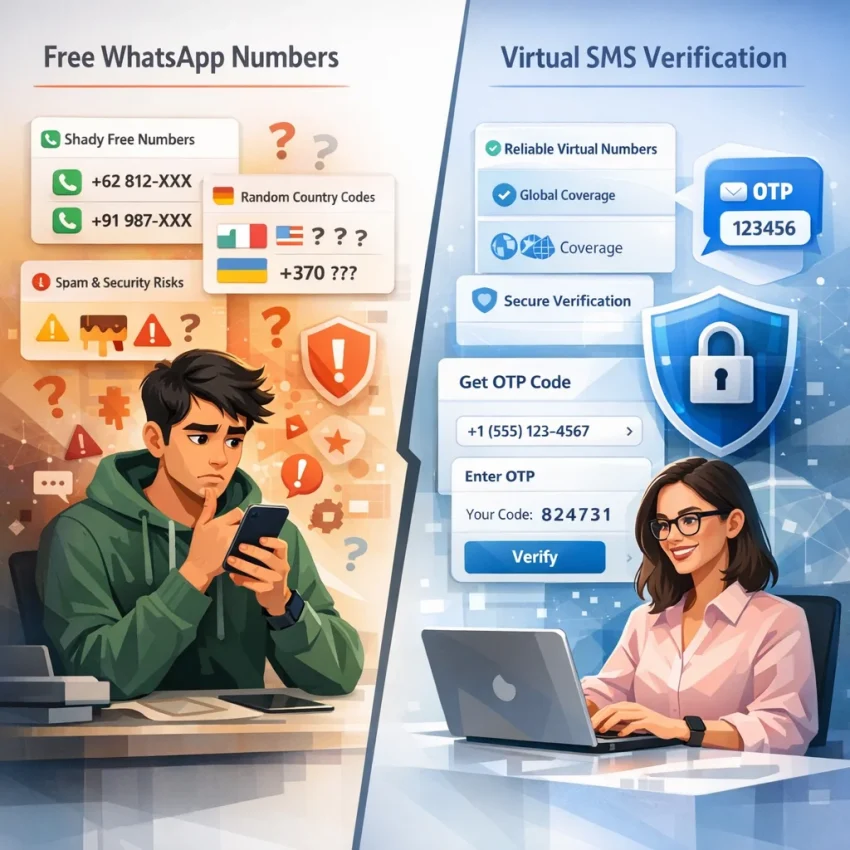
The phrase free number for WhatsApp keeps getting searched because it sounds simple. Users want a quick way to verify an account, protect their personal number, or test a setup in another region. Many also want to avoid long signup flows and unpredictable costs.
But in 2026, that search usually means something more practical. Most people do not need a literally free inbox that anyone can access. They need a WhatsApp verification number that is affordable, private enough for their use case, and more likely to receive the OTP when needed.
Public free-number sites often fail for the same reasons. Too many users try the same number. Old messages may already expose the inbox. The number may be blocked, overused, or simply unavailable for WhatsApp. So the real problem is not finding a zero-cost number. The real problem is finding a workflow that helps you receive SMS for WhatsApp with less friction.
That is why Receive SMS online with SmsPva is the practical starting point. Instead of chasing random free listings, you can use a service-specific verification flow designed for SMS activation and OTP receipt.
Why “Free Number for WhatsApp” Searches Keep Growing in 2026
The intent behind best free number for WhatsApp is usually one of five things: privacy, one-time activation, testing, international access, or cost control. A privacy-conscious user may not want to attach a personal SIM to a fresh account. A tester may need to verify a temporary environment. An international user may want a setup that fits a specific region.
In each case, the goal is not “free” by itself. The goal is a smoother verification outcome. That is why generic temporary-number advice often disappoints. Temporary access without service alignment is unreliable. WhatsApp verification depends on receiving the right code at the right time through a number flow built for that purpose.
The 2026 conversation has shifted from “free” to “workable.” Users have learned that free can become expensive in time. Repeated failures, expired codes, blocked public numbers, and reused inboxes create frustration fast. Even when a free method appears to work, it may not offer the privacy or consistency users expected.
A low-cost, service-specific option is often the smarter move because it reduces guesswork. It helps users focus on the activation itself instead of hunting through recycled public numbers. That is the practical lens here: not whether a free number exists somewhere, but whether it is a realistic way to complete WhatsApp verification.
What Actually Makes a WhatsApp Verification Number Worth Using
If you are searching for a free number for WhatsApp, the real question is simpler: which option gives you the best chance of receiving a WhatsApp OTP without wasting time? A usable virtual number for WhatsApp is not defined by price alone. It is defined by fit.
The first filter is service-specific support. A generic public number board may receive some SMS messages, but that does not make it a good fit for WhatsApp. Verification can be sensitive to number history, reuse, and how many people have already tried that number. A source designed for service-specific activation is usually the better path. That is why the practical route is to use WhatsAPP SMS verification on SmsPva instead of gambling on random free listings.
The second filter is country fit. Many users do not need a number from any country. They need one that makes sense for their setup, language, or testing environment. An online number for WhatsApp verification should let you review relevant options before you commit. The goal is not to chase a trendy region. The goal is to choose a number flow that matches your use case and reduces avoidable errors.
OTP Flow, Privacy, and Troubleshooting
The next thing to evaluate is how the OTP is received. Public free-number sites often fail here. The inbox may be visible to everyone, overloaded, delayed, or already used so many times that the number is no longer practical. Even when a code arrives, you may be competing with other users viewing the same inbox.
A better workflow gives you a clear request-and-receive path. You choose the service, select a number option, wait for the incoming SMS, and enter the code. SmsPva is built around that process. Instead of browsing a public wall of recycled numbers, you use a service-specific flow designed for OTP receipt and account activation.
Privacy matters too. A free public inbox can expose message content, timing, and number reuse patterns. If you care about keeping your personal number off a new account, using a public inbox defeats part of that purpose. A good WhatsApp virtual number workflow should reduce direct exposure of your personal line while still giving you a practical way to complete verification.
You should also check what happens if the code does not arrive. Many free-number sources give you no real troubleshooting path. A usable verification workflow should at least give you a structured next step, such as retry timing, a different number option, or help resources.
The Best Workflow for WhatsApp in 2026: Use SmsPva Instead of Chasing Free Lists
If your goal is a working WhatsApp verification number, the best path in 2026 is not hunting for a public free inbox. It is using a service-specific flow designed for WhatsApp SMS verification. That reduces wasted attempts, avoids public inbox exposure, and keeps the process focused on one task: getting the code and finishing setup.
Step 1: Start with the WhatsApp-Specific Flow
Open the WhatsApp service page on SmsPva instead of choosing a generic number first. This helps align the request with the platform you want to verify. Review the currently shown options carefully. Focus on what is available at that moment rather than assuming a country or route will always be in stock.
Before requesting a number, decide what you need:
- The service is WhatsApp.
- The country should match your setup preference if relevant.
- The goal is one OTP receipt for activation.
- The number should be used promptly after selection.
This is where many users lose time with free methods. A number that works for one platform may fail for another. SmsPva avoids that mismatch by letting you begin with the WhatsApp use case itself.
Step 2: Choose a Number Option and Request It
After confirming the service flow, select an available number option that fits your region preference and budget. Then request the number through the platform. At this stage, speed and accuracy matter. Open WhatsApp, enter the number exactly as shown, and submit the verification request without unnecessary delays.
If you are comparing cost, keep it grounded in live snapshots. At the time of writing, WhatsAPP in the United Kingdom was listed from $6.00 for UK and $0.30 for UK_V on SmsPva. These are time-sensitive API snapshots, not permanent promises, and they do not guarantee stock or delivery.
Once the number is active in your session, keep the page open and wait for the incoming code.
Step 3: Receive the OTP and Complete Verification
When WhatsApp sends the code, check the SmsPva inbox area for the incoming SMS. Enter the OTP exactly as received. Most problems here come from user-side friction, such as entering the wrong country code, mistyping a digit, requesting another code too quickly, or waiting too long before starting verification.
Use this simple sequence:
- Request the number on SmsPva.
- Copy the full number carefully.
- Enter it into WhatsApp with the correct country prefix.
- Request the SMS code once.
- Watch the inbox for the OTP.
- Enter the code immediately.
If your search started with “free number for WhatsApp,” this is the realistic alternative: low-friction, service-specific, and built around verification instead of guesswork.
Free vs Low-Cost WhatsApp Numbers: The Trade-Offs Most Guides Ignore
Many users search for a free number for WhatsApp because the goal sounds simple: get a code, verify an account, and move on. In practice, the real choice is not free versus paid in the abstract. It is unreliable public access versus a controlled, service-specific workflow that gives you a better chance of receiving the OTP.
A public free number often looks attractive because there is no upfront cost. But the hidden cost appears fast. The same number may have been used by many people before you. That raises the odds of blocked attempts, unavailable verification, or a number already tied to prior account activity.
The biggest problem with a typical free temporary number is exposure. Public inboxes are public by design. If an SMS arrives there, other users may be able to see it too. Even if the code appears first for you, privacy is weak. That is a poor fit for users who care about account separation, testing hygiene, or basic data protection.
Free sources also tend to have uneven support. If the code never arrives, there is usually no practical troubleshooting path. A low-cost source organized by service is more useful than a free list that treats every number as interchangeable.
A cheap WhatsApp verification number can be the better financial choice because it reduces repeat attempts. One successful verification is often cheaper than several failed free attempts that force you to restart. The benefit is not only price. It is efficiency, privacy, and less friction.
The price gap is often smaller than people expect. At the time of writing, the WhatsAPP United Kingdom snapshot on SmsPva was listed from $6.00 for UK and $0.30 for UK_V. Those are time-sensitive API snapshots, not permanent prices. Still, they show the core point: a low-cost verification workflow may be inexpensive enough that it makes more sense than gambling on a free-number list.
Common WhatsApp Verification Problems and How to Troubleshoot Them
Most issues with a whatsapp verification number come down to fit, timing, or reuse. Users often assume the problem is random. In practice, the workflow is usually the problem. A public inbox may have been used too many times, the wrong region may have been selected, or the number may not match the service-specific flow.
When the OTP Does Not Arrive
If your WhatsApp OTP does not arrive, first confirm you selected the correct service flow and entered the number exactly as provided. Small formatting mistakes matter. A wrong country assumption can also break verification.
Next, give the request a reasonable window. Do not spam resend immediately. Repeated requests can create delays or trigger retry timers. If the code still does not appear, move through this checklist:
- Confirm the number was ordered for WhatsApp.
- Check that you entered the full number and country code correctly.
- Wait for the current retry timer to finish before requesting another code.
- Avoid switching between too many attempts in the same session.
- If the inbox stays empty, switch to a fresh number instead of forcing more retries.
This is where free public numbers fail most often. They may already be exhausted or tied to prior attempts.
Region Mistakes and When to Switch
Another common problem is choosing a number type that does not fit your use case. If you need a region-specific setup, check the available options before paying. Do not assume every country or operator behaves the same.
You should also switch workflows quickly when the evidence is clear. If a number shows signs of prior use, if the OTP never appears after a normal wait, or if WhatsApp pushes you into repeated retry timers, stop recycling the same attempt. A fresh number is often more efficient than repeated guesses.
If you are comparing cost against friction, keep the comparison realistic. For WhatsApp in the United Kingdom, SmsPva listings were shown from $6.00 for UK or $0.30 for UK_V at the time of writing. Those are API snapshots, not permanent promises. The point is simple: a low-cost, service-specific route is often better than multiple failed free attempts.
Who Should Use SmsPva for WhatsApp Verification
If you searched for a free number for WhatsApp, you probably want one of three things: lower cost, more privacy, or a faster way to finish verification. That is where SmsPva makes sense. It is not built around random public inboxes. It is designed for service-specific OTP workflows.
SmsPva is a better fit for privacy-conscious users who do not want to expose a personal number during signup. It also suits people who only need a number for one activation, such as a secondary setup, a short-term project, or a controlled registration flow.
Use Cases Where SmsPva Is the Practical Choice
SmsPva is also useful for testers and product teams. If you validate onboarding steps, regional messaging flows, or app signup journeys, using a service-specific number source is easier to manage than browsing public numbers that may already be blocked or reused.
The same logic helps freelancers, remote workers, and travelers who need an online number for WhatsApp verification without tying the account setup to their main personal line. It also makes sense for international users comparing region options and trying to control cost.
You should switch to SmsPva when public numbers keep failing, when codes do not arrive, or when the same number appears to have been used too many times before. Those are common signs that the free route is costing more in time and friction than it saves in money.
In short, SmsPva is best for users who want a practical balance of privacy, control, and realistic verification outcomes. If your goal is successful WhatsApp SMS verification rather than endless trial and error with a so-called free number, the recommended move is simple: use SmsPva and follow the WhatsApp-specific workflow.
FAQ
Can I get a free number for WhatsApp verification in 2026?
You may find public numbers online, but they are often overused, exposed, or unreliable. In most cases, a low-cost service-specific workflow is more practical than chasing a truly free option.
Why do free public numbers often fail for WhatsApp?
They are commonly shared by many users, may have visible public inboxes, and can already be tied to prior verification attempts. That makes OTP delivery less reliable.
Is a virtual number safe to use for WhatsApp verification?
It can be safer than using a public free inbox if the workflow is service-specific and controlled. Public inboxes expose more message and usage data than dedicated verification flows.
How do I receive a WhatsApp OTP with SmsPva?
Choose the WhatsApp-specific flow, request an available number, enter it into WhatsApp, wait for the SMS to appear in your session inbox, and then enter the OTP.
What should I do if my WhatsApp verification code does not arrive?
Check the number format, confirm you selected WhatsApp, wait for retry timers, and switch to a fresh number if the inbox stays empty.
Is there a low-cost alternative to free WhatsApp number websites?
Yes. SmsPva is a practical alternative because it uses a service-specific verification flow instead of relying on public shared inboxes.
Can I choose a country for WhatsApp verification on SmsPva?
Available options can vary, so check the live WhatsApp service page before ordering. Do not assume a country will always be listed.
How much does a WhatsApp verification number cost on SmsPva?
At the time of writing, the United Kingdom WhatsAPP snapshot was listed from $6.00 for UK and $0.30 for UK_V. These are API snapshots, not guarantees or permanent prices.
What is the difference between a temporary number and a service-specific verification number?
A temporary number is a broad concept. A service-specific verification number is selected for a specific platform workflow, which usually makes it more practical for OTP receipt.
When should I switch from a free-number method to SmsPva?
Switch when codes do not arrive, numbers appear overused, public inboxes expose too much information, or repeated retries waste more time than a low-cost verified workflow.