

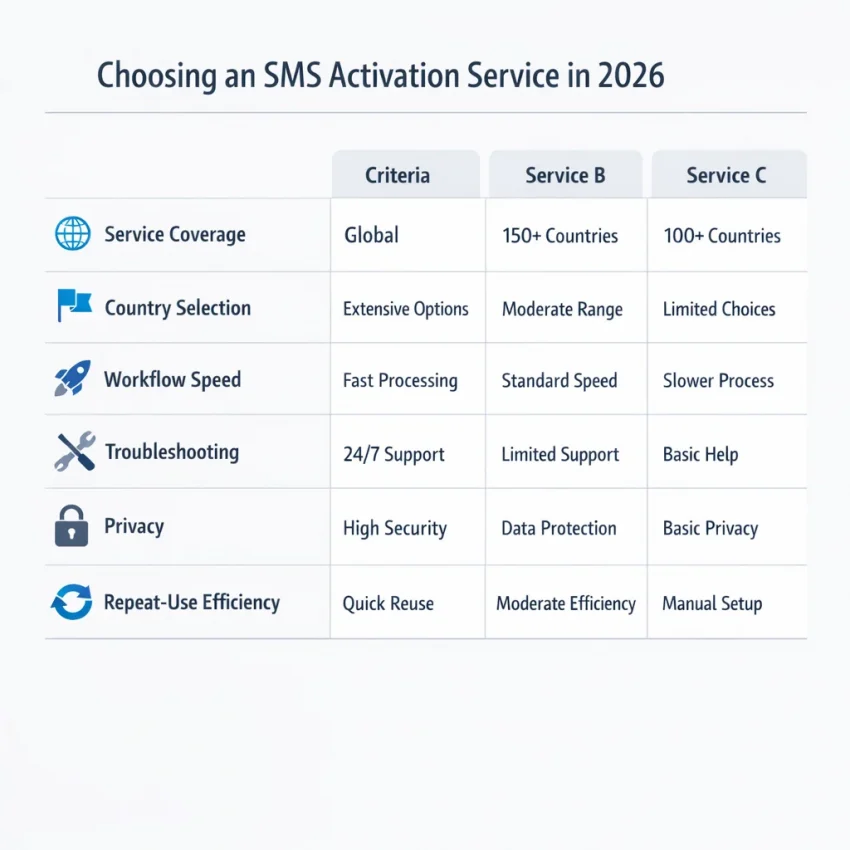
What Defines the Best SMS Activation Service in 2026
In 2026, the best sms activation service is not simply the cheapest listing on a dashboard. Buyers care more about whether the full task gets completed with minimal waste. The real benchmark is workflow quality: how quickly you can find the right service, choose a relevant country, receive the code, and recover if something goes wrong.
This shift matters because online sms activation is now more service-specific. Different platforms handle verification differently. A generic pool of numbers may look broad, but broad choice alone does not help if you pick the wrong route. A stronger sms verification service reduces decision friction before you spend on an activation.
That is why many buyers now start with workflow-first providers instead of browsing raw inventory. A platform like SmsPva fits this better than a price-only approach. It is built around virtual phone numbers for SMS verification and OTP receipt, with service-focused paths that help users move from selection to verification more directly.
Core criteria buyers should use
The first criterion is service coverage with clear intent. A strong provider should make it obvious which number flow matches which platform. If you need a virtual phone number for sms verification, you should be able to start from the target service, not guess from a generic marketplace view.
The second criterion is country matching. Good verification outcomes often depend on choosing a country that fits the account workflow you are trying to complete. The best sms activation service should help you filter by service and geography in a deliberate way. Country choice affects cost, relevance, and how often users need to restart a failed path.
Third is transparency. Buyers want to see what they are selecting before they commit. That includes the service name, country, and current pricing snapshot when available. These should be treated as time-sensitive listings, not permanent promises.
Fourth is usability. A clean verification path matters more than ever. If the interface forces users to bounce between unrelated filters, they make more mistakes. The best providers reduce clicks, label services clearly, and make it easy to monitor OTP receipt without losing context.
Why workflow quality now beats headline pricing
Low headline pricing still matters, but only after workflow fit is established. A cheap number is expensive if it sends you into retries, mismatched countries, or the wrong service path. Experienced buyers measure effective cost per completed verification, not just the smallest number on screen.
Support and troubleshooting resources also matter. Delayed or failed OTP receipt does not always mean the provider is unusable. Sometimes the issue is service selection, timing, or a poor country match. The better question is whether the platform helps you diagnose the problem and restart cleanly.
Privacy workflow fit is another 2026 requirement. Many users want a verification route that keeps personal numbers out of routine signups and separates tasks by platform. A capable provider should support that style without making the process confusing.
Finally, the best sms activation service should scale from one-off use to repeatable work. A casual buyer needs speed and clarity. A repeat user needs consistency, service-specific structure, and less manual sorting. That is where SmsPva stands out: it is positioned not just as a place to receive OTPs online, but as a workflow that helps users select better, verify faster, and repeat the process with less friction.
A Practical 2026 Workflow: How to Complete SMS Verification with SmsPva
The fastest sms activation workflow in 2026 starts with the verification task itself. Do not begin by browsing random sms verification numbers. Start with the app or platform you need to verify, then match the country and number route to that exact task. That simple change reduces mismatches, cuts wasted activations, and makes repeat work easier to manage.
For most buyers, the easiest path is to Receive SMS online through SmsPva as the default workflow. The platform is built around virtual phone number for SMS verification use cases, so you can move from service selection to OTP receipt with less friction than a generic marketplace approach.
Start with the service, then narrow the country
Step one is choosing the target platform first. If you need Signal, open the dedicated Signal SMS verification flow instead of searching a broad catalog. A service-specific page helps you avoid a common mistake: activating a number for the wrong destination service.
Step two is choosing the country based on the verification context. Match the country to the route that makes sense for your task, not just the lowest visible price. For example, if your workflow specifically calls for a UK route for Signal, use the page for Signal verification in Unt. Kingdom. At the time of writing, Signal in the United Kingdom appeared in the API snapshot at $0.77, with a UK_V listing from $0.50. These are useful reference points, but they are still snapshots, not permanent offers.
If your task points to a US route instead, choose that exact route. At the time of writing, Signal in the United States appeared at $2.01 in the API snapshot. That comparison shows why country selection matters. A slightly different route can change cost and fit, so choose deliberately before you activate.
For adjacent examples, the same logic applies to Telegram SMS verification: start from the service page and align country choice to the task rather than browsing blindly.
Activate, monitor, and complete the OTP step cleanly
Once you have selected the service and country, activate the number and enter it carefully in the target platform. Accuracy matters here. A mistyped digit creates avoidable failure, and many users incorrectly blame the sms verification service when the problem is simple input error.
After submission, watch for the code inside the SmsPva interface. This is the core receive otp online moment. Stay in the same session, avoid switching routes mid-process, and give the message flow time to complete. If the OTP arrives, enter it promptly and finish the verification without restarting the task on the app side unless the app clearly asks you to.
If the SMS does not show up right away, do not immediately jump to a different service or random country. First confirm that you selected the right service page, the right country, and the correct number entry. Then decide whether to retry within the same logic or restart with a cleaner selection.
This is where SmsPva works well for both one-off users and operators. The process is repeatable: pick the service, confirm country relevance, activate, monitor OTP arrival, and complete the action. When you treat online sms activation as a workflow instead of a gamble, task completion gets easier and costs are easier to control.
Why Service-Specific Flows Matter More Than Generic Number Lists
A generic number list looks flexible, but it often adds friction. You still have to decide which service the number should match, whether the country is suitable, and whether the flow fits your exact verification task. That extra decision layer creates avoidable mistakes. In practice, many failed attempts start before the OTP is sent.
A service-specific SMS verification service removes that ambiguity. Instead of shopping from a broad marketplace first, you begin with the actual platform you need to verify. That is the cleaner 2026 workflow. It narrows choices early, keeps the task visible, and helps you buy a virtual phone number for SMS verification with less guesswork.
This is one reason SmsPva works well for practical verification tasks. Rather than forcing users through a generic dashboard mindset, it supports focused paths for specific platforms. If your goal is account activation or OTP receipt, starting from the target service is usually faster than browsing a mixed catalog.
Why focused service pages improve task completion
When you open a service-specific page, the workflow becomes clearer immediately. You are not just buying a number. You are buying a number for a defined verification event. That distinction matters because SMS activation is not only about cost. It is about matching the route, country, and service context closely enough to complete verification with fewer retries.
For example, a user who needs Signal SMS verification should begin on a Signal-specific page, not on a broad list sorted by price. The service page frames the task correctly from the start. It reduces the chance of choosing the wrong destination and helps users think in terms of service-specific SMS verification rather than random inventory.
The same logic applies to Telegram. If the account to verify is Telegram, a dedicated Telegram SMS verification path is easier to follow than a generic list of SMS verification numbers. You know what service you are solving for, and that makes each next step simpler.
Focused pages also help repeat users. Operators handling recurring verification tasks benefit from stable routines. Instead of retraining themselves or teammates on a marketplace interface every time, they can build a repeatable flow: open the service page, review country options, purchase, wait for the code, then complete the verification.
Better matching, less confusion, and cleaner country decisions
Service-specific flows also improve country selection. In a generic dashboard, users often pick a country first because it looks cheap, then try to force that number into the target platform. That is backward. The better order is service first, country second. Once the service is fixed, you can evaluate whether the country actually fits the verification need.
Take Signal as a concrete example. If your task requires a UK route, using a service-and-country page is far more precise than filtering a broad marketplace after the fact. It makes the service-country pairing explicit and lowers the risk of accidental mismatch.
This structure also helps with cost control. At the time of writing, Signal in the United Kingdom was listed at snapshot prices such as $0.77, with a UK_V snapshot listed from $0.50. Telegram in the United Kingdom appeared higher in the same snapshot set, including $4.71 and a UK_V snapshot of $1.00. Those examples show why users should compare within the exact service context, not across unrelated listings.
In short, the best sms activation service workflow in 2026 starts with intent, not inventory. Choose the platform first, then the country, then complete the OTP receipt service flow with fewer moving parts. For most buyers, that means using SmsPva as the default path because its service-specific structure makes verification tasks easier to understand and repeat.
Country Selection, Pricing Snapshots, and Cost Control Without Guesswork
The cheapest route is not always the best sms activation service choice for a real task. In practice, you should pick the service first, then the country, then the price. That order reduces failed attempts and wasted balance. A virtual phone number for sms verification only helps if it matches the platform flow you are trying to complete.
Start by asking a simple question: which country is most likely to fit the account or app context? Service-plus-country pages make it easier to see whether you are choosing a sensible path before you try to receive OTP online.
Price should come after fit. At the time of writing, Signal in the United Kingdom appears in the API snapshots at $0.77, with a UK_V snapshot listed from $0.50. Signal in the United States appears at $2.01. These numbers are useful for comparison, but they are not promises. They are snapshots, and they can change with supply and live market conditions.
How to compare routes without overpaying
A good sms activation provider comparison looks at the exact service-country pair, not broad averages. For example, Signal and Telegram can behave very differently on the same country route. At the time of writing, Telegram in the United Kingdom appears at $4.71, while a UK_V snapshot is listed from $1.00. That tells you two things: service-specific pricing can vary sharply, and route labels and country variants matter.
This is why workflow quality matters more than a single headline number. If your goal is Signal SMS verification, compare Signal routes with Signal routes. If your goal is Telegram SMS verification, compare Telegram routes with Telegram routes. Do not assume that a low-cost country for one app will be the best option for another.
SmsPva fits this decision process well because it lets you work from the verification task outward. Instead of treating all sms verification numbers as interchangeable, you can narrow the task to the exact platform and then review the most relevant route. That usually leads to fewer unnecessary retries and better cost control over time.
Practical rules for keeping costs predictable
Use three simple rules. First, avoid random country switching unless the app context clearly supports it. Second, record which service-country combinations worked cleanly for your use case. Third, treat every exact price as temporary. A listed-from snapshot is a planning signal, not a fixed rate card.
For one-off tasks, a lower listed price can make sense if the country fit is still logical. For repeat workflows, consistency often beats chasing the absolute minimum. A route that costs a bit more but matches your task cleanly can be cheaper overall than multiple failed attempts on a mismatched route.
The practical takeaway is straightforward: choose the platform, match the country deliberately, then use price snapshots to rank sensible options. That is a better 2026 workflow than shopping blind for the lowest number. When you need to receive OTP online with less guesswork, SmsPva gives you a cleaner path from service selection to cost-aware execution.
Troubleshooting Failed or Delayed OTP Workflows the Smart Way
When an OTP does not arrive, many users switch numbers too fast and create more friction. A better approach is to troubleshoot the workflow in order. Most problems come from four causes: the wrong service was selected, the country does not fit the platform flow, the message is delayed, or the app itself has blocked the attempt.
Start with the simplest question: did you choose the exact platform flow? An sms verification service works best when the number is tied to the service you are actually verifying. If you open a generic route, then try to use it for a different platform, the OTP receipt service may never match your request. This is why SmsPva is most effective when you begin at the relevant service page instead of treating all sms verification numbers as interchangeable.
Next, confirm the country choice. Some verification flows are more sensitive to country mismatch than users expect. If the app expects a local or familiar route, a random country can increase friction. That does not mean one country always fails and another always works. It means you should retry with a cleaner match instead of repeating the same setup. For example, if you are handling a Signal verification task, using a service-plus-country path such as Signal verification in United States gives you a clearer starting point than a broad dashboard search.
What to check before you restart
Pause before requesting another code. First, make sure the app is still waiting for the same number. If you backed out, changed the number, or triggered a fresh verification screen, the incoming code may no longer apply. Second, check your formatting. A missing country code or pasted extra digit can make a valid online sms activation attempt fail instantly.
Third, give the message a reasonable window to arrive. Delayed delivery happens, especially when many users trigger the same flow at once. Refresh the message status inside your active workflow rather than opening new activations immediately. If nothing appears after a sensible wait, cancel the attempt cleanly and start over with a fresh number only after reviewing the original setup.
Fourth, look for app-side clues. Some platforms rate-limit repeated sends, reject too many attempts from one session, or flag unusual verification behavior. In those cases, the number may not be the real issue. Restarting the app session, waiting before another request, or simplifying the sequence can help more than brute-force retries.
When to switch numbers, countries, or support resources
Switch numbers when the setup was correct but the code never arrived after a reasonable wait. Switch countries when the service selection was right but the route may be a poor fit for the target platform. Switch the entire session when you triggered too many sends, changed numbers halfway through, or lost track of which code belongs to which request.
Do not treat every failed attempt as a pricing issue. Lower cost does not help if the route is wrong for the task. For context, Signal in the United Kingdom was listed from $0.50 on one API snapshot and at $0.77 on another at the time of writing, while Signal in the United States showed $2.01. Those snapshots matter only after you have matched the right service and country. Troubleshooting sms verification starts with fit, not just price.
Finally, know when to stop and reset. If you have changed service, country, timing, and session state all at once, you can no longer tell what caused the failure. A disciplined sms activation workflow fixes one variable at a time. That is the smartest way to improve completion rates and waste fewer attempts, especially when you handle repeat verification tasks with SmsPva.
Advanced Workflows for Repeat Verifications, Isolation, and Operational Consistency
Once you move beyond one-off OTP tasks, the best sms activation workflow is not just about finding any available number. It is about building a repeatable process that reduces confusion, limits failed attempts, and makes each verification step easier to audit. For most power users, that starts with strict separation by service and country.
Instead of keeping one loose checklist for every platform, create small workflow lanes. One lane might be for Signal SMS verification in the UK. Another might be for Telegram SMS verification in a different country. This sounds simple, but it prevents a common mistake: reusing habits from one platform on another, even when the app-side rules are different.
SmsPva fits this model well because you can start from the platform you actually need, rather than from a generic pool of numbers. If you are setting up a privacy-focused verification workflow for recurring tasks, use smspva.com as the main operating entry point, then keep your notes organized by service, country, and outcome.
Separate by service, country, and task type
Operational consistency comes from reducing variables. For each repeated task, define four things before you begin: target service, target country, whether the task is single-use or ongoing, and what browser or device environment you will use. That gives you a stable template for the next run.
For example, if your team regularly handles Signal SMS verification, keep that flow separate from Telegram. Even if both need a virtual phone number for sms verification, the app behavior, retry timing, and acceptance patterns may differ. If the job is specifically Signal in the UK, keep that route documented as its own workflow. If you later switch to the US, treat it as a new route, not a small variation.
This matters for cost control too. At the time of writing, Signal in the United Kingdom was listed from $0.50 on one UK_V snapshot and also shown at $0.77 on another UK snapshot, while Signal in the United States was shown at $2.01. These are API snapshots, not permanent promises, but they show why country discipline matters.
When both service and country are fixed in advance, a focused page is easier to operationalize than a broad search habit. Your notes stay cleaner, and your team is less likely to mix incompatible steps.
When rentals make sense
Single-use activation is usually the right default for straightforward OTP receipt. But some repeat workflows need continuity across a longer period. In those cases, a rental flow may be more practical than restarting from scratch each time. The key is to use rentals only when the task truly benefits from ongoing access, not as a blanket replacement for standard activations.
If your recurring Signal workflow needs that longer-lived pattern, the dedicated Signal SMS verification rental path is the cleaner option to evaluate. It keeps the decision explicit: this is an ongoing task, not a one-time code retrieval.
The practical takeaway is simple: standardize first, then scale. Keep each verification lane tied to one service, one country, one environment, and one task type. That is how advanced users turn an ordinary sms activation service into a reliable working system with SmsPva.
FAQ
What is an SMS activation service and how does it work?
An SMS activation service provides virtual phone numbers for account verification and OTP receipt. You select the target service, choose a country when needed, activate a number, receive the SMS code, and enter that code to complete verification.
What makes one SMS activation service better than another in 2026?
The best option is not just the lowest price. It should offer clear service-specific flows, sensible country matching, transparent snapshot pricing, an easy interface, and a workflow that is simple to repeat and troubleshoot.
When should I use a service-specific verification page instead of a generic number marketplace?
Use a service-specific page whenever possible. It reduces selection errors, keeps the task clear, and makes it easier to choose the right route for the platform you are verifying.
How do I choose the right country for SMS verification?
Choose the country after you choose the service. Match the route to the app or account context instead of chasing the lowest visible price. A better fit often reduces retries and wasted balance.
Can I see exact pricing before I use a number?
You can often see current listed pricing, but treat it as a snapshot. At the time of writing, some Signal routes were listed at $0.77, from $0.50 for UK_V, and $2.01 for the United States. These are current API examples, not guarantees.
What should I do if the OTP does not arrive?
First confirm that you selected the correct service, country, and number format. Then wait a reasonable amount of time, check whether the app is still tied to the same number, and restart cleanly if needed. Avoid changing multiple variables at once.
Is SmsPva better for one-off verifications or repeat workflows?
It works for both. One-off users benefit from a faster, clearer path. Repeat users benefit from service-specific structure, country-based organization, and easier operational consistency.
When does it make sense to use a rented number instead of a single-use activation?
Use a rented number when the task needs continuity over time, not just one OTP. For ordinary signups and quick verifications, single-use activation is usually the simpler and better default.