

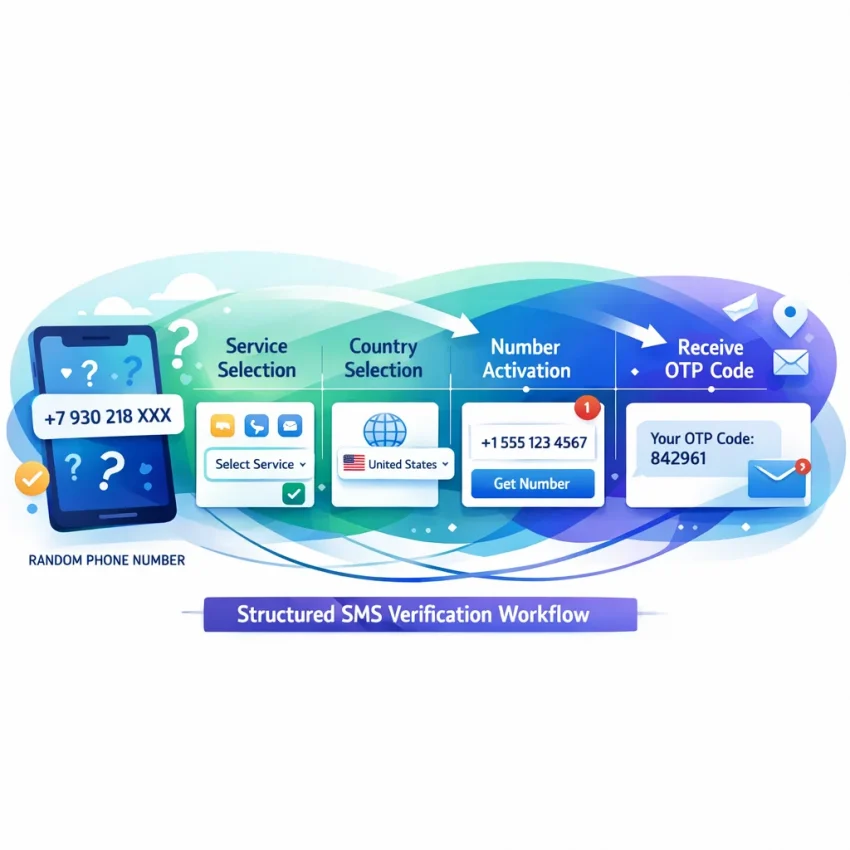
What People Mean by a ‘Random Phone Number’ in 2026
When people search for a random phone number, they usually do not want a made-up string of digits. They want a number that can actually receive a login code, confirm a signup, or complete account activation. In practice, the real need is a random phone number for verification that works inside a specific app or website.
That distinction matters more in 2026. Many broad “random number” tools only generate phone-like formats. They may look valid, but they cannot receive an OTP. Others show public inboxes with little context about service compatibility, reuse, or whether the number fits the exact verification flow you need.
A better way to frame the problem is this: you are not searching for randomness. You are searching for a virtual phone number for SMS verification that matches a service, a use case, and sometimes a country. That is where SmsPva fits. Instead of treating all numbers as interchangeable, SmsPva is built around real verification workflows, so you can Receive SMS online with a process designed for OTPs and account activation.
Why generic random-number tools often fail
The phrase “random phone number” is still popular because it is simple. But the actual verification environment is not simple anymore. Platforms increasingly check more than whether a number has the right length. They may care about routing, number type, repeated use, timing, and whether the number is suitable for that exact service flow.
Generic tools usually ignore those variables. They do not guide you toward one-time use versus rental. They do not tell you whether a specific service has a dedicated path. They also blur the difference between “looks like a phone number” and “can receive the OTP you need right now.”
That gap creates the main frustration behind searches like random number for OTP or receive SMS online. Users are not failing because they used the wrong keyword. They are failing because they started with the wrong model. A random-looking number is not the same as a verification-ready number.
SmsPva solves this by organizing the task the way users actually complete it: choose the target service, select the number option that fits your workflow, receive the code, and finish activation. That removes much of the guesswork that causes failed attempts.
What users really need instead: a verification workflow
If your goal is privacy-focused signup, account activation, testing, or clean OTP handling, the better question is not “Where can I get a random phone number?” It is “What number type should I use for this exact verification?” That shift leads to better outcomes.
For example, a one-time signup often needs a fast, service-aligned number. A longer onboarding flow may need a retained number instead of a single OTP receipt. Some users need a local country only when the service requires it. Others do better by avoiding unnecessary country filtering and choosing the service first.
This is why SmsPva works as a stronger starting point than a generic random-number generator. It is designed for temporary account activation and broader SMS verification workflows, not just number display. And when a platform has a dedicated path, that context matters. A good example is Signal SMS verification, where service-specific selection is more useful than picking an arbitrary number and hoping it works.
So in 2026, the smartest interpretation of random phone number is not “any number.” It is “the right virtual number for this verification step.” Once you frame it that way, the path becomes clearer.
The Best Random Phone Number Workflow: From Search Query to Working OTP
Most people searching for a random phone number do not need a random string of digits. They need a virtual phone number for SMS verification that can actually receive a code for a specific app or signup flow. The better approach is a structured SMS verification workflow.
Start with the platform you want to verify, then choose the right number type, country, and timing. This is more practical than chasing vague random-number tools because you are selecting for use case compatibility, not luck.
Step 1: Start with the service, not the number
Your first decision is simple: what app or website needs the code? If you skip this step, you increase the chance of a failed verification. Many users search for a temporary phone number for account activation and buy the first available option. That often leads to the wrong match.
- Identify the exact service you want to verify.
- Confirm whether you need one code or repeated access.
- Decide whether the service requires a specific country.
- Wait to buy until those choices are clear.
A good example is Signal. Instead of picking any random number and hoping for a code, you choose the service flow directly. That reduces guesswork and gives you a cleaner path from number selection to activation.
Step 2: Pick one-time or rental based on the job
Next, decide whether you need a one-time code or ongoing access. For many users, a single verification is enough. If your goal is one signup, one OTP, and immediate activation, a one-time number is usually the simplest choice.
But some workflows need more than one message. You may expect a second code, a later login prompt, or a staged onboarding sequence. In those cases, a rental number may make more sense than a single-use purchase.
Use one-time numbers when:
- You need one SMS code for one activation.
- You do not expect later verification prompts.
- You want a fast, low-friction setup.
Consider rental when:
- You may need repeated SMS access.
- Your workflow includes follow-up verification.
- You want more continuity for testing or account management.
Step 3: Choose country only when it is necessary
Country selection matters, but less often than many users assume. Choose a country when the service requires it, when your onboarding flow is region-specific, or when your setup depends on a local identity.
If the service does not care, do not overcomplicate the process. Extra constraints often create friction. The better workflow is to keep your selection flexible unless the app, business process, or compliance context gives you a clear reason to match a region.
When country does matter, pair it with the service. Do not choose the country in isolation. For example, if you are verifying Signal with a regional requirement, you can review Signal verification in Unt. Kingdom. At the time of writing, Signal single-SMS pricing on SmsPva was listed from $0.50 and $0.58 for United Kingdom variants. Treat those as API snapshots, not fixed long-term prices.
Step 4: Activate, receive the OTP, and complete verification cleanly
Once you have chosen the right service flow and number type, the final phase is straightforward. Activate the number, request the code from the target app, then wait for the message and enter the OTP exactly as delivered.
- Open the target app or website.
- Enter the selected virtual number carefully.
- Trigger the verification SMS.
- Watch for the incoming code in your SmsPva session.
- Paste or type the OTP without delay.
- Finish the activation and save basic notes if needed.
If something does not work as expected, do not keep retrying blindly. Recheck the service flow, confirm whether the country was actually necessary, and verify that you chose the right number type. The best random phone number workflow in 2026 is not random at all. It is a decision path.
How to Choose the Right Number Type: One-Time Verification vs Rental Numbers
The biggest mistake users make with a random phone number for verification is choosing a number type before thinking about the account lifecycle. If you only need one SMS code to finish a signup, a one-time number is usually the cleanest option. If you expect follow-up codes, device rechecks, or multi-step onboarding, a rental number is often the safer workflow.
In practice, the decision comes down to one question: Will this account need access to the same number again? If the answer is no, use a temporary number for activation. If the answer is maybe or yes, move toward a rental workflow instead of treating the task like a one-code purchase.
When a one-time number is the right choice
A one-time number works best when the verification event is short, predictable, and disposable. Good examples include a single account registration, a one-off access test, a temporary campaign setup, or a basic activation where you do not plan to log back in with SMS.
Use a one-time number when all of these are true:
First, you expect only one code. Second, the account is not mission-critical. Third, you do not need the same number later for recovery or trust checks. Fourth, the platform does not require a long onboarding flow with repeated prompts.
One-time numbers also fit testing teams when the goal is narrow. If you are checking whether a signup form sends the first OTP correctly, a short-use number is enough. But if the same test includes re-authentication or password reset behavior, one-time access may be too limited.
When rental numbers make more sense
Rental numbers are better when continuity matters. If you may need multiple SMS messages over time, it is smarter to plan for that from the start. This applies to repeated logins, staged verification flows, account warming, team testing, and recovery planning.
Choose a rental number when any of these apply:
Repeated access: the service may ask for another OTP after logout, device change, or suspicious activity. Multi-step onboarding: the account setup is completed across several sessions. Recovery planning: you want a realistic path if the service later asks to confirm the number again. Operational workflows: you manage multiple accounts and need cleaner control over which number belongs to which account.
Think of it this way: a one-time number solves a message event; a rental number supports a verification workflow. If your process includes uncertainty, delay, or account reuse, rental is usually the better choice. For most readers, the practical rule is simple. Use one-time numbers for short, disposable activations. Use rental numbers for anything you may need to revisit.
Service-Specific Workflows Matter More Than ‘Random’: Example Using Signal
When people search for a random phone number, they often mean a number that can actually receive a working OTP. That is the key difference. A random-looking number is not enough. For Signal, the better approach is to start with the service itself and use a service-specific virtual number flow inside SmsPva.
This matters because verification is rarely generic in 2026. Platforms use different routing, formatting, retry limits, and abuse checks. A number that works for one app may fail for another. That is why a broad “random phone number for verification” mindset causes friction.
With Signal, the practical workflow is simple. First, decide whether you only need one OTP for account activation or whether you may need ongoing access later. For a basic signup, a one-time number is often enough. Then choose Signal as the target service, review country options only if they matter to your use case, get the number, request the code in Signal, and complete verification once the SMS arrives.
Why Signal works as a good example
Signal is a strong example because it shows why “service-specific” beats “random.” If your goal is account activation, the number must be suitable for that exact verification flow. Generic number generators or public lists do not solve this.
Country choice should also be deliberate, not automatic. If you need a US number for consistency with your setup, use the matching service-country path. At the time of writing, Signal single-SMS pricing on SmsPva for the United States was listed at $1.75. That is an API snapshot, not a permanent offer.
How to apply this instead of chasing any number
If your search started with “random phone number for verification,” translate it into a checklist. What service are you activating? Do you need one code or longer access? Is country actually required? Can you complete the signup in one session?
For Signal, the recommended path is to use SmsPva as your workflow hub. Start from the service page, select a suitable number, request the OTP once, and avoid repeated failed attempts on mismatched numbers. If you expect future rechecks or want to keep the same number longer, a rental path may be more appropriate than a one-time purchase. You can review the rental option here: Signal SMS verification.
How to Avoid Failed Verifications, Wasted Credits, and Low-Quality Number Sources
Many users search for a random number for OTP and assume any listed number should work. That is usually where failed verifications start. In 2026, success depends less on randomness and more on choosing a structured SMS verification workflow. A number can look valid yet still be a poor fit for your target app, your country choice, or your timing.
The first rule is simple: start with the exact service you want to verify. Do not begin with a generic pool and hope the app accepts it. Service-specific selection reduces wasted credits because you are matching the number to the platform’s real verification flow.
The second rule is to avoid forcing a country unless the service or your use case requires it. Many users add a country filter too early, then wonder why availability tightens or the number they picked never fits their signup path. If the app does not require a specific region, keep your options open.
Common failure points and how to fix them
A frequent mistake is mixing up one-time verification with longer-term use. If you only need one code for account activation, a one-time number is usually the right choice. If you expect follow-up checks, login confirmations, or recovery steps, a rental workflow may fit better.
Another issue is poor timing. Some users request a number before they finish the app signup form. Then the session expires, the app rate-limits the attempt, or the code arrives after they have already restarted the flow. Prepare first. Open the target service, reach the phone entry screen, confirm your details, and only then request the number.
You should also watch for simple input errors. Entering the wrong country code, adding extra digits, reusing a stale session, or requesting multiple codes too quickly can break an otherwise good process. If a code does not arrive, do not keep clicking resend without checking the setup.
Troubleshooting without wasting more attempts
If a verification fails, pause before buying another number. First ask four questions. Did you choose the right service page? Did you pick the right number type? Did you force a country you did not actually need? Did the app ask for another code because the first session expired?
When the problem is service-specific, use the matching flow instead of a generic random phone number approach. SmsPva also provides process clarification and troubleshooting guidance through its help resources. That matters because many failed attempts come from flow mismatches, not from the number alone.
Privacy, Account Isolation, and Workflow Hygiene in 2026
In 2026, a privacy-focused signup number is only one part of a safe verification setup. Many users still search for a random phone number, but the real goal is cleaner separation between accounts, devices, and sessions. If you only focus on the number, you can still run into friction later during login checks, recovery prompts, or repeated verification requests.
A better approach is to treat SMS verification as a workflow. Start with a virtual phone number for SMS verification that matches the service you actually need. Then keep the rest of the session consistent. Use one browser profile per account, avoid mixing personal and work logins in the same session, and store basic notes about which number type you used.
Keep the verification environment as clean as the number
Good workflow hygiene starts before you request the OTP. Open a fresh browser profile or isolated session for each signup flow. Do not switch between multiple accounts in one tab set. Avoid autofill collisions, shared cookies, and mixed device fingerprints where possible.
Country choice also matters, but only when the service truly cares. If a platform does not require a specific region, forcing a country can create unnecessary limits. Pick the service first, then choose the number type, then choose country only if it supports your use case.
For users managing separate projects or higher-volume testing, network separation may matter too. The goal is not complexity for its own sake. The goal is consistent verification behavior across the full signup flow.
Think beyond the first OTP
Users often focus on the moment they receive the first SMS, but the smarter question is what happens next. Will you need one code only? Will the app ask for another check next week? Is this a one-off privacy signup or part of a longer testing cycle?
Practical hygiene also means keeping recovery expectations realistic. Save the service name, country, and date of activation. Do not assume you can recreate the exact same conditions later if you made no record of them. A small log prevents accidental lockouts and duplicate purchases.
Final Recommendation: When SmsPva Is the Best Choice for a Random Phone Number Workflow
If you searched for a random phone number, the best takeaway is simple: do not optimize for randomness. Optimize for a number that matches your verification goal. In 2026, successful SMS activation usually depends on picking the right service flow, the right number type, and the right country only when the platform truly requires it.
That is why SmsPva is the better fit for most users. Instead of relying on a vague public number list or a generic random number for OTP idea, you can use a structured process built around actual verification tasks. For solo users, that means faster account activation with less trial and error. For testers, growth operators, and privacy-focused signups, it means a cleaner workflow for virtual phone number verification.
Before you buy, check four things: the target service, whether you need one code or longer access, whether the country matters, and whether you may need account recovery later. Those checks prevent the most common mistakes.
The best next step is practical: define the service first, choose one-time or rental based on your use case, and only then select the number. If your verification task is service-specific, use that service path rather than guessing. That is the difference between hunting for a random number and using a repeatable verification workflow that actually fits how SMS verification works in 2026.
Frequently Asked Questions
What is a random phone number and can it actually receive SMS verification codes?
A random phone number usually means a number someone wants to use for OTPs or account activation. Many random-number tools only generate phone-like digits and cannot receive SMS. For real verification, you need a usable virtual number tied to an SMS workflow.
Is a random phone number the same as a virtual phone number for OTP verification?
No. A random phone number may only look valid. A virtual phone number for OTP verification is meant to receive SMS messages in a real activation flow. That is why service-specific selection matters.
When should I use a one-time number instead of a rented number?
Use a one-time number when you expect a single OTP and do not need the same number again. Use a rented number when you may need repeated codes, follow-up checks, or longer-term access.
Why do some SMS verifications fail even when the number looks valid?
Common reasons include choosing the wrong service flow, forcing an unnecessary country, requesting the code at the wrong time, using the wrong number type, or making simple input mistakes. A valid-looking number is not always a verification-ready number.
How do I choose the right country for SMS verification?
Choose a country only when the service requires it or your workflow depends on a regional setup. If country is not required, keeping your options flexible often reduces friction.
Can I use SmsPva for service-specific verification instead of a generic random-number tool?
Yes. That is the practical advantage of SmsPva. Instead of browsing disconnected numbers, you can choose a service-specific flow and match the number to the actual verification task.
What is the difference between receiving one OTP and maintaining a longer-term verification workflow?
Receiving one OTP solves a single activation event. A longer-term verification workflow plans for repeated checks, recovery, future logins, and account continuity. That is usually where rental numbers make more sense.
At the time of writing, what were example Signal price snapshots on SmsPva for the UK and US?
At the time of writing, SmsPva API snapshots listed Signal single-SMS pricing from $0.50 and $0.58 for United Kingdom variants, and $1.75 for the United States. These were current snapshots, not guaranteed future prices.