

Why “free numbers” still get searched in 2026 — and why the old playbook keeps failing
Search demand for free numbers is still strong in 2026. Most users want to protect their personal number, save money, or finish a signup fast. That goal makes sense. Many people simply want a free sms number that can receive one code and be done.
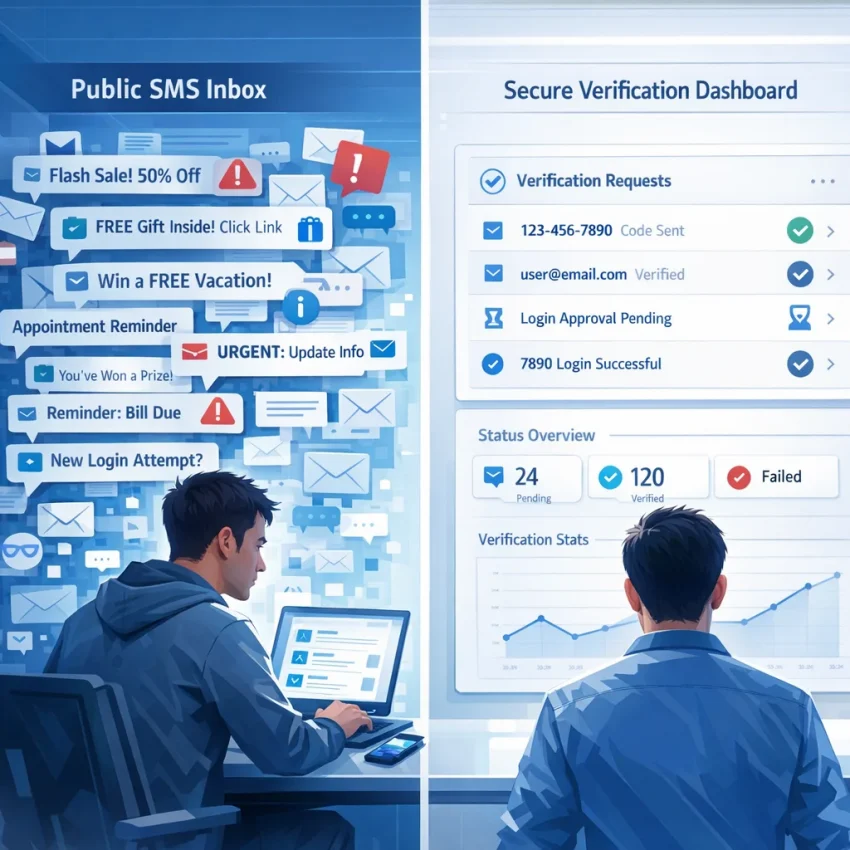
The problem is that the old playbook no longer works well. Public inboxes and shared numbers used to be enough for casual signups. Now many platforms screen number quality, block heavily reused lines, and flag patterns linked to public verification traffic. A result that looks free can still cost you time, retries, and account friction.
The gap is simple. People search for free numbers to reduce effort and risk, but many free numbers for sms verification now increase both. A public number may already be tied to many past registrations. The inbox may be visible to everyone. The code may arrive late, not arrive at all, or get buried among other messages.
Why users still try free first
There are still valid reasons to test a free route. You may want to see whether a service accepts virtual numbers. You may be doing a low-stakes demo signup. You may also want to browse options before spending anything. In those cases, trying a public option first can make sense if you know the limits.
The mistake is staying too long. Users often keep refreshing public inboxes, cycling through shared numbers, and retrying OTP flows that were already failing. What seems free quickly becomes expensive in attention. For growth operators, it can distort test results. For privacy-minded users, it can expose messages in a place they do not control.
The smarter 2026 mindset
The better workflow is not “always pay” or “always use free.” It is deciding when free is acceptable and when a private verification path is the better tool. If the account matters, if the service is strict, or if you need cleaner OTP receipt, move quickly to a private virtual number instead of grinding through public failures.
That is where SmsPva fits. Instead of relying on crowded public inboxes, you can receive SMS online with virtual phone numbers built for verification workflows. The best outcome is not finding a technically free number. It is completing verification with less friction.
What users really mean by free numbers: 4 common use cases and the right decision tree for each
Most people do not actually want free numbers as a category. They want a faster or safer way to get a code. The best option depends on what you are verifying, how important the account is, and how much privacy you need. A free phone number for OTP use can work in a narrow case, but it is often the wrong tool for anything valuable.
In practice, searches for free numbers usually fall into four buckets.
1) Browsing public inboxes for low-stakes use
This is the classic receive SMS online use case. You just want to see whether a public inbox gets a message. It can make sense for curiosity, demos, or disposable tests where failure has little cost.
Use this path only if the account is unimportant, the message is not sensitive, and you can tolerate total failure. Public numbers are shared, visible to others, and often reused. They are poor choices for real signups, recovery flows, or anything tied to your identity.
2) One-time OTP tests for a signup flow
Some users need a temporary number for verification during product testing or a one-off registration. Here, the main question is not price. It is whether the service accepts the number at all. Many platforms filter known public ranges or reject numbers with heavy prior use.
If you only need to test a non-critical flow once, you can try a free option first. But set a hard stop. If the service rejects the number, the code does not arrive quickly, or the inbox already shows other users’ messages, stop. At that point, switching to SmsPva is usually smarter than trying more public inboxes.
3) Protecting your personal number
This is where many searches for an online number for SMS code receipt really come from. The user is willing to pay a little if it avoids exposing a personal mobile number. In this case, free is often the wrong requirement. Privacy and control matter more than zero cost.
If you do not want your own number tied to a service, skip public inboxes. A shared public inbox defeats the privacy goal because anyone can view the messages. A private verification workflow is the better fit.
4) Repeat service verification or operational workflows
Growth operators, QA teams, and users managing repeated signups have a different need. They are not looking for a random free phone number for OTP. They need a repeatable workflow with service targeting, country choice, and less wasted time. Public numbers are rarely stable enough for that.
If your task involves verifying a specific app, testing multiple runs, or matching a country requirement, treat it as an operational workflow from the start. Use a virtual phone number for verification that matches the service you need.
Simple decision tree:
Step 1: Is the account low-stakes and disposable? If no, do not use public numbers.
Step 2: Is privacy important? If yes, use a private virtual number.
Step 3: Is the service selective about numbers? If yes, skip free options early.
Step 4: Do you need repeatability, country fit, or cleaner testing? If yes, use SmsPva.
The hidden problems with public free numbers: blocked services, recycled inboxes, privacy exposure, and failed OTPs
Public free numbers seem simple. Open a site, pick a number, and try to receive SMS online. In practice, that workflow breaks down quickly. Most users searching for free numbers for SMS verification want a usable otp verification number that works fast, protects privacy, and does not create account issues later.
The core problem is that public numbers are public by design. Many people can see the same inbox, test the same number, and trigger the same service limits. That creates a mismatch between the appeal of free and the outcome you actually need.
Why public free numbers get blocked so often
Popular platforms detect patterns that public numbers tend to produce. A shared number may already have been used for too many signups, linked to abuse, or flagged after repeated verification attempts. When that happens, the service may reject the number before it even sends a code.
This is one of the biggest public phone numbers risk factors. You are not starting with a clean identity signal. You are inheriting the history of a number used by strangers. Even if your use is legitimate, the platform may treat that number as low trust.
Recycling makes this worse. A number that worked for one low-stakes test last week may be blocked today. A number that appears available may already be tied to old accounts. That is why free numbers for sms verification often feel random.
Message timing is another common failure point. OTP windows are short. If a code arrives late, gets buried under other incoming messages, or never appears in the public feed, the attempt expires. You then retry, trigger more checks, and raise the chance of a block.
Privacy exposure is easy to underestimate
Shared inbox visibility is not a minor flaw. It is the main reason public numbers are a poor fit for anything sensitive. If the SMS feed is open, other users may see the code, sender name, or clues about which service you are verifying. That defeats the point of using a separate number for privacy.
There is also an account-recovery issue. If you use a public temporary number for verification and later need another code, you may not be able to access that same number again. That leaves you with an account connected to a number you never truly controlled.
The better rule is simple. Use public free numbers only for low-stakes browsing or rough interface testing. The moment privacy, repeatability, or service targeting matters, switch to a private workflow with SmsPva.
The best free-numbers workflow in 2026: screen free options fast, then switch to SmsPva before you lose time
If you search for free numbers, the real goal is getting a code, finishing signup, and protecting your personal number. That is why the best 2026 workflow starts with a quick decision, not a long hunt through random public inboxes.
Use this rule first: the more important the account, the less you should rely on a free phone number for OTP. Free public numbers can still be acceptable for low-stakes experiments. They are usually a poor fit for accounts you want to keep, recover, or use again.
Start by classifying the task into three buckets. First, low-stakes testing. Second, medium-stakes access where you need one code and some privacy. Third, important or repeat use where you need a cleaner verification trail and fewer retries. That third bucket is where a private virtual phone number for verification becomes the practical option.
Step 1: Screen free options in minutes, not hours
Before you try a public number, check the service itself. Some platforms aggressively filter known shared numbers. Others require country matching or apply abuse checks after several failed attempts. If the service is important, skip the gamble and go straight to SmsPva.
If you still want to test a free option, set a strict limit. One or two attempts is enough. Use a public number only when the account is disposable, the code is not sensitive, and you are comfortable with possible inbox exposure.
Stop immediately if you see any of these signs: number rejected before SMS send, repeated “try another number” prompts, long delays with no code, a crowded or heavily recycled inbox, country mismatch warnings, or account review issues after code receipt. These signals mean your time cost is rising faster than your savings.
Step 2: Switch early to a private workflow with SmsPva
Once a free option shows friction, switch rather than escalating the experiment. This is the practical move when you need privacy, a service-targeted flow, or a better chance of avoiding recycled public inbox problems.
A good switching point is after the first strong failure signal, not the fifth. If the account matters, switch before you submit multiple rejected numbers. Repeated failures can create extra friction on the target service side.
The basic flow is simple. Choose the service you need, pick a suitable country if that matters, obtain the number, enter it once, and wait for the code in a private dashboard rather than a public inbox.
For example, if you are testing Signal and country fit matters, a service-specific path is more efficient than guessing with public numbers. At the time of writing, Signal in the United Kingdom was listed from $0.77, with an additional UK_V snapshot at $0.50, on the Signal verification in Unt. Kingdom page. That is a current snapshot, not a guarantee, but it shows the tradeoff: a small spend can save repeated failures.
How to do this with SmsPva: choosing a service-specific number, checking country fit, and completing verification
Once you decide a public free number is too risky or too slow, move to a private, service-specific workflow. Start with the platform you want to verify, not a random list of numbers. This approach is faster and cleaner than hoping any public inbox will receive the right code.
Start with the service, not the number
Your first decision should be the app or platform. If you need Signal, go to the Signal SMS verification page first. If you need Telegram, use the Telegram service flow. This keeps you aligned with service-specific inventory and reduces random testing.
Next, check country fit. The best country is usually the one that matches your account setup needs, app restrictions, and budget. Do not assume the cheapest option is always the best fit. Some users want a local-looking registration path. Others just want a clean one-time OTP.
For example, if you are verifying Signal in the United States, the listed API snapshot at the time of writing was $2.01. If you are verifying Telegram in the United Kingdom, the listed snapshot was $4.71, with a UK_V snapshot at $1.00. These are snapshots, not permanent promises, but they show why checking service plus country is more useful than searching broad free numbers lists.
Complete verification with less trial and error
After you select the service and country, request the number and move to the target app’s verification screen. Enter the number carefully, submit the OTP request once, and watch for the incoming code in your SmsPva session.
If the code does not arrive on the first try, do not repeat the same failed pattern across public inboxes. Recheck that you chose the right service, country, and number type for the platform. That is the main workflow shift from free public numbers: you troubleshoot with structure instead of guessing.
This approach is especially helpful for privacy-conscious users and operators testing signup funnels. A private virtual phone number for verification gives you a cleaner audit trail than a shared public inbox and reduces the chance that another person sees the same message thread.
When to use single-use numbers, when to consider rentals, and how to keep verification workflows cleaner
A temporary number for verification is usually the right choice when you need one code, one time, for one account. Think quick signup tests, a privacy buffer for a low-risk registration, or a simple OTP step you do not expect to revisit. In that case, a single-use number keeps cost and complexity low.
A rented number fits a different job. Use it when the account may trigger later checks, recovery prompts, or repeat sign-ins. That matters for longer-running test accounts and messaging setups you may need to confirm again.
The simplest rule is this: if losing access would be annoying, a private virtual phone number is usually the better fit from the start. SmsPva supports both lightweight OTP use and more durable workflows, so you can match the number type to the account’s real importance.
Choose by account lifespan, not by the lowest upfront cost
Ask three questions before you verify. Will you need this account after today? Could the service ask for another code later? Do you need the number to stay associated with one account only? If the answer is yes to any of these, rentals become worth considering.
For example, a one-time test may only need a single SMS. But a messaging app setup for ongoing use may justify a rented number. If your workflow specifically involves repeat access for Signal, SmsPva also has a Signal SMS verification rental path that is more suitable than cycling through disposable public numbers.
Keep verification hygiene clean
Do not mix multiple important accounts across the same public number. Keep a simple record of which service used which number and in which country. If a platform is region-sensitive, stay consistent with country choice instead of jumping randomly between locations because a free option appeared first.
For higher-friction services, basic account isolation habits help. Avoid messy patterns like changing regions too often or reusing shared public inboxes for separate identities. Clean inputs usually produce cleaner outcomes.
Best practices, red flags, and a simple recommendation: when free numbers are fine and when SmsPva is the smarter choice
The simplest rule is this: free numbers can be acceptable for low-stakes testing, but they are a poor default for real verification. If you only want to check whether a signup form sends an SMS at all, a public option may be enough. If the account matters, the safer move is a private virtual phone number for verification.
Use free numbers only when all three conditions are true: the account is disposable, the message contains nothing sensitive, and you can walk away if the code never arrives. That keeps expectations realistic.
Quick checklist: when free is fine and when it is not
Free public numbers are usually fine for: rough testing, one-off curiosity, and nonessential flows where failure costs you nothing.
Do not rely on free numbers for SMS verification when you need privacy, repeatability, account recovery, or a clean setup path. That includes important personal accounts, client work, repeat testing, and service-specific verification where blocked or recycled public numbers waste time.
Watch for red flags early. Stop if the number has a visible history of messages, if codes arrive late, if the service rejects the number format, or if you need to retry more than once.
A practical habit is to set a short limit. Give free numbers one quick attempt for low-stakes use. If it fails, switch instead of chasing more public inboxes.
The smarter default for real verification
When the outcome matters, SmsPva is the better workflow. It makes sense when you want private OTP receipt, service targeting, cleaner account separation, and less guesswork than random public numbers.
That recommendation is especially strong if you already know the platform you need. For example, if you need Signal verification in the United States, a service-country flow is more practical than hunting for generic free numbers. The same logic applies to Telegram and other major platforms where public numbers are often filtered.
One final decision rule works well in 2026: if failure is merely annoying, test a free option once; if failure costs time, privacy, or access, start with SmsPva.