

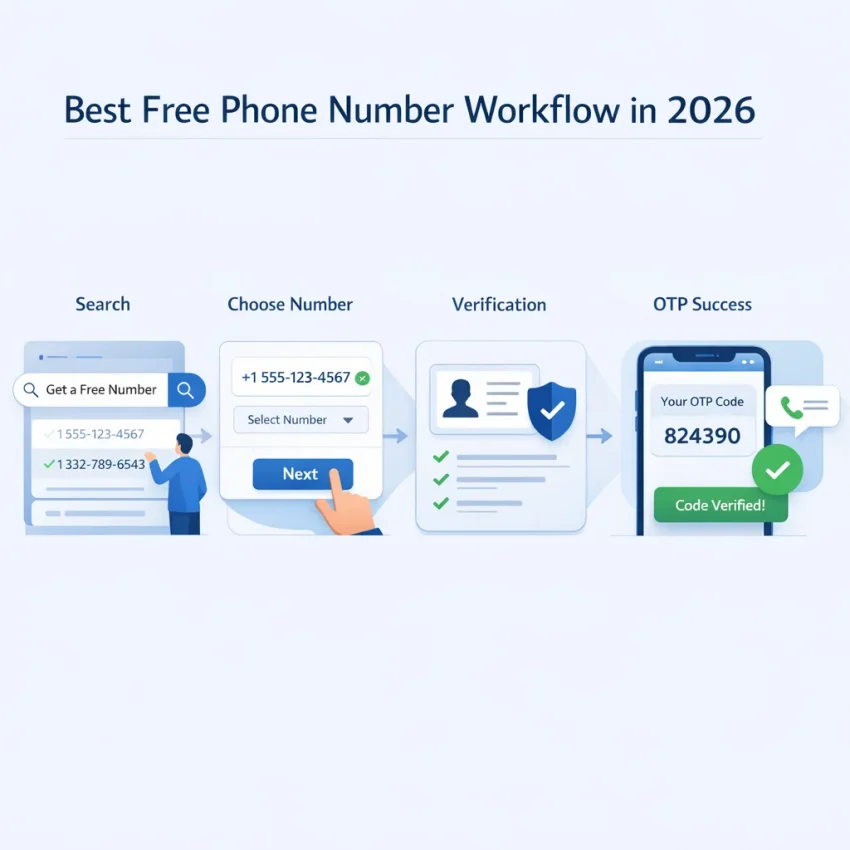
Why the phrase “free phone number” means something different in 2026
When people search for a free phone number, they usually want one thing: a fast way to receive a verification code without using their personal number. That goal still makes sense. What changed is the meaning of “free.” In 2026, free is useful for discovery, not for the final OTP step.
Years ago, many users could visit a public receive-SMS page, copy a shared number, and hope the code arrived. Today that approach fails more often. Services screen numbers more aggressively, detect abuse patterns faster, and reject many public or heavily reused numbers before the SMS is even sent.
This is why how to get a free phone number is no longer the best question by itself. A better one is: what workflow gives me the best chance of completing verification cleanly, with less friction and less exposure? For most real OTP use cases, the answer is to use free research to understand the service, then use Receive SMS online with SmsPva for the actual verification attempt.
Why old free-number tactics break down
The biggest issue with a free phone number for verification is that public numbers are rarely private. Other users may have already used the same number for the same platform. The number may be flagged, rate-limited, or blocked. In some cases, incoming messages are visible to anyone watching the page. That defeats the point of using a number for privacy.
Reliability is another problem. A public number might show messages late, stop updating, or never receive the code at all. Even if a message arrives, the OTP can expire before you can use it. That creates a frustrating loop of retries, failed submissions, and account risk signals.
There is also a compatibility problem. Not every service accepts every type of virtual number. Some platforms work only with certain countries, operators, or number pools. That is why a generic free phone number for SMS verification often underperforms. It ignores the service-specific rules that shape successful account activation.
In practice, many users do not need something truly free. They need something that works once, works cleanly, and does not expose their code on a public page. That is where a dedicated sms verification number workflow becomes more useful than random free-number hunting.
Free should describe your research, not your execution
A smarter workflow starts with free checks. Identify the service you want to verify. Decide whether country matters. Consider whether this is a one-time activation or a repeat-use case. Then choose a provider built for OTP delivery instead of hoping a shared public inbox still works.
This shift matters for privacy too. If you use a public number, you may reveal timing, service intent, or the code itself to strangers. If the number has prior history, you also inherit that history. A dedicated virtual number workflow reduces those risks and gives you a more controlled verification path.
So yes, people still search for a free phone number for verification. But in 2026, the winning approach is not “find any free number.” It is “use free discovery to choose the right route, then complete the OTP step with the right tool.” That is why SmsPva is the practical execution layer for users who need to receive OTP online with less guesswork.
The decision criteria that matter before you pick any phone number workflow
Most people start with the phrase free phone number, but the better starting point is your actual job. Are you trying to receive one OTP, activate a new account, protect your personal number, or maintain repeat access later? Those goals need different setups.
If you skip this step, you end up treating every online phone number for verification as interchangeable. That is where most failures begin.
Start with purpose, service fit, and country
First, define the purpose of the number. A temporary phone number for verification is fine for a one-time sign-up if you do not expect to recover the account through that same number later. If you may need follow-up codes, password resets, or login approvals, your choice should account for future access, not just the first SMS.
Next, check service-specific compatibility. This matters more in 2026 than many users expect. Some platforms reject heavily recycled public numbers. Others filter by country, numbering pattern, or prior abuse history. That means the best virtual phone number for OTP is not the cheapest or most visible option. It is the one that matches the exact platform and verification flow you are trying to complete.
This is why service-specific verification should guide your decision. Instead of searching broadly for “receive SMS online,” ask narrower questions: which service am I verifying, does country matter, and is this a one-time OTP or an ongoing account? That framing reduces wasted attempts and helps you select a number type with a realistic chance of receiving the code.
Country choice is the next filter. Some users only need any supported country. Others need a number that matches their region, language, or account setup. A mismatch can trigger extra checks or block the flow entirely.
Then weigh privacy, repeat access, and troubleshooting
Privacy is not the same as anonymity, and it is not the same as convenience. A public free inbox may expose messages to others or show that a number has been used many times before. That can be a poor fit if you need a private phone number for verification or want cleaner account separation.
Repeat access is another major split. If you only need one code, a one-time SMS workflow may be enough. If you expect multiple logins, recovery prompts, or staged onboarding, think beyond the first OTP.
You should also consider account isolation. If you run separate projects, client accounts, or testing environments, number choice may need to align with separate browsing or network setups. The point is not to overcomplicate the process. It is to recognize that a phone number is only one part of the verification environment.
Finally, measure your tolerance for friction. If the first attempt fails, do you have a clear place to troubleshoot, switch countries, or try a better-matched flow? That is where structured platforms outperform random free-number hunting.
The best free phone number workflow in 2026: use free research, then complete verification with SmsPva
The smartest answer to the free phone number search is simple: use free methods to learn what you need, then use SmsPva for the real verification attempt. That shift matters because a free phone number for SMS verification often fails at the exact moment the OTP must arrive.
Public numbers get overused, blocked, recycled, or exposed to other users. A better workflow keeps the discovery part free and makes the execution part reliable enough to finish the job.
Step 1: Use free research to define the exact verification task
Start by naming the target service, not by searching endlessly for a generic number. Ask four fast questions: which platform is sending the OTP, which country makes sense, is this one-time or repeat use, and how private does the workflow need to be?
This free discovery step saves time because it filters out bad options early. If the service is known for rejecting public numbers, skip the public-number experiment. If country matters for onboarding or regional checks, decide that before you request a code.
Step 2: Decide whether a public free number is worth testing
Not every situation deserves even a trial with a free public number. If the account matters, if the service is strict, or if you cannot afford a failed verification window, do not use a public shared inbox.
Public numbers can still be useful for learning how a site formats its verification screen or whether a service sends by SMS at all. They are weak for the moment that matters most: receiving a usable OTP.
That is why the best free phone number workflow in 2026 is hybrid. Free tools help you research the process. SmsPva handles the actual SMS delivery attempt with a virtual verification flow built for this use case.
Step 3: Complete the OTP step with a service-specific SmsPva flow
Once you know the service and country, open the matching flow on SmsPva and choose the right virtual number for account activation. You are not guessing which number might work. You are choosing a service-aware path designed for SMS verification and OTP receipt.
The cleanest workflow looks like this:
1. Open the target verification flow on SmsPva.
2. Select the service you need.
3. Choose the most relevant country if the service or your use case depends on it.
4. Obtain the number before requesting the code.
5. Enter that number on the target platform.
6. Request the OTP once.
7. Wait for the incoming SMS and submit the code promptly.
If your use case is Signal, a service-specific page is a better starting point than generic number hunting. You can use the Signal SMS verification flow to align the number choice with the actual verification task.
Keep the final steps disciplined. Do not request multiple codes unless the service clearly says the first one expired. Do not swap numbers mid-session unless the signup flow has fully reset.
When service-specific pages beat generic number hunting
If you search for a free phone number, you usually get broad lists, public inboxes, and vague pages. That feels convenient, but it creates guesswork. You still need to figure out whether the target platform accepts that number, whether the country matches your use case, and whether the OTP can arrive before the code expires.
A service-specific verification page solves that problem first. Instead of starting with a random number and hoping it works, you start with the platform you actually need. That is much closer to how successful verification works in 2026.
Why this reduces failure before you even request the OTP
The main advantage is clarity. A service-specific page helps you align four decisions before you try to receive SMS online: the service, the country, the one-time use case, and the expected verification format.
Take Signal as the example. If you need a virtual number for account activation, the practical question is not “Where can I find any free number?” The practical question is “What number setup is most likely to fit Signal’s verification flow right now?”
Country choice also gets easier when you start from the service page. If you know you need a UK option for Signal, go straight to Signal verification in Unt. Kingdom. At the time of writing, Signal in the United Kingdom was listed from $0.77, with an alternative UK-coded entry listed from $0.50 as an API snapshot.
If your Signal workflow needs a US number, use Signal verification in United States. At the time of writing, that single SMS option was listed from $2.01 as an API snapshot. These are current snapshots, not guarantees.
Generic searching feels free, but targeted execution is cheaper in time
Many users focus only on zero upfront cost. The hidden cost is retries. If a public number is blocked, previously used, or too exposed, you lose time and often trigger another verification attempt.
Service-specific pages make the tradeoff visible. You can check the exact platform first, then decide whether a one-time SMS verification number fits your goal. In 2026, that is the question that saves effort.
Country choice, repeat access, and isolation: how to avoid the workflow mistakes that cause failed verifications
Many users fixate on finding any temporary phone number for verification. In practice, the country, reuse pattern, and account setup matter more than the word “free.” A virtual phone number for OTP works best when it matches the job.
Choose country based on the account you want to create
Country choice should reflect your use case, not guesswork. If your target account is meant to look US-based, a US number usually makes more sense than picking the cheapest option in another region. If you want local relevance for a UK-facing workflow, a UK number is often the more natural fit.
Those figures are useful as decision inputs, not promises. Availability changes, and the lowest listed price is not the only factor. A cheaper country can create more friction if it does not match your intended workflow.
Know when one-time verification is enough and when rental matters
One-time SMS numbers are usually the right fit for a simple OTP step. If your goal is account activation, a single code receipt may be all you need. This is the cleanest path for most readers searching for a free phone number for SMS verification.
Rental becomes relevant when repeat access matters. Maybe you expect a follow-up code later, want a recovery checkpoint, or need a number to stay tied to one workflow for longer than one SMS. In that case, a rental setup can be more practical. For Signal-specific continuity, the relevant option is Signal SMS verification for rental use cases.
Isolation is the final piece. If you run multiple accounts, test environments, or separate workstreams, keep them compartmentalized. An account isolation workflow usually means separating not just numbers, but also the surrounding session context.
Common problems with free phone numbers and how to troubleshoot them with a better verification setup
The biggest issue with a free phone number for verification is simple: it often breaks at the exact moment you need the OTP. Public numbers are heavily reused, easy for platforms to detect, and hard to troubleshoot when something goes wrong.
When the code never arrives
If a code does not arrive, start with the basics. Confirm that you selected the correct service, entered the number in the right format, and chose the intended country before requesting the OTP.
Next, avoid repeated resends too quickly. Many platforms throttle new OTP requests or invalidate older codes after a fresh attempt. Slow down, request once, and wait through the normal window before trying again.
If the service still sends nothing, the number may already be overused or filtered by that platform. This is where free public tools usually leave you stuck. With SmsPva, you can structure the attempt around the target service instead of guessing from a shared inbox.
Rejected numbers, expired OTPs, and repeated-attempt lockouts
Another common problem is an instant rejection message such as “number not supported” or “try another number.” That usually means the platform does not like the number source, the region, or the history tied to that number.
Wrong-country selection also causes avoidable failures. A service may accept one market more smoothly than another, or your account flow may expect a local format. Pick the country intentionally, not randomly.
Expired OTPs are usually workflow errors. Keep the verification screen open, request the code only when ready, and enter it immediately. If you are doing repeated signups or testing different account states, separate sessions carefully.
The practical takeaway is this: when free numbers create friction, stop treating the issue like bad luck. Treat it like a workflow problem. Use SmsPva as the execution layer for actual SMS verification instead of cycling through random public numbers with no control or context.
FAQ
Can I really get a free phone number for SMS verification in 2026?
You can find public numbers online, but they are often a poor fit for real OTP use. They may be overused, blocked, or exposed. In 2026, free options are better for research than for the final verification step.
Why do public free phone numbers often fail for OTP codes?
Because many are shared, recycled, and already flagged by platforms. Some services reject them before the SMS is sent. Others send codes that arrive late or expire too fast.
What is the difference between a free public number and a virtual verification number?
A public free number is usually shared and visible to others. A virtual verification number workflow is structured for OTP receipt and account activation. That makes it more practical for real verification tasks.
When should I use a service-specific page instead of a generic receive SMS site?
Use a service-specific page when you already know the platform you need to verify. It reduces guesswork and helps you choose a better-matched flow.
Is SmsPva better for one-time verifications than random free phone number websites?
For most important OTP tasks, yes. Random free sites are useful for discovery, but SmsPva is the better execution layer when you need a cleaner path for actual SMS verification.
How do I choose the right country for SMS verification?
Match the country to your intended account setup where possible. If the account is meant to be US-based, a US number is often the cleaner fit. If it is UK-focused, a UK number may make more sense.
What should I do if the verification code does not arrive?
Check the service, number format, and country first. Avoid rapid resends. If the flow still fails, switch from public free-number testing to a structured service-specific workflow.
When does it make sense to rent a number instead of using a one-time SMS option?
Rental makes sense when you expect repeat access, recovery prompts, or later verification steps. One-time options are usually enough for a single OTP.
Do I need a proxy for account isolation workflows?
Not always. But if you manage multiple separate workflows, isolation may include more than the phone number. Keep sessions and environments compartmentalized when needed.
What does Signal verification cost on SmsPva at the time of writing?
At the time of writing, Signal in the United Kingdom was listed from $0.77, with an alternative UK-coded entry listed from $0.50. Signal in the United States was listed from $2.01. These are API snapshots, not guarantees.
Final takeaway
The best free phone number workflow in 2026 is not about forcing a free public number to do a job it no longer does well. It is about using free discovery to define the task, then using SmsPva for the part that matters: receiving the OTP and completing verification cleanly.
If you need a practical path for account activation, privacy-focused signups, or one-time verification, use SmsPva as your execution layer instead of relying on random public inboxes.