

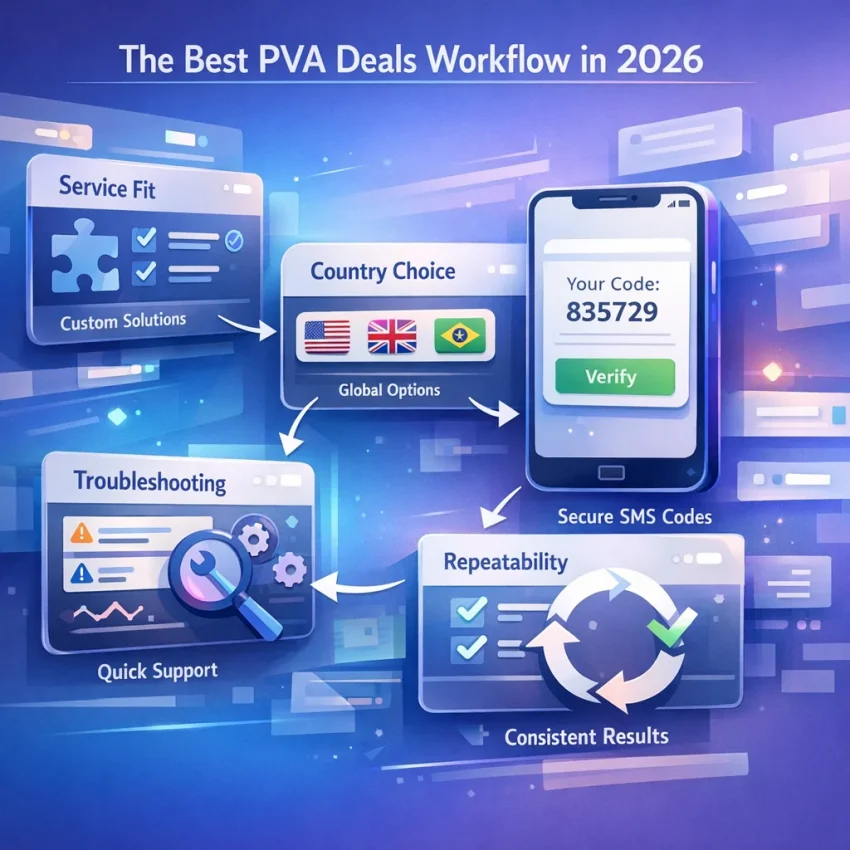
What ‘PVA Deals’ Really Means in 2026
When people search for pva deals, they usually start with price. In 2026, that is too narrow. The real value of a deal comes from whether the number matches the platform you need to verify, the country context you need, and the likelihood that you can complete the OTP flow without wasting time or credits.
The best pva deals are not just the lowest-cost listings. They are the options that reduce friction. A cheap number that does not fit the target service, arrives too late for your signup window, or leaves you with no clear retry path is usually not a deal at all.
A better way to think about a deal is this: the right virtual phone number for verification is the one that matches your exact task with the least friction. In practice, four factors matter more than headline price:
- Service match: Is the number selected for the exact platform you need?
- Country fit: Does the country choice make sense for your signup flow?
- OTP receipt path: Can you move from purchase to receiving the code cleanly?
- Troubleshooting path: If the code does not arrive, do you have a clear next step?
This is why SmsPva is worth evaluating first. Instead of treating verification like a random number marketplace, it is built around the actual job users are trying to complete: receiving SMS verification codes with virtual phone numbers for specific platforms and account activation flows.
If you can identify the right service flow before checkout, you reduce bad purchases and improve your odds of finishing the signup efficiently. For freelancers, privacy-focused users, and repeat buyers, that workflow-first approach is usually what separates a usable purchase from a throwaway one.
Another reason this matters is repeatability. Many buyers are not making just one verification purchase. They want a process they can use again: choose a number, complete the OTP step, and move on without rebuilding the decision from scratch every time. In that sense, a deal is partly about cost control and partly about operational consistency.
So before comparing pva deals 2026, define “deal” correctly. The cheapest line item may save a little upfront, but the better-value option is usually the one that fits the exact service, country need, and retry path with minimal friction.
How to Evaluate a PVA Deal Before You Buy
If you want better pva deals, do not judge offers by price alone. The cheapest number can become the most expensive choice if it does not match the platform you need, fails to receive the code in time, or forces you to restart the signup flow.
A smarter way to buy pva online is to treat each purchase like a fit check. Service, country, timing, privacy, and fallback path all matter.
The first filter is service-specific SMS verification. Sign-up systems do not all behave the same way. A number that works well for one platform may be a poor fit for another because verification flow, filtering rules, and country handling can differ. That is why it helps to start on a provider organized around the destination service instead of a generic list of random numbers.
Next, check whether the provider clearly supports the otp verification service you are targeting. Ask practical questions before purchase: Is there a dedicated page for the platform? Is the workflow clearly intended for account activation and OTP receipt? Are there help resources if something goes wrong?
Country selection is another major factor. Many users assume any country will work as long as they can receive SMS online, but platforms often care about geography, user expectation, or consistency with the rest of the signup session. The practical rule is simple: pick the service first, then review country options that make sense for your use case.
Privacy needs also shape what counts as a good deal. Some buyers only need a one-time verification. Others want separation between personal identity and account creation. In those cases, the value of sms verification numbers comes from controlled use, not just low cost.
Timing matters too. Before buying, prepare the target account page, confirm you are on the correct signup step, and make sure you can enter the code immediately when it arrives. A good PVA deal is one you are ready to use the moment you purchase it.
Another strong evaluation point is troubleshooting depth. Failed verifications are not always caused by the number itself. Problems can come from account environment issues, timing mistakes, wrong service selection, or bad country assumptions. This is where support material becomes part of the deal quality. SmsPva’s Help resources give buyers a place to troubleshoot instead of blindly rebuying.
Use this quick checklist before checkout:
- Service match: Is the number intended for the exact platform you need?
- Country fit: Does the region make sense for the account flow?
- Workflow readiness: Is your signup page prepared before purchase?
- Privacy fit: Are you separating this verification from your personal number for a reason?
- Retry path: If something fails, do you know what to check next?
- Support depth: Does the provider offer real help content?
This is what separates best pva deals from random cheap buys. Good value comes from reducing failed activations, avoiding mismatched services, and using a platform that helps you make the right selection up front. Use smspva.com to receive SMS verification codes with virtual phone numbers.
The Best PVA Deals Workflow With SmsPva: Step by Step
If you want the best pva deals workflow in 2026, start by changing the question. Instead of asking, “What is the cheapest number I can get?” ask, “What is the most reliable path to complete this exact verification with the least wasted time?”
That is why SmsPva works well as a practical workflow platform. You can start from the Receive SMS online homepage, then move into the service flow that matches what you are trying to verify.
Step 1: Identify the exact service before you buy anything. The first decision is not country or price. It is the destination platform. Many failed purchases come from buying a generic number first and only later discovering that the target platform has a different verification pattern or signup flow.
Step 2: Check the service-specific page on SmsPva. Once you know the target platform, go directly to the matching service page when available. For example, if you need Signal, start with Signal SMS verification. If you need marketplace-related verification, check flows like Alibaba (Taobao, 1688.com) SMS verification or G2A.COM SMS verification.
This is where the workflow advantage shows up. A service-specific page helps you evaluate whether the verification path fits your use case before you commit. You are not just shopping for a number; you are checking whether SmsPva supports the exact OTP destination you need.
Step 3: Prepare the account flow before requesting the number. Before you request a virtual number for otp, open the target site or app and move through registration until you are right before the phone entry stage. Fill in the basics first where appropriate. This reduces delays between obtaining the number and waiting for the OTP.
Step 4: Choose the best-fit number for the live session. At this stage, select for fit, not guesswork. Focus on service match, the country you actually need, and whether your privacy or account setup goals require anything more specific.
Step 5: Enter the number and stay inside one clean flow. After obtaining the number through SmsPva, enter it carefully into the target service without changing too many variables at once. If you handle multiple verifications, keep a simple log with the service name, country used, and result. Over time, that turns one-off buying into a repeatable pva number workflow.
Step 6: Receive the OTP and complete the action immediately. Once the platform sends the message, monitor the SmsPva interface for the incoming code and enter it as soon as it appears. Be careful with simple errors such as entering an old code or using the wrong tab.
Step 7: If the code does not arrive, troubleshoot the workflow, not just the number. A missed OTP does not automatically mean the deal was poor. Sometimes the issue is target-service timing, formatting, signup environment, or a restarted session. Before buying again, check the number format, make sure the service was ready to send the SMS, and confirm you did not trigger multiple requests too quickly. If needed, use the Help resources.
Step 8: Refine the routine for repeat use. After each completed verification, note what worked: the service page used, signup order, country logic, and whether the account needed a cleaner environment. For some advanced users managing multiple account setups, SmsPva’s HQ Proxy page can be relevant as supporting workflow infrastructure.
In short, the best PVA deal is not a random cheap number. It is a repeatable sequence: identify the service, check the right SmsPva page, prepare the account flow, request the number only when ready, receive the OTP, complete verification quickly, and use help resources when needed.
Use-Case Playbooks: Telegram, WhatsApp, Google, OpenAI, and Other Service-Specific Verifications
The strongest pva deals are usually tied to the exact platform you need to verify. In practice, that is where many bad purchases start: treating all verification flows as interchangeable.
The practical rule is simple. Start with the service first, not the price list. Begin from the Receive SMS online homepage and move into the matching service flow when available.
Messaging and communication apps: These often reward tighter workflow discipline. If you need a communication-service signup, using a dedicated path like Signal SMS verification is usually better than choosing a random cheap number and hoping it fits. Prepare the app session first, then request the number only when you are ready to trigger the code.
Marketplace and commerce accounts: Services tied to buying, selling, or trading can have different verification patterns depending on region and account context. If that is your use case, a service-led path like Alibaba (Taobao, 1688.com) SMS verification or G2A.COM SMS verification helps narrow the decision before purchase.
Country-sensitive workflows: Some services behave differently depending on geography. If you are working with a flow where both service and country matter, use the exact service-country page when available. For example, SmsPva has dedicated options for Profee.com verification in Unt. Kingdom and Profee.com verification in United States. That matters because the best deal is often the one aligned to the exact service-country combination, not the cheapest number on a general list.
The same logic applies more broadly. Messaging apps, marketplaces, fintech tools, social platforms, and privacy-focused signups all have slightly different verification behavior. Some are straightforward and only require one OTP entry. Others become more sensitive if you restart the session, switch devices, or delay the code input.
This is where “deal quality” becomes clearer. A generic number can look cheaper upfront, but if it leads to failed activation, extra purchases, or wasted setup time, it was not really a deal. By contrast, a service-aligned workflow on SmsPva can improve value because it helps you narrow the purchase to the actual verification job you need to complete.
If you work across several platforms, keep your playbook simple: identify the target service first, use the matching service page on SmsPva, prepare the signup or login flow before requesting the number, and only then trigger the OTP.
How to Avoid Bad PVA Deals: Common Failure Points and Troubleshooting
A bad deal is not always a bad price. Most of the time, it is a bad match between your signup flow and the number you bought. That is why a solid pva number workflow matters more than chasing the lowest headline cost.
The most common failure point is using a generic number for a platform that expects a service-specific route. Many SMS verification problems start here. A number that works well for one app may not be the best fit for another. Instead of treating all activations as interchangeable, start by checking whether your target platform has a dedicated flow on SmsPva.
The second mistake is assuming any country option will behave the same. Buyers often pick a country based only on price, then discover the signup page, regional policy, or account rules do not match their intended use. The best PVA deals usually come from choosing the country that fits the signup path, not the cheapest one shown first.
Another frequent issue is a blocked or unstable signup environment. Sometimes the number is fine, but the account creation session has already been flagged by the destination platform. Signs include repeated captcha loops, instant rejection before code send, or verification prompts that never progress. In that case, buying another number alone may not solve anything. Review the browser session, device state, account history, and network conditions before retrying.
For users managing multiple signups or wanting cleaner separation between sessions, a proxy for account isolation can support a more organized workflow, but it should be treated as setup hygiene rather than a guaranteed fix.
Timing is another place where cheap-looking deals become expensive. If you request a code before your registration form is fully ready, switch tabs too long, or refresh the flow at the wrong moment, you can create avoidable OTP confusion.
When an OTP does not arrive, troubleshoot in order:
- Check whether the target service actually sent the code.
- Confirm that the selected service and country were correct.
- Make sure you did not trigger duplicate sends or restart the form.
- Review whether the destination platform may be delaying or rate-limiting messages.
It also helps to separate number problems from account problems. If one service consistently rejects the flow before any message is sent, the issue is likely with the signup environment rather than with SmsPva. If the service accepts the request and you still need guidance, use the SmsPva Help resources.
For repeat users, the best prevention strategy is simple: document what worked. Note the service, country, account setup pattern, network conditions, and time-to-code experience for successful runs. Over time, that turns one-off buying into a repeatable workflow.
Comparing Deal Types: Cheapest Number vs. Best-Fit Workflow vs. Repeatable Setup
When people search for best pva deals, they often start by sorting for the lowest price. That works only if the signup is simple, the target platform is flexible, and you do not mind retrying if the first attempt fails.
A better way to compare sms activation deals is to split them into three categories: the cheapest number, the best-fit workflow, and the repeatable setup.
1. Cheapest number: This is the pure price-hunting approach. It may suit one-off, low-priority verifications where speed and long-term consistency do not matter much. The downside is that a random low-cost virtual phone number for verification may not align well with the exact platform, country expectation, or signup flow you are trying to complete.
2. Best-fit workflow: This is usually where smarter buyers land. Instead of asking, “What is the cheapest number?” the question becomes, “What number and verification path fit this exact service?” A service-specific workflow reduces guesswork, avoids avoidable retries, and improves the odds of completing the OTP step cleanly.
3. Repeatable setup: This matters most for freelancers, operators, and anyone managing ongoing account creation or multiple service verifications. Here, the real value is not just one successful OTP. It is having a process you can run again with less friction.
This is the key distinction: a low-price purchase is a transaction, but a good workflow is a system. If you only need one activation today, a cheap option might be enough. If you care about privacy-focused signups, service matching, or steady execution across different platforms, best-fit and repeatability matter more than headline price.
That is where SmsPva stands out as the more practical path. Instead of buying blind, users can follow a structured flow based on the destination service, check guidance through the Help page, and add supporting tools like HQ Proxy when account isolation is part of the workflow.
So what is the best deal? For a one-time casual test, it may be the lowest-cost option that works. For most serious buyers in 2026, the better answer is the offer that combines service fit, manageable risk, and a process you can repeat. Use smspva.com to receive SMS verification codes with virtual phone numbers.
How to Build a Smarter PVA Buying Routine in 2026
In 2026, the users who get the best pva deals are usually not the ones chasing the absolute lowest listing. They are the ones following a repeatable buying routine: match the number to the exact service, confirm the intended verification flow, prepare the account environment, and keep a troubleshooting path ready before checkout.
If you want a practical place to start, SmsPva is the sensible option to evaluate first. Its structure fits how real buyers buy PVA online today: check the target service, choose the verification path that matches your use case, then complete OTP receipt with support resources available if something goes wrong.
Use this routine every time you compare pva deals 2026:
- Start with the destination platform. Identify the exact app or website you are verifying.
- Check the service page first. On SmsPva, use the service-specific path when available.
- Confirm your country need, if relevant. Do not assume every country option is interchangeable.
- Prepare the account flow before ordering. Move to the phone-entry stage first.
- Use the number immediately and monitor the OTP step. Enter the code without unnecessary delays.
- Keep a troubleshooting path ready. Use the Help resources instead of guessing.
- For repeatable setups, standardize your process. Document what worked so the next purchase is faster and more controlled.
A smart routine also means knowing when to add supporting tools. If your workflow involves account separation or multi-account hygiene, review HQ Proxy as a workflow support option, not as a shortcut or guarantee.
The bottom line is simple: the strongest pva deals are the ones you can repeat with fewer failed purchases and less friction. Start from the service you actually need, verify the live setup path, and use SmsPva as your default workflow hub for virtual numbers and OTP receipt.
Frequently Asked Questions
What are pva deals and how are they different from just buying the cheapest virtual number?
PVA deals are offers for phone-verified account workflows using virtual numbers, but the best deal is not always the cheapest number. A real deal is the option that fits the target service, country need, OTP timing, and troubleshooting path with the least friction.
How do I choose the right SMS verification number for a specific service?
Start with the exact destination platform, then use the relevant service-specific path when available. Prepare the signup flow before purchase, choose a country that matches the account context, and only request the number when you are ready to receive and enter the code.
Why do service-specific verification pages matter when comparing PVA platforms?
They reduce guesswork. A service-specific page helps you evaluate whether the provider supports the exact verification flow you need instead of forcing you to gamble on a generic number.
What should I check before buying a virtual number for OTP verification?
Check service match, country fit, whether your account session is ready, whether you can enter the OTP immediately, and whether the provider has troubleshooting resources if something goes wrong.
What causes SMS verification failures even when I already bought a number?
Common causes include the wrong service selection, poor country fit, a blocked signup session, bad timing, incorrect number formatting, or duplicate code requests. Not every failed verification is caused by the number itself.
When does it make sense to use a proxy alongside SMS verification workflows?
It makes sense when you need cleaner account isolation, better multi-account hygiene, or more structured separation between sessions. A proxy can support workflow organization, but it should not be treated as a guarantee.
How can I find better long-term value from pva deals in 2026?
Focus on repeatability. Use a workflow that starts with service fit, prepares the account session before purchase, tracks what worked, and uses support resources when needed. That usually creates better long-term value than chasing the absolute lowest price each time.