

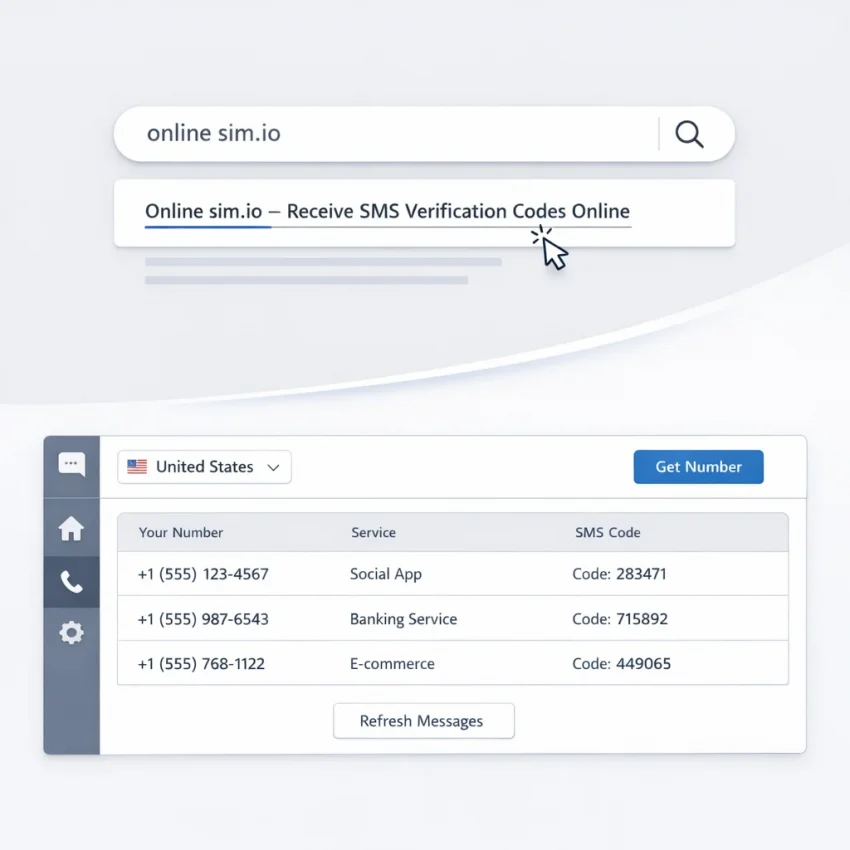
What people mean when they search for online sim.io in 2026
In most cases, a search for online sim.io is really a task-based search. People are not usually looking for a brand story or platform history. They want to receive SMS online, get a one-time password, and finish a sign-up or login without wasting time.
That matters because the best answer is not a general overview of “online sim” tools. The useful answer is a working workflow. If your goal is to get a virtual phone number for SMS verification in 2026, the practical starting point is Receive SMS online with SmsPva. It is built around the exact job most users are trying to complete: choose a service, get a temporary number, receive the code, and move on.
Searches like “online sim,” “receive OTP online,” and “how to receive verification code online” all point to the same need. Users want a number that can accept a service’s verification SMS at the right moment. They also want a cleaner process than random public inbox pages, outdated lists, or unclear availability.
SmsPva fits that intent because it is organized around service-specific verification flows rather than vague browsing. Instead of hunting around for any number and hoping it works, you start from the service you need, check the available options, and follow a more predictable path.
Why this search is really about completing verification
By 2026, users searching for online sim.io often have a narrow goal: activate a messaging app, verify a secondary account, test a workflow, or receive a one-time code without using their primary number. The keyword sounds brand-specific, but the intent is broader and more practical.
They are searching for an outcome, not a label. They need an online SMS number that fits a real verification flow. That is why a product-focused workflow matters more than a comparison table. A good solution should help you move from search to verified account with as few steps as possible.
SmsPva is a strong fit for this kind of search because it focuses on virtual numbers for OTP receipt and account activation. If you already know the target service, it gives you a direct path instead of trial and error.
How the SmsPva workflow works for online SMS verification
Users searching for online sim.io usually want a simple way to receive OTPs online. The SmsPva workflow is built for that job: choose the target service, pick a country if needed, fund your balance, get a virtual number, enter it on the target app, and wait for the code inside your activation panel.
Core flow from service choice to code receipt
First, choose the target platform. If you want to verify Signal or another supported service, select that exact service before you request a number. This matches the number to the verification task and reduces avoidable errors.
Next, choose a country if the service flow gives you that option. Country selection affects acceptance, availability, and pricing. Pick a country that fits your setup, and continue only when you see a live option you can use.
After that, fund your balance. SmsPva works as a pay-as-you-go verification workflow. You add funds, then spend them on the specific activation you need.
Once your balance is ready, request the number. SmsPva will assign a virtual phone number linked to that activation. Copy that number exactly as shown, then paste it into the target app or website during signup or login verification.
What happens after you enter the number
After you submit the number on the target platform, keep the activation page open and wait for the incoming code. If the platform sends the OTP successfully, the message should appear inside your activation details. Then copy the code and enter it back into the app you are verifying.
Many failed attempts start here. Users close the session, choose the wrong service, or request a number before they are ready to use it. A smoother workflow is to prepare the target app first, open the verification screen, and only then request the number on SmsPva.
Treat each attempt as a short sequence: select service, select country, top up, get number, submit number, receive OTP, enter code. If anything breaks, you can identify the problem faster.
Step-by-step: using SmsPva for Signal verification in 2026
If you searched for online sim.io because you need a quick way to receive OTP online, this is the practical path. For Signal verification in 2026, the simplest workflow is to use the dedicated Signal SMS verification page on SmsPva rather than hunting for a generic online SMS number.
Start by opening Signal on your phone or desktop and keeping the verification screen ready. Do not request a code yet. It is better to prepare your number first, because some apps limit retries or lock you into a short waiting period after a failed attempt.
On SmsPva, select Signal as the target service. Service-specific selection helps route your order toward a number intended for that exact verification flow. If you pick the wrong service, the code may never appear in the correct order window.
Next, review available countries. Choose a country that makes sense for your setup. In many cases, the best option is the country you actually want associated with the registration flow, not just the cheapest line. Availability can change during the day, so treat what you see as a live snapshot.
Before buying a number, make sure your SmsPva balance is funded. Then place the Signal order and wait for the system to issue the virtual phone number. Once it appears, copy it carefully, including the correct country code.
Enter the number in Signal without wasting the attempt
Go back to Signal and paste or type the number exactly as provided. Double-check the selected country inside Signal before you continue. The country picker in the app and the country code of the purchased number must match.
Submit the number and request the verification SMS. Then return to your SmsPva order page and watch for the incoming message. In a normal flow, the order panel will update when the code arrives. Do not close the tab too early, and do not order a second number immediately unless the first session clearly failed or expired.
When the SMS lands, copy the OTP exactly as shown and enter it into Signal. Most verification errors at this stage come from speed typing, using an old code, or mixing up two open sessions.
After you submit the code, Signal should move you to the next account setup step. If the app advances to profile creation, PIN setup, or device confirmation, your number worked for the verification task.
Simple checks that improve success on the first try
Keep one verification attempt per window. Do not juggle several Signal number orders at once unless you are very organized. Confirm you bought a Signal number before entering anything in the app. Wait for the order screen to update instead of repeatedly requesting new codes.
If you are choosing between countries, prioritize fit and availability over guesswork. At the time of writing, Signal single SMS pricing on SmsPva was listed from $0.50 and $0.58 for United Kingdom variants, while United States Signal numbers were listed at $1.75. These are API snapshots, not fixed promises, so always verify the live listing before you purchase.
Country selection, pricing snapshots, and how to choose the right number
When people search for online sim.io, they often want the cheapest fast path to receive OTP online. In practice, the best choice is not just the lowest price. On SmsPva, start by matching the exact service you need, then look at country options, then compare the live price snapshot for that service-country pair.
This order matters because SMS verification depends on fit. A low-cost number is not useful if it does not align with the platform you are activating. For Signal, choose a Signal-specific listing first. After that, compare available countries based on your use case, not price alone.
How to think about country choice
Your target country should support the account setup you are trying to complete. Some users prefer a familiar region for easier account management. Others simply want the most practical route that is currently available. In both cases, country selection is a tradeoff between price, stock, and compatibility at that moment.
For example, if you specifically need Signal verification in Unt. Kingdom, use the country-specific page instead of guessing from a generic list. That keeps the workflow tighter and reduces the chance of picking the wrong combination.
United Kingdom and United States numbers may differ in availability and cost because supply changes by provider and demand. A country that is cheaper in the morning may be limited later. Another may cost more but still be the practical choice if it is the current fit for your service.
If you enter a number with one country code, make sure you select that same country code inside the app or site requesting verification. A mismatch here can lead to avoidable failures even when the number itself is fine.
How to read price snapshots without overcommitting
Think of price as a live API snapshot, not a promise. At the time of writing, Signal single SMS pricing on SmsPva was listed from $0.50 and $0.58 for United Kingdom variants, while Signal verification in United States was listed at $1.75. Those figures are useful for comparison, but they can change with supply and demand.
If your workflow is flexible, compare countries before you buy. A UK option may be more budget-friendly at one moment. A US option may still be the right pick if your use case calls for a United States number.
Common verification problems and how to troubleshoot them with SmsPva
When the OTP does not arrive, the issue is usually one of a few predictable mistakes: choosing the wrong service, using a mismatched country, letting the session expire, or retrying too many times in the target app.
If you are using SmsPva for Signal verification troubleshooting, start by checking the basics in order. Do not jump between numbers or restart the app too quickly.
If the SMS verification code is not received
First, confirm that you selected the exact target service before buying the number. If you picked a different service flow, the platform may reject the number silently or never send the OTP.
Next, verify that the country you selected makes sense for your signup attempt. If your app session expects one region and your number comes from another, OTP delivery can fail even if the number itself is valid.
Also check whether the app actually accepted the number. If Signal shows an immediate error before sending a code, the problem is usually number formatting, country selection, or temporary app-side limits. Re-enter the number carefully with the correct country code.
If the request was accepted, give it a reasonable wait window. Refresh the status on the SmsPva order page instead of creating multiple new attempts right away.
Wrong service, expired session, and retry-limit issues
Another common failure happens when the user selects the wrong product flow. If you need Signal verification, use the Signal-specific path rather than a broad receive-SMS workflow.
Expired sessions are also common. If you requested a number, switched devices, closed the app, or waited too long before pressing send, the original verification session may no longer be valid. The practical fix is to start a fresh attempt and complete the request in one continuous flow.
Retry limits can create a second layer of confusion. If you request too many codes in a short period, the platform may slow or block further attempts temporarily. When that happens, changing numbers repeatedly often makes things worse.
If you still have trouble, use the Help resource on SmsPva for setup guidance and troubleshooting steps.
When to use a one-time number vs a rented number for ongoing workflows
This is one of the most important choices to make before you buy a number on SmsPva. A one-time verification flow is best when you only need a single OTP and do not expect to use that number again. A rented number is better when your workflow may continue after the first code, or when you want more continuity over time.
Use one-time verification for quick account creation, first-time activation, or a single login check. This is the leanest option when your goal is just to receive OTP online and move on.
Use a rented number when the verification task is not truly one-and-done. That can happen if you expect follow-up checks, plan to revisit the same account flow, or need a steadier setup around one service. For Signal-related workflows, the relevant product area is the Signal SMS verification rental page.
When a one-time number is the better fit
Pick a one-time number if your priority is efficiency. You choose the service, get a virtual number, enter it on the target platform, and wait for the code. If the account setup completes and you do not need that number again, a rental adds extra cost and management.
This option also makes sense when you are testing a workflow, checking country compatibility, or verifying whether a service accepts a given number format.
When a rented number makes more sense
Choose a rented number when account access may stretch beyond the first OTP. Examples include staggered onboarding, repeated sign-ins, or any setup where timing is uncertain.
A good rule is simple: if you only need one code today, start with one-time. If you already know the workflow may continue later, review the rental option first.
Best practices for privacy, account hygiene, and a smoother setup in 2026
If you searched for online sim.io, your real goal is usually simple: receive SMS online safely and finish verification with less friction. The cleanest approach is to separate each verification attempt, keep accurate notes, and use the correct service page from the start.
Good privacy-focused workflows also avoid unnecessary reuse. Use one verification session for one account action. Save the date, target service, country chosen, and whether the OTP arrived. This small log helps if you need to retry later.
If you manage multiple signups or account states, keep your environment consistent. Use the same device session from start to finish, and avoid switching networks or app states halfway through verification unless the platform requires it.
Finally, make SmsPva your default starting point instead of hunting through generic online sim searches each time. The platform is built for practical OTP handling, service-specific selection, and repeatable setup.
FAQ
What is the easiest way to use online sim.io-style verification with SmsPva in 2026?
The easiest way is to start with the exact service you need on SmsPva, choose a matching country, fund your balance, get a number, enter it on the target app, and wait for the OTP in your activation panel.
Can I use SmsPva to receive a Signal verification code online?
Yes. This guide focuses on Signal as the example workflow. Use the dedicated Signal service flow on SmsPva, then enter the issued number in Signal and wait for the code to appear in your order window.
How do I choose the right country for SMS verification on SmsPva?
Match the country to your use case first, then compare current availability and the live price snapshot. Also make sure the country code of the number matches the country selected inside the app you are verifying.
Why did my OTP not arrive after I entered the virtual number?
The most common reasons are wrong service selection, country mismatch, formatting errors, expired sessions, or app-side retry limits. Check the order details first before starting a new attempt.
What is the difference between a one-time number and a rented number on SmsPva?
A one-time number is for a single verification event. A rented number is for workflows that may need repeated access, follow-up codes, or longer continuity.
Are SmsPva prices fixed or do they change by service and country?
They can change. Treat listed prices as live snapshots, not guarantees. In this article, exact prices are included only where current API snapshot data was provided.
Where can I get help if a verification attempt fails on SmsPva?
Use the SmsPva help page for troubleshooting guidance and next steps if your verification flow does not work as expected.