

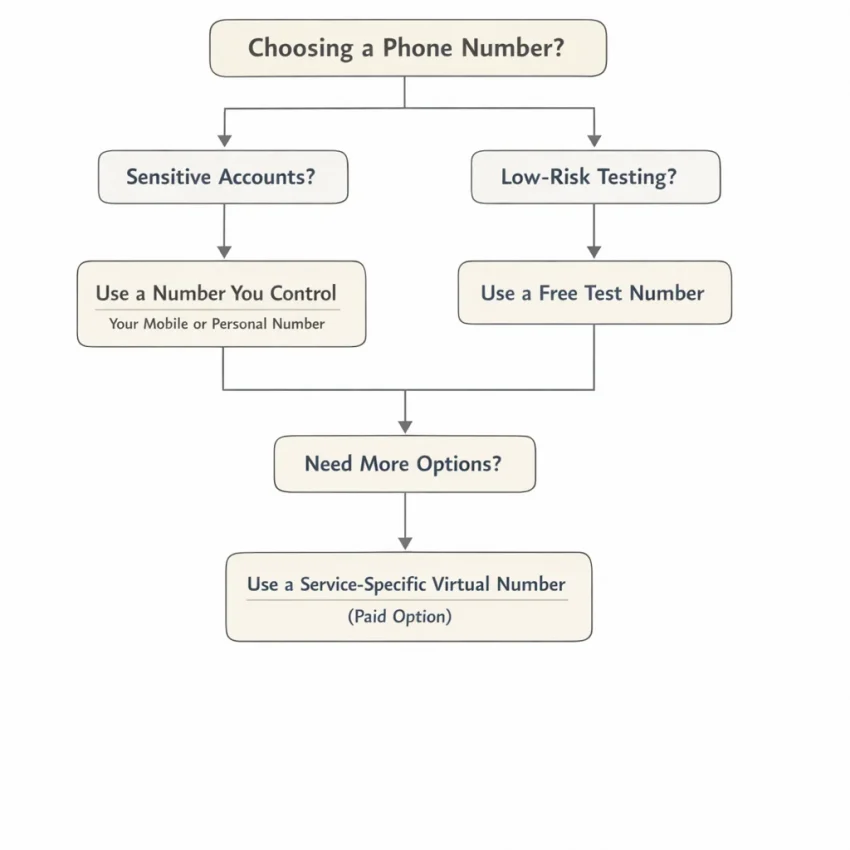
The best free phone number SMS workflow in brief
For a free phone number SMS option, first check whether you already have an eligible number you control. It is usually a better choice for accounts you may need to access again, because you can keep receiving messages and handle recovery. Confirm that the platform accepts your number type before requesting a code.
Public online inboxes can receive SMS without a charge, but they are shared: other people may be able to see messages sent to the same number. Treat them as a low-privacy option for low-risk tests, not for sensitive codes or accounts you cannot afford to lose. A listing that looks available also does not mean a particular platform will accept that number or send a message to it.
The short decision path is simple: use a number you control when future access matters; consider a public inbox only when the use is genuinely low stakes; and, if neither fits, decide whether a paid service-specific virtual number is appropriate. No option guarantees acceptance or receipt.
When to consider a paid fallback
If you need a virtual number for a particular verification flow and are prepared to pay, SmsPva is an option to check. It is not a free SMS service. Review the live site for the target service, country availability, instructions, and current terms before proceeding. Acceptance and receipt can vary, so do not treat a virtual number as a guaranteed solution.
Before choosing, weigh five practical factors: cost, who can see incoming messages, whether you can retain access to the number, whether the platform permits that number type, and whether the account needs dependable recovery. For a bank or important personal account, prioritize a number you control and follow the platform’s verification rules.
What “free phone number SMS” can mean
A search for a free phone number SMS can lead to several kinds of numbers. They may all appear to receive texts, but that does not make them equally private, controllable, or suitable for verification.
Public inboxes and temporary numbers
A free online SMS inbox usually displays incoming messages on a public webpage. Anyone who can access that inbox may be able to read its texts, including verification codes. Other people may also use the same number, so messages can be mixed together or an account may already be associated with it. Treat a public inbox as visible to strangers, not as a private phone line.
“Temporary phone number” describes a number intended for short-term use or assigned for a limited period. It does not, by itself, tell you whether the inbox is public, whether you control the number, or whether you can receive another message later. Check how the number works before using it. A number that accepts one text now may not remain accessible for a later login or recovery check.
Seeing a number listed does not mean a particular website or app will accept it. A platform may decline some number types or numbers it recognizes as shared or virtual. Acceptance can vary by service and may change. Avoid repeatedly trying random numbers if the platform rejects one.
Numbers you control and paid virtual numbers
A number included with a legitimate phone plan or device may be a no-extra-cost option if you already have access to it. Because you control the line, you can generally see messages sent to it and may be better positioned to receive future account alerts. Check your plan and the platform’s rules; “free” in this case does not mean the phone service itself has no cost.
A paid virtual number is another category. It is provided for online use rather than as a line on your personal device, and some services offer numbers for specific verification destinations. It is not automatically private, permanent, or accepted everywhere. Read the live terms and check current service and country options before relying on one.
The key distinction is control over future messages. A number you can keep accessing is usually a better fit for an account you may need to recover. Shared or short-lived options are poor choices when losing access would matter. Choose based on the account’s importance, not just whether a number appears free.
Compare the free and paid options before choosing
The lowest-cost option is not always the best fit. Before choosing a free SMS verification number or a paid alternative, consider who can see incoming messages, whether you can receive future codes, and whether the target service accepts that number type. A number that works for a one-time test may be a poor choice for an account you need to keep.
Compare the main options
| Option | Cost | Privacy and control | Best-fit use |
|---|---|---|---|
| Public shared inbox | Often no direct charge | Messages may be visible to anyone who opens the inbox. You may not control the number or later messages. | Low-stakes tests where the account and code are not sensitive. |
| Number you control | May already be included with an existing phone plan or device; otherwise, costs vary. | You control access to incoming messages, subject to your provider and account security. | Important accounts and situations where future recovery codes may be needed. |
| Temporary virtual number | Varies; some options may charge | Access may be limited or temporary. Check who can receive later messages and for how long. | A short-term task when ongoing access is not important and the service permits it. |
| Service-specific virtual number | Usually a paid option; terms and availability vary | Access depends on the provider’s workflow and the number selected. Do not assume exclusive or lasting access. | A permitted service-specific verification flow when a public inbox is unsuitable. |
These are broad patterns, not guarantees. Free online SMS inboxes can be easy to try, but a visible inbox is not private. Avoid entering personal details or using a public number for an account that contains sensitive information. A number that appears available also may not be accepted by the platform.
A number already under your control is generally the more practical choice when you may need future OTP messages. It gives you a clearer route to receive later codes, though it does not remove risks such as losing access to your device or phone plan. For accounts with recovery requirements, check the provider’s options before signing up.
Match the choice to the account
For low-stakes testing, a public inbox may be adequate if the platform allows it and you accept that others could see the message. For a personal account you rely on, favor a number you control and can keep using. Treat a temporary number as short-lived unless its terms clearly explain continued access.
A paid virtual phone number for verification may suit a one-time, service-specific workflow when you do not want to use a public inbox. It still may not work with every platform, and it may not be appropriate for long-term recovery. Check the target service’s rules and the provider’s current service and country availability before choosing.
Setup effort also differs. A public inbox may require little preparation, while a virtual-number workflow may involve selecting a service and country and following the provider’s instructions. Focus on your actual need: a single code, repeat access, or dependable recovery. Do not cycle through random numbers when a service rejects one; reconsider whether that number type is permitted and suitable.
Quick decision rule: Use a public shared inbox only for low-risk purposes. Choose a number you control when future access matters. Consider a service-specific paid virtual number only when the target service permits it and its limits fit your needs. Check availability at decision time; neither apparent availability nor past success guarantees acceptance or SMS receipt.
Privacy, account security, and platform rules to check first
A free phone number to receive SMS may be convenient, but the type of number matters. Before requesting a code, consider what the account protects, who could see the message, and whether you will need access to that number later. A one-time code can help confirm a login, but the phone number may also become part of account recovery.
Assume public inbox messages are visible
A public online inbox is shared: other visitors may be able to view incoming texts, and messages may remain visible after they arrive. If a verification code appears there, someone else could potentially use it while it is valid. Avoid entering personal details or other sensitive information into a shared inbox. Do not treat a free SMS verification number as private just because you opened the page yourself.
For that reason, do not use a public inbox for banking, healthcare, email accounts that control password resets, or any account you cannot afford to lose. Avoid using one for private conversations or services that may send personal information by text. If a code arrives unexpectedly, do not share or use it; review the account’s security settings through its official app or website.
A private number for SMS verification can reduce exposure to a public inbox, but “private” does not automatically mean secure or permanently under your control. Check what the provider says about number access, message handling, and the duration of access. Never assume a temporary phone number for SMS will remain available for a later login.
Think through recovery and the platform’s rules
Some services let you add a phone number to help recover an account or confirm important changes. If you later lose access to that number, you may be unable to receive a recovery code. Before using a number, check whether the account lets you add another recovery method, such as an authenticator app, backup codes, or a second email address. Store recovery codes somewhere secure and separate from the account.
Reusing a number also creates risk. A number that has been used for another account may be associated with someone else, or a future user might receive texts sent to it. Do not assume a number is exclusive to you unless the provider clearly explains the arrangement. For an important, long-term account, a number you personally control and can keep is generally the safer choice.
Check the account provider’s current terms and verification instructions before choosing a number. Some platforms may restrict virtual, temporary, or shared numbers, and acceptance can vary by service and situation. If the platform rejects a number, stop and use an allowed method rather than cycling through random numbers. A virtual number is not a way to bypass identity checks, regional restrictions, age requirements, or account limits.
Use the same risk test for any free phone number SMS option: if losing access would cause financial, professional, or personal harm, do not rely on a public inbox or a number you may not control later. Choose a permitted method that supports recovery, and keep verification codes to yourself.
A step-by-step free-first SMS verification workflow
A free phone number SMS option is not automatically suitable just because you can see a number online. Use this workflow to weigh privacy, account security, and the chance that a platform will accept the number before requesting a code.
Assess the account and choose a number
- Classify the account. Ask what you could lose if you cannot sign in again. For banking, work, health, primary email, or any account with valuable personal data, avoid public inboxes and temporary numbers. Choose a number you control and can access again, and follow the platform’s recovery options.
- Check the platform’s rules. Read its current verification instructions and terms before choosing a number type. Some services may reject virtual, temporary, or previously used numbers. A number appearing in a free SMS verification number directory does not mean the service will accept it or send a message to it.
- Prefer a number under your control when continuity matters. If your existing mobile plan or another legitimate option includes SMS access, that may be a better fit for an account you need to keep. Consider whether you can still receive future codes, including during a password reset or a new-device sign-in.
- Keep public inboxes for low-risk tests only. A free online SMS inbox may show incoming messages to anyone who visits the same page. Other people might see a code while it is visible, and the number may be reused. Do not use it for sensitive accounts, personal details, or anything you cannot afford to lose.
Before proceeding, check: Is the account low stakes? Does the platform permit this number type? Can other people see the inbox? Will you need this number for recovery later? If any answer raises concern, choose a more suitable route instead.
Request the code carefully
- Use the service’s own instructions. Enter the selected number in the platform’s verification form, including the correct country code if requested. Check the digits before submitting. If you use a public inbox to receive SMS online, make sure you selected the matching number and can view the inbox without exposing other personal information.
- Request one code and wait. Submit the request once, then allow the service time to process it. Follow its instructions about when to request another code. Repeated requests can create delays, trigger rate limits, or make it harder to identify which message belongs to the current attempt. Never share a verification code with someone who contacts you unexpectedly.
- Enter the current code promptly. Use the code only in the platform’s official verification flow. A code may expire, and a shared inbox may receive messages for a number used by multiple people. Do not assume a message is yours if the number or request does not match.
- Plan for future access. If the account is worth keeping, add a recovery method the platform allows and that you can reliably access. A temporary number may stop being available to you, so do not treat successful sign-up as proof that it will work for later recovery.
If there is no suitable free route, stop rather than cycling through random numbers. Recheck the service’s rules and consider a number you control or a paid, service-specific virtual number if the platform permits it. SmsPva is not a free service; check its current terms and availability before deciding. No number type guarantees that a platform will accept it or that a message will arrive.
Quick decision: For low-stakes testing, a public inbox may be an option if you accept its limited privacy. For important accounts, use a number you control. If neither is suitable, pause and review permitted alternatives before requesting another code.
When a free option is not a good fit: using SmsPva as a paid fallback
A free phone number SMS option can be convenient for a low-stakes test, but it may be unsuitable when you need a number for a specific service or do not want to use a public shared inbox. If you have no appropriate number under your control, a paid virtual number may be another option to assess.
SmsPva provides virtual numbers for SMS verification and OTP receipt. It is not a free service, and a number should not be treated as a guarantee that a platform will accept it or that a code will arrive. Check the live site for current instructions, service and country availability, and terms before deciding.
Check the service and number options first
Start by checking the target platform’s verification rules. Confirm that it permits the type of number you plan to use, and consider whether you will need access to that number again. If you are setting up an account that matters, a number you control over time is generally more suitable for recovery than a temporary or shared inbox.
If you decide a virtual number fits your needs, choose the relevant service on SmsPva and review the countries and number options currently shown. Availability can vary, so do not assume a particular country or service will always have a suitable number. Follow the live workflow to request a code and check for a response. The process depends on the target service and its rules; successful verification is not assured.
For a concrete example, SmsPva has a Signal SMS verification page. It is a service-specific reference, not evidence that every country or account will be supported. Check the page’s current options and the platform’s requirements before placing a request.
Compare the cost and account risk
Consider the cost alongside the privacy and recovery tradeoffs. A public inbox may expose an incoming message to other visitors, while a paid virtual number still may not provide dependable long-term access for account recovery. Avoid using any number option that conflicts with a service’s terms or verification rules.
At the October 15, 2026 API snapshot, a single-SMS Signal option for the United States was listed at $2.01. See the current Signal verification in the United States listing before deciding. Treat that figure as a time-sensitive snapshot, not a fixed price or promise of availability. Do not buy simply because an option appears inexpensive if you cannot accept the risk of a rejected number or an undelivered code.
For banking, sensitive personal accounts, or accounts you cannot afford to lose, favor a number you control and can use for recovery. A virtual phone number for verification may make sense for a limited, permitted workflow, but it is not a workaround for identity checks, regional restrictions, or account limits. If no suitable option meets your needs, pause rather than cycling through numbers.
Troubleshooting and a final decision checklist
If a verification code does not arrive, pause before requesting another. Check the target service’s current instructions and status, then confirm you selected the intended service and country. Follow any stated waiting period; repeated requests can create delays or trigger limits.
Make sure the number type is allowed by the platform. If it rejects a free or temporary number, do not keep cycling through random numbers. Stop and choose an option permitted by the service, preferably a number you control if you need ongoing access. A rejected number or missing message does not prove another number will work.
Check before trying again
- Verify the service, country, and number details against the live instructions.
- Wait for the platform’s stated interval before making another request.
- Check whether the account or service has limits on verification attempts.
- If you are using SmsPva SMS verification, review current service and country availability and follow the live site’s instructions. If the issue remains, consult the available product support resources.
Availability and message receipt can vary. Support resources may clarify the workflow, but no number type can guarantee that a platform will accept it or that an SMS will arrive.
Make the final choice
- Low-stakes test: A public inbox may be an option only if you accept that other people can see its messages and the number may be reused.
- Account you need to keep: Prefer a number you control and can access for future verification or recovery.
- Service-specific need: Consider SmsPva as a paid virtual-number option when it suits the service’s rules. Check current availability and terms first.
- Sensitive account: Avoid public inboxes and temporary numbers when losing access would cause harm or serious inconvenience.
Before requesting a code, ask: Is this account important? Does the platform permit this number type? Can I receive future recovery messages? If any answer is uncertain, stop and check the service’s rules before proceeding.
Frequently asked questions
Can I receive SMS online for free without using my own phone number?
Yes. Some public online inboxes display incoming SMS without charging the visitor. However, messages may be visible to other people, numbers may be reused, and a platform may reject them. Keep this option for low-risk uses where you accept those limits.
Are free public SMS inboxes private?
No. A public inbox may let other visitors view incoming messages, including verification codes. Do not use one for sensitive accounts, personal information, or an account you cannot afford to lose.
Can I use a free phone number for account recovery?
Only if the number remains accessible to you and the account provider permits it. A public or temporary number may not be available when you need a recovery code later. For an important account, use a number you control and add other recovery methods where possible.
Why might a platform reject a free or temporary number?
Some platforms restrict shared, temporary, virtual, or previously used numbers. Rules vary and can change. Check the platform’s current requirements rather than repeatedly trying different numbers.
Is SmsPva a free SMS verification service?
No. SmsPva is a paid option for virtual numbers used for SMS verification and OTP receipt. Check the live site for current terms, availability, and any listed prices before deciding. A number does not guarantee acceptance or message delivery.
What should I do if a verification code does not arrive?
Check the platform’s instructions, confirm the service and number details, and wait for any stated interval before trying again. If the platform rejects the number, stop and choose a permitted option. Do not assume repeated requests or a different number will solve the issue.
Should I use a temporary number for an account I need to keep?
Usually not. You may lose access to the number and be unable to receive future login or recovery codes. For an account you rely on, prefer a number you control and can keep using, subject to the platform’s rules.