

What “SMS free phone number” means—and what SmsPva offers
An “SMS free phone number” can mean several things: a public number whose incoming texts are visible online, a mobile number you already own, or a virtual number used to receive a verification text. These options differ in cost, privacy, and whether a platform accepts them. A number advertised as free is not automatically private or suitable for every signup.
A public inbox may let visitors view incoming messages without owning the number. That can be convenient for a low-stakes test, but it is a poor choice for sensitive accounts. A personal mobile number is under your ongoing control, while a virtual number is provided for a particular online SMS use and may have different limits on access or reuse.
SmsPva offers virtual phone numbers for SMS verification and one-time passcode receipt. Do not assume a SmsPva number is free. Review the current options on SmsPva, including live terms and listing details, before choosing one. Availability, cost, and platform acceptance can vary.
Choose the number for the task
For a supported, permitted verification flow, a virtual number may be an option if you have checked the platform’s rules and do not need the number as a long-term recovery method. For an important account, prefer a durable number or another recovery option that remains under your control. A temporary verification number should not replace secure account recovery.
Before using any number, confirm that the platform allows it and that the service and country options shown on SmsPva fit your intended flow. Platforms may reject virtual numbers, including numbers that have been used before. No SMS verification method can guarantee that a code will arrive or be accepted.
Use this workflow only for your own account and a legitimate verification purpose. Do not use a temporary number to impersonate someone, bypass a platform restriction, or defeat its security checks. If the platform does not permit virtual numbers, choose one of its approved verification methods instead.
Free public number or virtual number? Choose based on privacy and reliability
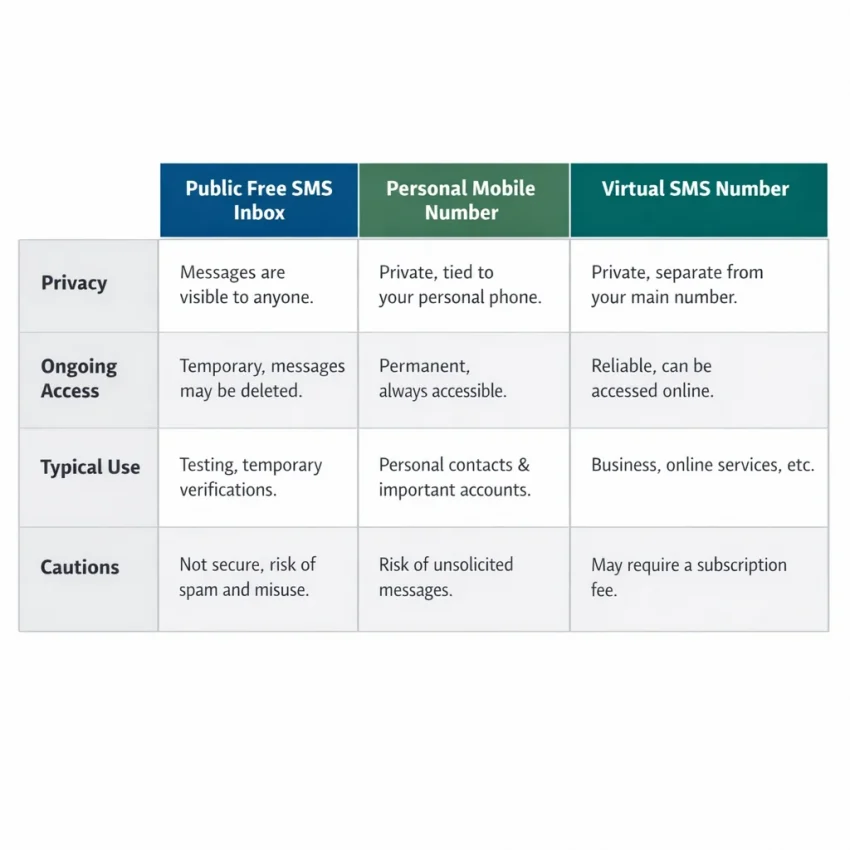
A search for a “free phone number for SMS verification” can lead to very different options. A public SMS inbox is usually a shared number with messages displayed on a webpage. A personal mobile number is controlled by you through your carrier. A virtual number is provided online for SMS use, often for a particular service or verification flow. These options are not interchangeable, especially when privacy or later account recovery matters.
How the three options differ
Public free SMS inbox: It may let you view incoming texts without registering, but the inbox can be visible to other visitors. Someone else may see a code while it is displayed, and a number may be reused. Platforms may recognize public numbers and refuse them. That makes a public inbox a poor choice for private messages or an account you care about keeping.
Personal mobile number: You generally have direct control of the SIM or mobile account, making this the more suitable option when you need ongoing access or account recovery. It still involves sharing your number with the platform, and you should follow that platform’s verification rules.
Virtual number: A virtual phone number for SMS verification can be another option for a supported flow. It is not automatically private, permanent, or accepted everywhere. Access may be limited, and the number may not be suitable for future recovery codes. Check the provider’s current terms and the platform’s rules before using one.
Use this checklist to decide
- How important is the account? For banking, work, or other high-value accounts, choose a platform-approved method you can access over time—not a public inbox or temporary number.
- Would exposure matter? If the text could reveal sensitive information, avoid a shared public inbox. Do not assume an online number provides exclusive access.
- Does the platform permit it? A service may reject public, virtual, or previously used numbers. Use only verification methods allowed by its terms; do not use a number to bypass a ban or security check.
- Will you need the number again? If you may need another code for login or recovery, use a number or method that remains under your control. A one-time code does not mean you retain future access to the number.
- Is the flow suitable for a separate number? For a low-stakes test or a permitted verification flow, a virtual number may be worth considering after checking current availability and limitations.
SmsPva provides virtual numbers for supported SMS verification flows. It is not the same as a public free inbox, and you should not assume a number is free or will be accepted. Treat it as an option to assess against the current listing and your account’s needs—not as a replacement for a durable recovery number.
Before you start: check platform rules, account purpose, and number access
Before choosing an SMS verification number, confirm that the platform allows virtual numbers for your account. Rules vary by service and can change. A platform may reject a number because it is virtual, has been used before, or does not match its eligibility requirements. A working number therefore does not guarantee that the verification flow will accept it.
If you are considering SmsPva, check the live site for current service and country options, and read the applicable terms before proceeding. Do not assume a specific country or number type will be available or accepted.
Check the platform’s rules and your purpose
Read the platform’s account and verification guidance first. Check whether it permits virtual phone numbers for your use case and whether it requires a number from a particular country. If the service offers a test or sandbox environment, use that for testing instead of creating an ordinary account with a temporary number.
Some services may not accept a number that has appeared on another account, while others may apply their own limits to virtual numbers. If you see a rejection message, follow the platform’s approved alternatives rather than trying to work around its controls.
Use a virtual number only for a legitimate, permitted verification flow. Do not use one to evade a ban, impersonate someone, conceal prohibited activity, or defeat a platform’s security checks. If the service says your account must use a personally controlled number, follow that requirement.
Decide whether you need lasting access
A temporary number may suit a one-time, low-stakes test when the platform permits it. It is a poor choice if you need to keep receiving messages, reset a password later, or prove ongoing ownership of the account. Access to a virtual number may be limited, and you may not be able to use it as a private, long-term contact channel.
For email, social, work, or financial accounts you cannot afford to lose, use a durable number under your control and set up the platform’s other approved recovery options. These may include an authenticator app, backup codes, or a recovery email. Do not rely on a temporary phone number as the only way back into an important account.
A quick decision check: Is the platform’s policy clear? Is this account low-risk? Do you need future access to this number? If the rules are unclear, the account is important, or you need reliable recovery, choose a platform-approved method tied to a number you control.
How to receive an SMS verification code with SmsPva
SmsPva provides virtual phone numbers for supported SMS verification flows; do not assume a number is free. Options, terms, and availability can change, and a platform may reject a virtual number. Before you begin, make sure this method is permitted for the account you are creating or verifying. Use it for a legitimate flow, not to bypass a restriction or security check.
Choose a supported service and check the live options
Start on SmsPva and identify the service you need to verify. Check the live site for matching service and country options. Do not assume that a country or service mentioned in an older guide is currently available. Review the current listing and applicable terms before proceeding, including any cost or usage details displayed there.
It helps to open the platform’s verification form first, so you know which service is requesting a code and whether it specifies a country or number format. If the platform does not allow virtual numbers, or its rules require a personal number, stop and use an approved method instead. For a service-specific example, the Signal SMS verification page is relevant only when Signal is the service you are verifying; it does not imply that a number is available or will be accepted.
Once you find a suitable current option, read the listing carefully and obtain a number only if its terms fit your use. Do not select a country at random just because it appears in a list. Platform checks can differ by service and region, and previously used numbers may not work for a new verification attempt.
Submit the number and check for the message
- Get the number. Follow the steps presented on SmsPva for the chosen service and country. Keep the number visible so you can copy it accurately.
- Enter it in the platform’s own form. Use the country code and number format the form expects. Check the digits before submitting; an incorrect number can prevent the code from reaching the right place.
- Request the SMS. Submit the platform’s verification request once. Follow any instructions or waiting window shown by that platform rather than repeatedly requesting new codes.
- Check SmsPva. Return to the relevant message area or transaction information and look for an incoming SMS. If a code arrives, enter it promptly in the original verification form.
Keep the verification flow open while you check for a message, where practical. A code may expire, and requesting another code can make an earlier one invalid. Never share an OTP with another person or enter it into a page that is not the platform’s own verification form.
This is a practical sequence, not a delivery guarantee. SmsPva availability can change, and a platform may filter or reject virtual numbers. Receiving an SMS online depends on the specific service, number, and platform response at that time.
Pause and check before making another attempt
If no code appears, first confirm that you entered the selected number correctly and chose the option matching the service you are verifying. Check the platform’s stated waiting period, then review the SmsPva message area and any transaction status available for that attempt. Also look for a rejection notice, an expired request, or a platform limit on repeated code requests.
A missing SMS does not automatically mean you should obtain another number. Repeated attempts can trigger rate limits or make the platform less likely to accept further requests. Check whether the platform allows virtual numbers and whether the SmsPva listing still matches your intended service and country. If the platform rejects the number or the service cannot complete the request, stop rather than cycling through numbers.
When the flow is unsupported, use another legitimate verification method offered by the platform. For help understanding SmsPva’s product or process, consult its Help resources. Recheck current options before trying again; neither availability nor delivery should be assumed.
If the code does not arrive: troubleshoot before trying again
A missing SMS does not always mean something is wrong with your account. The platform may reject the number, the request may not have completed, or the message may not arrive within the expected window. Check each step before you retry or obtain another number.
Check the number, service, and request status
- Verify the number format. Compare the number you entered with the one SmsPva provided. Check the country prefix and digits, and follow the platform’s instructions about whether to include a leading zero or a plus sign. Avoid adding spaces or punctuation unless the form accepts them.
- Confirm the selected service matches. Make sure the number was obtained for the same platform and verification flow you are using. A number selected for one service may not be suitable for a different service, even if both send SMS codes.
- Wait within the platform’s stated window. Use the wait period shown by the platform, if provided. Repeatedly requesting new codes can trigger rate limits or invalidate an earlier request. Do not assume a specific delivery time.
- Check SmsPva’s message area and transaction status. Review the relevant message area for an incoming SMS, and check whether the request is still active or has another status shown. If no message appears, confirm the platform actually sent a code and did not display a number-rejection or eligibility message.
Keep the platform’s response in mind. A notice that the number is unsupported or has been used before is different from a delayed message. Re-entering the same number will not necessarily resolve a rejection.
Know when to stop and ask for help
If the number is correct, the service selection matches, and the platform’s waiting window has passed, avoid repeatedly purchasing numbers or requesting codes. More attempts may run into platform limits, and changing numbers without diagnosing the issue can make it harder to tell what happened.
Instead, read the platform’s instructions and choose another verification method it permits, such as a personal number or another offered account-verification option. This is especially important for accounts you need to keep. Do not use repeated attempts to bypass a platform’s restrictions or security checks.
If you need help with the SmsPva product or the status shown for your request, consult SmsPva Help. Share only the information support needs to understand the issue; never disclose a one-time code, password, or other secret. Support guidance cannot guarantee that a platform will accept a number or that a code will arrive.
Privacy, security, and account-recovery limits
Receiving an SMS code is only one part of protecting an account. A temporary phone number for verification may be suitable for a limited, permitted signup flow, but it is not the same as a personal number you control over time. Before using any virtual phone number for SMS, consider what could happen if you later need to verify your identity or recover the account.
Never share a one-time password (OTP) with another person, even if they claim to be support staff. Enter the code only in the service’s official verification flow. Avoid saving or forwarding verification messages unnecessarily, and do not use a number for activity that violates the platform’s terms.
Understand who may access the number
Public SMS inbox risks include messages being visible to other visitors, numbers being reused, and incoming texts appearing in a shared inbox. That makes a public free SMS inbox a poor choice for private communications or sensitive account access. A virtual number from a service such as SmsPva is a different option, but you should still review the current service terms and understand the limits on future access. Do not assume that a number is exclusive or will remain available to you.
Use a temporary number only when the account’s purpose and the platform’s rules allow it. Verification messages can contain personal information, and number reuse may create confusion if a later user receives a message intended for an account you once registered. Keep the account itself protected with a unique password, and enable additional security features where available.
Keep recovery methods under your control
Do not make a temporary number your sole recovery method for an important account. If access to that number ends, you may not be able to receive a future reset code. For email, work, financial, health, or other high-value accounts, use a durable phone number or another recovery method approved by the platform and under your control.
Where available, consider an authenticator app, passkey, or platform-provided backup codes as additional security options. Set them up through the account’s official security settings, and store backup codes somewhere private and accessible to you. These measures do not remove every risk, but they reduce dependence on receiving a text at a number you may not keep.
Think of SMS verification privacy as a limited trade-off: a virtual number can support a one-time code flow, but it is not a private channel for ongoing conversations or a guaranteed route back into an account. If you cannot accept that limitation, choose a platform-approved method tied to contact details you control long term.
A quick decision guide: when to use SmsPva and when not to
Looking for an SMS free phone number? First decide what the number needs to do. A public free SMS inbox may cost nothing, but its messages can be visible to other visitors, and platforms may reject its number. A virtual number is a separate option, and you should not assume it is free or accepted for every service.
SmsPva may fit a one-time, permitted verification
Consider SmsPva when the platform permits virtual numbers, the service and country you need appear among the current options, and you only need a code for a low-stakes, supported flow. Review the live listing and terms before proceeding. Availability, platform acceptance, and message delivery can vary.
This may be useful when testing an account flow or when you have a specific reason not to share your personal number. It is not a promise of a free phone number for SMS verification. Check current details before deciding whether the option suits your budget and use case.
Choose another method for important or lasting access
Use a personal, durable number or another platform-approved method when an account contains important information, handles money, or must remain recoverable. Do not rely on a temporary number as your only recovery route. You may not retain access to it, and a platform may reject a virtual or previously used number.
A quick checklist can help:
- Check the rules: Use a virtual number only if the platform allows it. Never use it to bypass a ban, impersonate someone, or defeat security controls.
- Consider privacy: Avoid public inboxes for private or sensitive accounts. Treat every code as confidential.
- Think beyond signup: If you may need future recovery codes, choose a number and recovery method you control over time.
- Stop if it fails: If a platform rejects the number or a code does not arrive, check the displayed status and platform guidance. Avoid repeated attempts; use another legitimate verification option instead.
In short, SmsPva SMS verification can be an option for a supported one-time flow after you check the live choices and accept the limitations. For high-value accounts, prioritize a long-term recovery method under your control. Check SmsPva’s current options before you begin; no number or delivery outcome is guaranteed.