

What People Mean by a ‘Free US Number for Verification’ in 2026
When people search for a free US number for verification, they usually want one thing: a US number that can receive a code without exposing their personal phone. That can mean OTP receipt, account activation, privacy-focused signup, or a quick one-time verification step.
But in 2026, the real need is usually bigger than “free.” Most users need a US number for verification that works inside a predictable process. A random public number may be visible to many people, already overused, or blocked by the service you want to join. A managed workflow gives you more privacy, better visibility, and a cleaner retry path if the code does not arrive.
“Free” Usually Means Public Access, Not Real Control
Many searchers picture a free online inbox that can receive any text code. That is one kind of free number for verification, but it comes with tradeoffs. The more public the number is, the less control you have over prior usage, inbox visibility, and service compatibility.
That is why virtual US number for SMS verification is often the better concept. The goal is not just to avoid cost. The goal is to finish verification quickly, protect your personal number, and reduce guesswork. For that, a managed platform is usually more useful than a public list of recycled numbers.
If your priority is a smoother verification process, Receive SMS online with SmsPva is the better starting point. It is built for SMS verification workflows rather than public-number hunting.
Why Most Free Verification Numbers Fail: The 2026 Reality Check
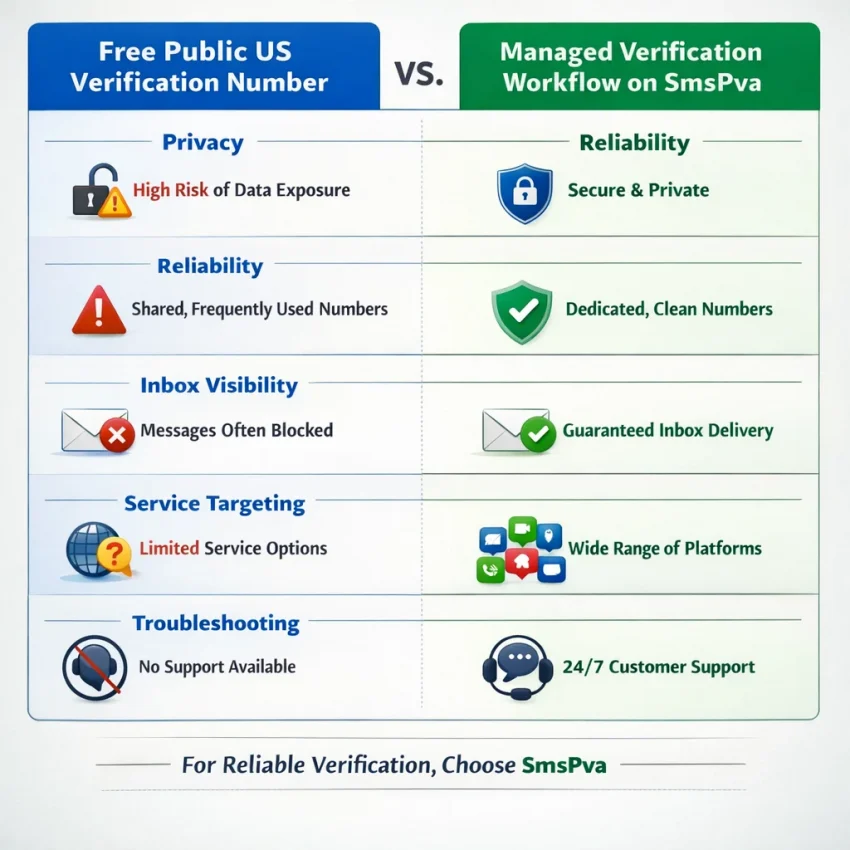
The appeal of a free US number for verification is obvious. You want a quick code, no commitment, and no need to use your personal line. The problem is that most free options are not real verification tools. They are public inboxes, recycled numbers, or random listings with little control.
That matters more in 2026. Verification systems are stricter, abuse filtering is better, and heavily reused numbers get flagged faster. So the better question is not “Can I find a free number?” It is “Can I complete signup reliably and privately?”
Shared Numbers Create Shared Problems
Most sites that let you receive SMS online US number messages for free use public inboxes. Anyone can see the messages, or many users are trying the same number at once.
That creates two immediate issues. Privacy is weak because OTPs may be visible to others. Usability is weak because a number that worked once may already be tied to too many prior signups. Public numbers also flood with unrelated texts, which makes your code harder to spot.
Platforms know that free public numbers are heavily recycled. They may reject them, throttle them, or never send the code. From the user side, it looks like the platform is broken. Often, the number has simply lost trust.
Filtering, Country Mismatch, and No Support Path
A generic public number may exist, but that does not mean it fits your service. Some platforms filter known public ranges. Others expect a closer match between service, country, and number history. If you need an OTP verification number USA, a random number with unclear prior usage can add friction before the SMS is even sent.
Country control is another weak point. People searching for a US number for verification often need the US specifically. Free sources rarely give dependable country selection.
The biggest hidden cost is time. When a public number fails, you usually have no support path, no service-specific flow, and no structured way to retry. That is why “free” often becomes expensive in practice.
SmsPva offers a cleaner alternative. Instead of chasing any free number, you can choose a workflow that fits the service and country you need. That does not guarantee every attempt will work, but it gives you more control and better privacy.
The Best Workflow Instead: How to Use SmsPva for US SMS Verification
If you searched for a free US number for verification, you are usually trying to solve a simple problem: get a code fast, avoid using your personal number, and finish signup. In 2026, the best path is usually a controlled workflow, not a public inbox.
With SmsPva, the practical process is straightforward. Start from the main dashboard, choose the service flow when available, select the US if that matters, request a number, and wait for the OTP inside a managed session.
Start With the Service, Not the Number
The biggest mistake is starting with a generic number. A better SMS verification workflow starts with the service you want to verify. If a service-specific route exists, use that first. It reduces guesswork and lowers the chance of mismatch.
Then ask whether the US is truly required. Sometimes you specifically need a US number for verification because the account is US-facing or the form expects a United States number. If so, choose the US in the workflow.
After that, request the number, enter it carefully on the signup page, and submit one clean verification attempt. Then wait for the OTP in your SmsPva session. This is much cleaner than jumping between public inbox sites and hoping your code appears.
Complete the OTP Step With Less Friction
Once the number is issued, avoid rushing repeated resends. Many failed attempts happen because users switch numbers mid-process, choose the wrong country, or trigger too many retries.
When the OTP appears, copy it right away and complete activation. That is the main value of using SmsPva for a temporary US number for verification: you get a more structured process without exposing your personal line.
If you are comparing options, think in terms of workflow quality. The best number is not the one with the lowest upfront cost. It is the one that matches the service, supports privacy, and gives you a clear path from request to code entry.
Service-Specific Example: US Signal Verification With SmsPva
If your goal is Signal verification in the United States, a generic hunt for a free public number usually creates more friction. You still have to guess whether the number fits the service, whether it is public, and whether it has already been overused.
A service-specific workflow is cleaner. Start with SmsPva’s Signal SMS verification page instead of browsing random numbers. If you already know you need a US number, go directly to the Signal verification in United States page.
How the Workflow Looks in Practice
First, select Signal as the service. Then choose the United States if that matches your signup. Request the number, enter it in Signal, and wait for the OTP in the SmsPva interface. Once the code appears, copy it into Signal and finish verification.
This solves several common problems behind the phrase free number for verification. You are not relying on a shared public inbox. You are not refreshing a crowded page. And you are not forcing a generic number into a stricter service flow.
Why This Is Better Than a “Free” Shortcut
Many users search for a free number because they want speed and privacy. Public options often reduce both. Shared access can expose incoming texts, and recycled numbers can fail before you even enter them.
With SmsPva, you can align the service with the country and move through the OTP step with less guesswork. At the time of writing, the API snapshot for Signal in the United States was listed from $2.01 for single SMS. That is a current snapshot, not a permanent promise of price or availability.
For users comparing the best US number for verification options, that tradeoff is simple: a small paid step can save much more time than chasing a free public number that never completes verification.
How to Choose the Right US Verification Setup: Free, One-Time, or Rental
If you are searching for a free US number for verification, the real question is fit. The best setup depends on privacy needs, whether you need one code or repeated access, and how much control you want if something goes wrong.
In practice, most users compare three paths: a public free number, a one-time virtual number, or a rental-style setup. They are not interchangeable.
When a Free Public Number Is Enough
A public free number is the lowest-control option. It may be enough for low-stakes testing or casual signups where privacy and continuity do not matter much.
But the tradeoff is obvious. Public numbers are shared, visible to others, and often already known to platforms. If the code is delayed or the service rejects the number, you usually just start over.
That makes free public numbers a narrow-use option in 2026.
Why One-Time Verification Is the Default for Most Users
For most signups, a one-time virtual US number is the practical default. You need one OTP, one activation step, and a cleaner process than a public inbox can offer.
With SmsPva, you can choose the relevant service path, select the United States if needed, request a number, and wait for the OTP in one place. That gives you better privacy and a clearer retry path than most free options.
This is usually the right choice for account creation, OTP receipt, and privacy-focused registration.
When Rental-Style Access Makes More Sense
A rental-style setup is worth considering when one code may not be enough. Some services send follow-up checks later, or may require another code during recovery or security review.
In those cases, the goal is not only to receive one SMS. It is to keep a more stable verification path for longer. If that fits your use case, you can review the Signal SMS verification rental option when working with Signal-related flows.
Common Problems and Fixes When a US Verification Number Doesn’t Work
If your verification flow fails, the problem is usually in the setup. A public inbox may be blocked, the wrong service may be selected, or the code may arrive after the session expires. That is why a controlled workflow matters more than chasing any free number you can find.
Start with the basics. Confirm the number matches the service. If a service-specific option exists, use it. Then confirm the country. If you need a US number, choosing another country can create rejection before the SMS is sent.
Most Common Failure Points
No code arrives: Wait a moment before retrying. Repeated taps on “send code” can create extra requests, and some platforms invalidate earlier attempts.
Wrong service selected: A number intended for one platform may not work well for another. Choose the exact service path when available.
Country mismatch: If the app expects a US registration flow, use a US number instead of switching countries mid-process.
Expired or stale code: OTP windows are short. Enter the newest code only.
Too many retries: Verification systems may slow down or block new sends after repeated attempts. Pause and restart cleanly instead of forcing more requests.
What to Do Next
A simple fix sequence works best: confirm the service, confirm the United States if required, request one number, wait for the live message, and enter the latest code once.
If you need more guidance, use SmsPva’s Help page for troubleshooting and workflow clarification.
Final Verdict: The Best ‘Free US Number’ Strategy Is Usually Not Free
If you searched for a free US number for verification, the honest answer in 2026 is simple: free rarely means dependable. Public numbers can still look tempting, but they often fail when you need privacy, service fit, and a usable verification flow.
That is why the best US number for verification is usually not the one that costs nothing. It is the one that gives you more control, lowers shared-access risk, and lets you choose a service-specific path when available. For most users, that makes SmsPva the practical choice.
Instead of chasing random public inboxes, start with a platform built for OTP receipt and account activation. Check the live service and country flow on SmsPva, use the most specific page available, and treat free public numbers as a last resort rather than your main strategy.