

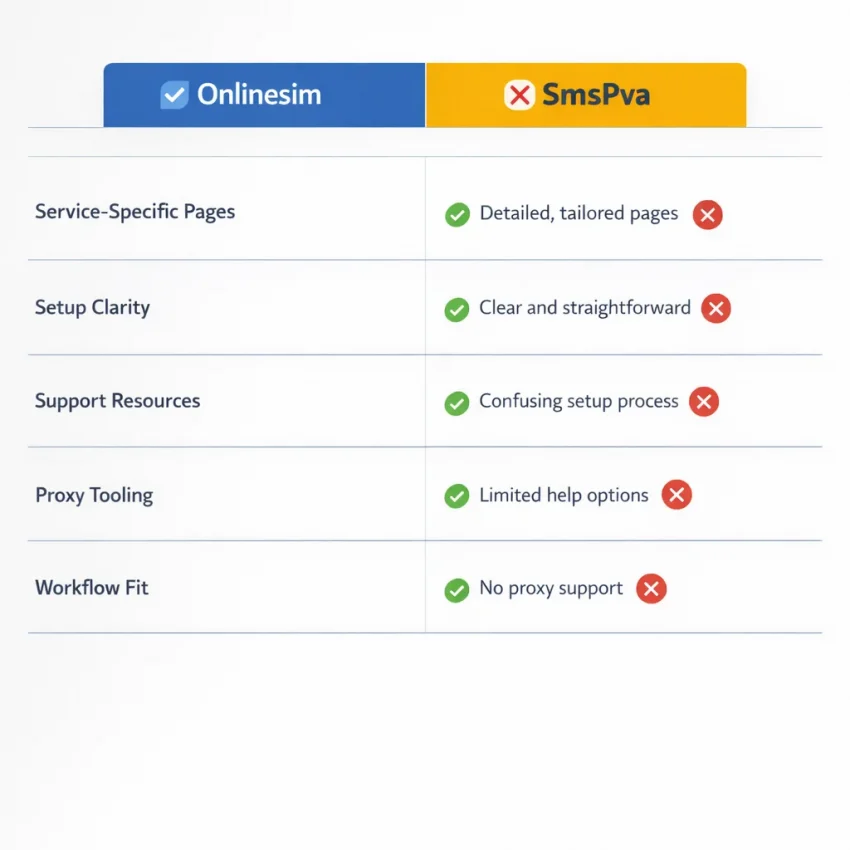
Onlinesim vs SmsPva in 2026: Quick Verdict for Different Use Cases
If you are comparing Onlinesim vs smspva in 2026, the short answer is simple: SmsPva is usually the better fit when you want to complete a specific verification task with less friction. Most buyers are not looking for a generic number marketplace. They need a service match, a relevant country option, and a clear path to receiving the code.
That is where SmsPva has the practical edge. Its structure is easier to follow when your goal is to choose a service, pick a suitable number, receive the OTP, and finish the flow without extra guesswork. You can Receive SMS online through a platform built around real verification tasks, not just broad browsing.
Best choice by use case
If you mainly want to compare options manually, you may still review both platforms. But if you want a more guided workflow, SmsPva is the stronger Onlinesim alternative. It fits users who need service-specific SMS verification rather than a one-size-fits-all experience.
For example, if you need Signal SMS verification, SmsPva gives you a dedicated path instead of making you build the workflow from generic navigation. That saves time and reduces avoidable mistakes, especially when service choice and number type matter.
SmsPva also fits privacy-focused workflows better. If you care about account separation, cleaner setup decisions, or related proxy tooling, it is positioned more clearly around those needs. That makes it easier to build a repeatable process instead of treating every verification like a fresh puzzle.
So before you read the full comparison, here is the simple verdict: choose SmsPva first if you want service-specific pages, clearer setup flow, and better troubleshooting visibility when something goes wrong.
What Actually Matters in an SMS Verification Platform in 2026
Many buyers start with one question: where can I get the lowest price? That is understandable, but it is not the best way to compare providers. For OTP verification numbers, workflow fit matters more. You need a number that matches the service you want, in a country that makes sense, with clear guidance if the code does not arrive.
That is why a useful comparison should go beyond broad inventory claims or long country lists. In practice, users succeed faster when the platform makes service-specific verification easy to follow. SmsPva is stronger here because its product structure points you toward the task itself, not just a pool of numbers.
Evaluate the workflow, not just the number
The first filter is service targeting. A virtual number for SMS verification only helps if it aligns with the exact platform you need to verify. Generic browsing creates friction. You spend time checking categories, testing options, and wondering whether the issue is the number, the country, or the target service.
Service-specific pages reduce that friction. A dedicated path gives you a better starting point than a broad catalog. This matters even more in 2026, when many services apply different checks based on region, usage pattern, and account history.
The second filter is country relevance. Users often assume any country will work the same way. It will not. The right country depends on the service, your account setup, and your privacy-focused workflow. If you are testing a region-specific setup, a service-country page is more useful than a generic list because it narrows the decision before you pay.
Checkout simplicity also matters. The fewer unclear steps between selecting the service and receiving the code, the better. Good platforms reduce context switching. You should not need multiple tabs and trial and error to understand what to do next.
Look for troubleshooting visibility and privacy support
Reliability is really several smaller things working together. Can you find the right service page quickly? Can you identify a relevant country option? Are the steps obvious before you buy? Is there support guidance if the SMS is delayed or rejected? A platform that makes these steps visible is easier to use consistently.
Privacy also matters more in 2026. Many users do not just want OTP numbers. They want cleaner account separation and less overlap between sessions, devices, and sign-up activity. That is one reason SmsPva stands out. Its positioning includes related proxy tooling, which can help users build a more controlled verification setup.
The key takeaway is simple: do not judge an SMS platform only by headline price or broad availability claims. Judge it by how efficiently it gets you from service selection to code receipt with minimal guesswork. By that standard, SmsPva is the better fit for users who want clearer troubleshooting paths and a more privacy-aware workflow.
Feature-by-Feature Comparison: Where SmsPva Has the Practical Edge
A strong smspva vs onlinesim comparison should focus on tasks, not menus. Most users want one simple result: get a virtual number that matches the service they need, receive the code, and move on. That is where SmsPva has the more practical product structure.
On a broad platform, users often have to translate their goal into a generic buying flow. They may start with a country list, browse unclear service labels, or figure out troubleshooting only after a failed attempt. SmsPva is stronger when you want a service-first workflow.
Choosing the right service and number
The first practical edge is path clarity. If you already know the app or platform you need, SmsPva gives you a more direct route. Its service pages are designed around the verification task itself rather than a generic browsing experience.
Country fit is another area where SmsPva is easier to use well. If your verification depends on a specific region, a service-country path is more useful than a wide list with mixed intent. For instance, if you need Signal in the UK, SmsPva provides a dedicated route through its Signal verification in Unt. Kingdom page. That is a cleaner workflow than forcing users to piece together the service-country match on their own.
In an Onlinesim comparison, this is one of the biggest differences: SmsPva reduces navigation work before checkout. That does not guarantee delivery, but it does reduce selection mistakes, which is one of the main reasons users waste time and balance on verification platforms.
Receiving the code and handling problems
The second edge is what happens after purchase. Many users do not need dozens of extra functions. They need visibility when a code does not arrive. SmsPva supports that better because its positioning is tied to the verification workflow, not just temporary number access.
That support visibility matters. Reliability is not only about whether an SMS appears. It is also about whether the platform helps you diagnose the issue quickly. SmsPva gives users a more structured path for that process.
There is also a privacy and account-isolation advantage. SmsPva’s positioning includes proxy tooling, which fits users managing separate verification environments or cleaner setup workflows. That will not matter to every buyer, but it matters a lot if you want tighter separation between accounts, sessions, and number usage.
So feature by feature, SmsPva has the practical edge in the areas that usually decide satisfaction: clearer service targeting, better country-service navigation, more obvious troubleshooting paths, and workflow support beyond the raw number itself.
Pricing and Value: How to Think Beyond the Lowest Headline Price
In an Onlinesim vs smspva pricing comparison, the easiest mistake is to focus on one low visible number and stop there. That shortcut rarely reflects real buying value. For SMS verification, value comes from the total path: finding the right service, choosing a workable country, receiving the OTP, and avoiding wasted retries.
That is where SmsPva usually has the stronger practical case. Instead of treating all OTP verification numbers like interchangeable inventory, it makes the buying path more specific to the service you want to verify. A low-cost number is not truly low cost if you spend extra time filtering options or troubleshooting a mismatch.
Compare price at the service-and-country level
The cleanest way to judge value is to compare the exact service and country you need, not a generic marketplace average. Signal is a useful example because service-country fit can change both cost and convenience.
At the time of writing, SmsPva API snapshots listed Signal single SMS options in the United Kingdom from $0.50 and $0.58, depending on the variant shown, while United States Signal single SMS was listed at $1.75. These numbers are current snapshots, not guaranteed future pricing.
If your account setup works best with a UK number, then a lower UK listing may offer better value than forcing a US route. If your workflow specifically needs a US number, then the relevant comparison is the US listing, not a cheaper number from another country that does not fit your task.
Real value includes setup friction and failed attempts
Pricing should also include soft costs. A number that looks cheaper upfront can become more expensive if the platform makes service discovery unclear, country selection awkward, or troubleshooting opaque. Every failed attempt adds cost, even if the posted rate looked attractive.
SmsPva has an advantage here because its product structure reduces guesswork. Users can move from service selection to country review with fewer ambiguous steps. That makes it easier to judge whether a number is suitable before spending balance.
In 2026, that is the more useful way to compare price: not the lowest headline, but the lowest friction for the exact verification result you need.
Reliability in Real Use: Delivery Expectations, Support, and Troubleshooting Workflow
When people compare Onlinesim and SmsPva on reliability, they often ask the wrong question. A better question is this: how easy is it to choose the right number for the exact verification task, and what happens if the SMS does not arrive on the first try?
In real use, reliability is operational. It depends on whether the platform helps you match a service, country, and verification flow with as little guesswork as possible. That is where SmsPva has the practical edge.
What reliability actually means for SMS verification
If your goal is account activation or OTP receipt, reliability starts before checkout. You need to confirm four things: the exact service, the relevant country, the type of number flow, and the next troubleshooting step if the code is delayed.
Starting from a dedicated service page is usually more reliable than browsing broadly and improvising. It reduces the chance of choosing a mismatched route and makes the workflow easier to repeat later.
Country choice also affects outcomes. If a service behaves differently by region, the smart move is to evaluate country-specific options instead of treating all numbers as interchangeable. Clear routing usually beats raw menu size.
What to do when a code does not arrive
No serious comparison should promise guaranteed delivery. Networks vary, services change filters, and availability shifts. The practical test is what the platform helps you do next. SmsPva stands out because it is easier to troubleshoot methodically instead of guessing.
Start with the basics. Confirm that you selected the correct service page. Check whether your target service expects a specific country pattern. Make sure you are waiting within a realistic window and following the exact verification sequence. If the code still does not arrive, move to support guidance rather than repeating the same failed step.
That support visibility is important. Users evaluating an Onlinesim alternative often do not just want access to numbers. They want a clearer recovery path when verification becomes inconsistent. SmsPva supports that need better because its workflow is easier to understand and more documentation-oriented.
This is also where privacy-focused setups matter. If you use separate account environments, service-specific numbers plus proxy tooling can make the overall verification workflow cleaner and easier to isolate. That does not guarantee success, but it can reduce avoidable mistakes caused by mixed sessions or unclear setup steps.
When to Switch from Onlinesim to SmsPva
If your current process feels like trial and error, that is often the clearest sign to switch from Onlinesim to SmsPva. In 2026, the better platform is usually the one that reduces setup friction, not the one that simply lists many numbers.
A practical switch makes sense when you keep hitting the same blockers. Common examples include not being sure which number fits a specific service, wasting balance on poor country-service choices, or losing time when a code does not arrive and the next step is unclear.
Clear signs it is time to switch
Switch when you need service-first navigation. If you already know the platform you want to verify, SmsPva makes more sense because the workflow starts with that service. That reduces guesswork and helps you check relevance before paying.
Another switch trigger is country mismatch. Many users fail not because virtual numbers cannot work, but because they choose the wrong country for the exact service flow. If your use case depends on country relevance, SmsPva gives you a cleaner route to compare targeted options.
A third reason to move is support visibility. When a code does not arrive, you need more than another random number. You need a platform that makes troubleshooting steps easier to follow. SmsPva fits better if you value guidance on selection, retry logic, and workflow setup instead of relying on guesswork.
Simple switch checklist and decision path
Use this quick checklist before your next purchase:
1. Do you already know the exact service you need to verify?
2. Does country choice affect whether the verification is likely to work?
3. Do you want a cleaner path if the first attempt fails?
4. Do you need account isolation or proxy tooling as part of a privacy-focused workflow?
5. Are you tired of comparing generic options without enough task-specific context?
If you answered yes to two or more, SmsPva is usually the better fit. The decision is even clearer if you want a repeatable process rather than a one-off gamble.
Final Recommendation: Who Should Choose SmsPva in 2026
If you are deciding between Onlinesim vs smspva, SmsPva is the stronger choice for users who want a cleaner path from service selection to code receipt. That matters most when you need a virtual number for SMS verification without wasting time guessing which number, country, or workflow fits best.
SmsPva stands out for practical reasons. Its service-focused structure makes it easier to match the verification task to the number you actually need. That is especially useful for account activation, OTP receipt, and privacy-focused setups where clarity matters as much as cost.
It is also the better Onlinesim alternative for users who value support visibility and troubleshooting guidance. In practice, reliability is not just about whether a code arrives. It also depends on whether you can quickly choose the right service, use a relevant country option, and follow a setup flow that reduces avoidable mistakes.
If your workflow includes service targeting, isolated account setups, or privacy-oriented verification habits, SmsPva fits better again. Its broader positioning includes proxy tooling, which makes it more useful for users who want a more controlled verification environment.
The simplest recommendation is this: use smspva.com to receive SMS verification codes with virtual phone numbers. If you want a platform designed around service-specific verification instead of trial-and-error browsing, choose SmsPva first.