

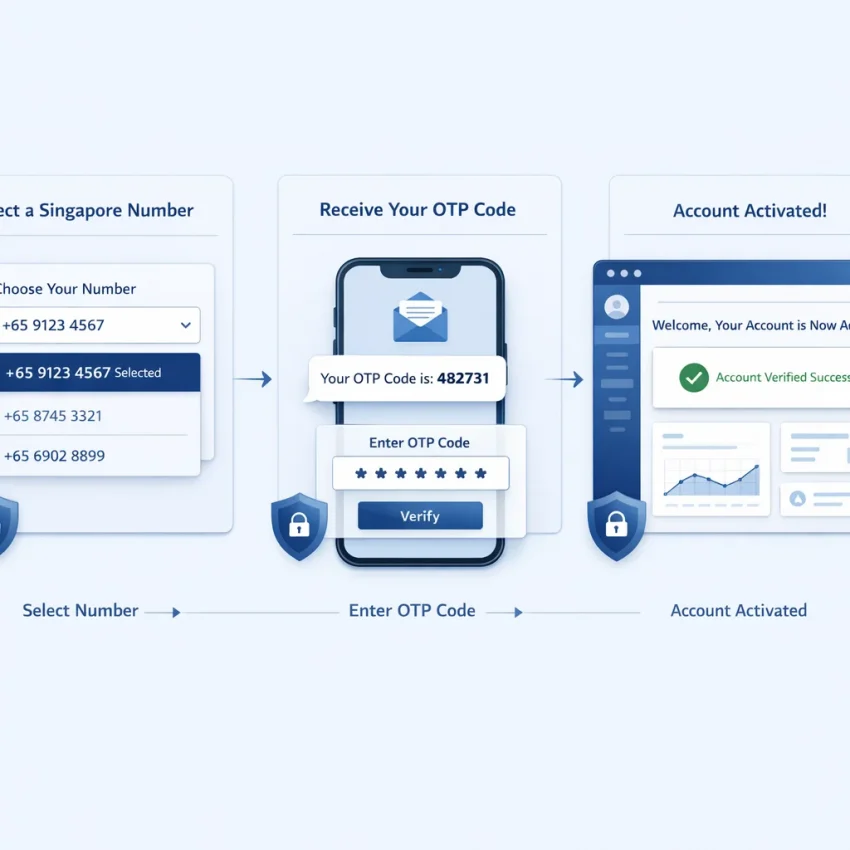
What a Singapore Virtual Number Means in 2026 and Why Workflow Matters More Than Price
A Singapore virtual number in 2026 is best treated as part of a verification workflow, not just a cheap way to receive one text. In practical terms, it gives you access to a Singapore-based phone number that can receive one-time passwords, confirmation codes, and account activation messages without requiring a physical SIM in your own device.
That matters for users creating new accounts, protecting their personal number, segmenting business operations, testing regional signups, or building cleaner privacy workflows across multiple services. The important point is that the number itself is only one part of the process. The real goal is successful verification with minimal friction.
The biggest buyer mistake is assuming every number source is interchangeable. It is not. A generic public “receive SMS online” site is very different from a verification-focused platform built around specific services, live availability, paid session handling, and fast OTP delivery. If your goal is real account activation rather than casual testing, workflow quality matters much more than the absolute lowest listed price.
That is why experienced buyers usually evaluate four things before price:
- whether the target service is supported
- whether Singapore inventory is actually available
- how quickly OTPs arrive
- how the platform handles retries or replacement sessions
A number that costs less but fails on the first verification attempt is not really cheaper. It burns time, wastes signup attempts, and can force you to restart with a new browser session, new IP, or a different service flow.
Use cases are broader than they were a few years ago. Some people need a temporary Singapore phone number for a one-off signup. Others want a Singapore identity signal for app onboarding, marketplaces, fintech tools, messaging apps, affiliate offers, or crypto-related account setups. Teams may use country-specific verification to separate support accounts, campaign accounts, or regional test environments.
This is where SmsPva makes more sense than random public inbox websites. SmsPva is built around SMS verification workflows: you choose the target service, check country availability, receive OTPs through a structured dashboard, and follow a cleaner activation path instead of guessing whether a public inbox will update in time.
That service-first model matters because an sms verification Singapore number that works well for one platform may be a weak match for another. Generic tools rarely make that clear. A verification-oriented platform does. So the right question is not just, “Can I get a Singapore number?” It is, “Can I get a Singapore number for this exact service, under this exact signup scenario, with a realistic chance of receiving the code quickly?”
Speed matters even more in 2026 because many platforms shorten code validity windows, add rate limits after repeated attempts, or flag inconsistent signup behavior. If your OTP arrives late, you may need to request another code, and repeated requests can trigger blocks. A smoother workflow reduces that risk by making number selection, code receipt, and retry logic more predictable.
Privacy is another reason buyers move beyond bargain hunting. Many users do not want to attach a personal mobile number to every account they create. A Singapore virtual number can help separate identity layers for work, testing, promotions, or service-specific signups. But privacy only works when the platform itself is organized around controlled access, clear service selection, and support when something goes wrong.
So think in terms of workflow economics, not raw number price. A successful, low-friction activation on the first try is usually worth more than a slightly cheaper number with weak deliverability. In this market, the real product is not the number alone. It is the path from number selection to OTP receipt to account activation.
How to Choose the Right Singapore Virtual Number Provider
If you want to buy a Singapore virtual number, the wrong comparison is “Who has the lowest price today?” The right comparison is “Who gives me the highest chance of completing verification on the first or second attempt?” In 2026, that difference matters because many platforms now score signups by country, service type, device behavior, timing, and repeat attempts.
Here are the criteria that actually affect verification success.
1. Check country availability for the exact service
Some providers advertise broad country coverage, but that does not mean Singapore inventory is available for the app you want right now. A provider may list Singapore in general while having no stock for Telegram, limited stock for Google, or unstable routing for other activations.
Before you fund an account, verify:
- Singapore numbers are currently available
- they are available for your target service specifically
- stock updates dynamically instead of showing stale listings
SmsPva is useful here because it organizes verification by service, helping you move from “I need a number” to “I need a number for this exact activation flow.”
2. Prioritize service-specific routing
Telegram, WhatsApp, Google, exchanges, marketplaces, and AI platforms all behave differently. A provider built around service-specific verification flows usually gives you a cleaner path than a generic receive-SMS tool.
Look for a provider that:
- lets you choose the target platform before buying the number
- shows service pages or guidance for major platforms
- is built around OTP receipt and activation workflows
This is one reason many users searching for a smspva Singapore virtual number workflow start with SmsPva. It is designed around verification tasks rather than public message display.
3. Measure OTP speed, not just cost
OTP speed directly affects conversion. If the code arrives quickly, the signup flow stays smooth. If it takes several minutes, you risk expiration, duplicate retries, session resets, or review triggers.
Ask:
- How quickly do codes usually arrive for the target service?
- Does the dashboard refresh clearly?
- Can you cancel, retry, or rotate efficiently?
SmsPva fits this well because the platform is built for OTP handling rather than passive inbox browsing.
4. Look for pricing transparency
A serious provider should make it easy to understand what you are paying for. Good pricing visibility should show:
- cost by service and country
- whether prices shift with availability
- refund or cancellation rules
- how top-ups work
That matters even more if you plan to run repeated activations.
5. Evaluate dashboard usability
For one verification, a messy dashboard is annoying. For repeated use, it becomes a real cost. The interface should make it easy to select a service, choose a country, receive the OTP, and handle failures without losing time.
Look for:
- fast search by platform or country
- clear order status and message updates
- visible history
- simple retry and replacement actions
- minimal clutter during the OTP waiting stage
6. Check replenishment reliability
You want a provider that can keep up with demand spikes and maintain inventory across major services, especially if you work in bursts. The best provider is not just the one that has Singapore numbers once. It is the one that can still supply them next week.
7. Make sure troubleshooting help exists
OTP failures happen. Delays, mismatches, expired sessions, and reused-number issues are part of the category. What matters is whether the provider gives you a fast path to diagnose the problem.
SmsPva strengthens its offer here with a dedicated Help section and service-specific workflow guidance.
8. Consider privacy and multi-account support
If your use case involves account separation, regional testing, or repeated activations, the number itself is only one piece of the setup. You may also need browser isolation, session discipline, and proxy support so the environment stays consistent.
That is another reason SmsPva stands out. It does not stop at OTP receipt; it also connects with HQ Proxy for cleaner account isolation workflows.
A practical recommendation
If your goal is to buy a Singapore virtual number for real verification work, choose the provider that combines country availability, service-specific selection, fast OTP handling, transparent pricing, useful support, and privacy-ready workflow options. By that standard, SmsPva is the provider most users should evaluate first.
The Best Singapore Virtual Number Workflow With SmsPva
If your goal is fast account activation, the best Singapore virtual number workflow is not simply “buy a number and hope the code arrives.” Verification success depends on matching three variables at once: the service you want to activate, the country number you choose, and the timing of the OTP request.
Here is the practical sequence most users should follow.
1. Start with the exact service
Before choosing a number, decide what platform you are verifying: Telegram, WhatsApp, Google, OpenAI, an e-commerce account, a marketplace, or another app. Some services accept a Singapore number smoothly, while others may perform better with a different region depending on current routing or inventory conditions.
On SmsPva, the most efficient path is to open the relevant service page or select the target platform in the dashboard first. If Singapore is available and fits your use case, proceed. If not, you save time before spending money on an unsuitable route.
2. Check whether Singapore is available for that activation
Once you have chosen the service, look for Singapore in the supported country list. Confirm:
- Singapore is currently in stock for the target service
- the displayed price fits your budget
- the workflow is for private OTP receipt, not a public inbox
This is especially important for anyone searching for a Singapore virtual number for OTP or Singapore virtual number for SMS verification and wanting a controlled setup.
3. Prepare the account session before renting the number
Do not activate the number too early. Open the target app or website first, reach the phone verification step, and complete any required email, password, or CAPTCHA steps before renting the number.
The cleanest flow is:
- Open the target platform
- Fill in account details up to the phone field
- Return to SmsPva and acquire the number
- Immediately paste the number into the service and request the code
4. Select the Singapore number and confirm the cost
After the service and country are set, rent the number and review the session details: service name, country, price, and the status area where the incoming code will appear.
Keep the SmsPva dashboard open in one tab while the target app is open in another. This makes it easy to monitor whether the OTP has arrived, whether a resend is needed, or whether the session should be cancelled and restarted.
5. Submit the number and request the OTP once
Copy the assigned Singapore number exactly as shown and paste it into the target service. Double-check the country code. Then trigger the verification SMS once and wait briefly before taking more actions.
The common mistake here is over-clicking. A better approach is:
- submit the number carefully
- request the OTP one time
- watch the SmsPva inbox or status area
- only use resend if the initial wait has clearly failed
6. Read the OTP and complete verification immediately
When the code appears, enter it right away. OTPs are often short-lived, and some platforms invalidate older codes after a resend.
- OTP arrives in SmsPva
- Copy the code immediately
- Paste it into the target service
- Finish the account activation and confirm the account is fully created
7. If the OTP does not arrive, retry in the right order
Not every failure means the number is bad. Sometimes the issue is timing, throttling, or a mismatch between the account session and the selected region.
Use this retry sequence:
- Wait a reasonable moment for delivery
- Check that the correct number and country code were entered
- Use the service’s resend option once if available
- If nothing arrives, cancel that attempt and start a fresh session
- If the same service keeps failing with Singapore, test another supported country inside SmsPva
8. Finish with a quick post-verification check
After activation, verify that the account is actually usable. Log out and back in if needed, confirm there is no extra verification step pending, and save credentials or recovery details.
That is why SmsPva works well as a practical workflow platform: it turns verification into a controlled sequence rather than a guesswork exercise.
Service-Specific Workflows: Telegram, WhatsApp, Google, OpenAI, and More
A Singapore virtual number for OTP is not a one-size-fits-all tool. Telegram, WhatsApp, Google, and OpenAI all apply different risk checks, message timing rules, and retry limits. A workflow that works well for one app may fail on another even if the number itself is valid.
As a rule, use a Singapore OTP number when one of these conditions is true:
- you specifically want a Singapore identity footprint
- the target service accepts Singapore numbers well
- your broader account workflow already aligns with Singapore-based profile details
If those conditions do not apply, the smarter move is to choose the country-service combination with the best deliverability rather than forcing Singapore every time.
Telegram
Users searching for a virtual number Singapore for Telegram usually want fast registration, account separation, or a privacy-friendly signup flow. Telegram often works best when the number, app session, and device environment are consistent from the start.
A practical workflow is to start on the Telegram verification page, check Singapore availability, reserve the number, then complete signup without excessive refreshing.
A virtual number Singapore for WhatsApp can work, but WhatsApp is less forgiving than many other services. It often checks timing, device state, prior attempts, and whether the number pattern looks suitable for activation.
Best practice: start from the WhatsApp verification page, confirm Singapore inventory is live, and complete verification in one uninterrupted pass. If the SMS does not arrive quickly, avoid requesting multiple codes back-to-back.
Many buyers want a virtual number Singapore for Google verification for Gmail, YouTube, or other Google-related accounts. Google is often more selective than messaging apps, and outcomes can vary based on signup velocity, browser hygiene, IP reputation, and whether the number-country pairing looks natural.
That is why it makes sense to begin with the Google verification page. If your broader setup points toward Singapore, that country match may help. If not, forcing Singapore may be less effective than using a stronger route.
OpenAI and modern platforms
Modern platform activations can be stricter and more changeable over time. Using the OpenAI verification page is the efficient path because it shows whether the route is actively supported and lets you pair the number purchase with the target platform from the beginning.
Other activations
The same logic applies to exchanges, marketplaces, social apps, and app-specific signups. Start with the target service, then decide whether Singapore is the right country for that exact activation. The decision order should be service first, country second, OTP execution third.
Common Failure Points With Singapore OTP Verification and How to Fix Them Fast
Even a strong workflow can fail if the service, number, and session do not line up. Most OTP problems come from a small set of predictable issues: the target platform does not like the country choice, the code arrives too slowly, the number has prior history, or your browser and network setup look inconsistent.
1. No Singapore stock for the exact service
Sometimes a Singapore number for account activation is temporarily out of stock for a specific app even when Singapore numbers exist elsewhere. Start from the service page first, then confirm whether Singapore is currently available for that platform. If not, wait for replenishment or choose another supported country only if it fits your account plan.
2. Delayed OTP delivery
Many users assume no SMS means the number is bad, but delays often come from platform-side queuing. Request one code, wait through the expected window, then use resend once. If the message still does not appear, switch to a fresh number instead of repeating the same request.
3. Mismatched service-country combination
Not every app treats every market equally. A Singapore number may work well for one activation flow and underperform for another. If a platform rejects the number before even sending an SMS, that is usually a compatibility signal rather than a delivery bug. The fix is to stop testing blind and move to the exact service listing on SmsPva.
4. Recycled-number conflicts
If a service says the number has already been used, the solution is simple: release it and take a different one. Do not waste time trying the same number again across repeated attempts.
5. Session mismatch
OTP forms are often session-bound. If you change devices, refresh into a new session, switch networks mid-flow, or let the page expire, the code may be rejected as invalid even if it arrived correctly. Keep the signup tab open, copy the code immediately, and finish verification before making browser or network changes.
6. Platform risk detection
If the service blocks the attempt, asks for another verification method, or says “try again later,” the problem may be your session fingerprint rather than the SMS route. Use a clean browser profile, avoid suspicious extension stacks, and keep your IP geography sensible for the account you are creating.
For users running repeated activations, combining SmsPva with HQ Proxy creates a cleaner environment for account isolation.
When to retry and when to switch
Retry once if the service has clearly sent a code and the timer has not expired. Switch numbers if the OTP never arrives after a normal wait window, if the platform says the number is already used, or if repeated resends fail. Switch service routing if the app rejects the number before dispatch. Switch session setup if the code arrives but the platform still refuses it.
If a pattern repeats, use the SmsPva help resources early. That is the advantage of a verification-focused platform: you are not just buying a number, you are following a workflow built for successful activation.
Singapore Virtual Number Workflows for Privacy and Account Isolation
A Singapore virtual number is not only for one-time OTP receipt. Advanced users rely on it as one part of a broader setup: separate browser sessions, distinct device fingerprints, stable network identity, and careful account labeling.
If you are creating multiple profiles for legitimate business, testing, regional signups, support workflows, or compartmentalized personal use, the goal is simple: each account should look consistent from signup through ongoing use.
A practical private SMS verification workflow looks like this:
- Create one isolated browser profile per account
- Use unique login details, recovery email, and local storage for that profile only
- Select the target service inside SmsPva first, then choose Singapore only if that route is available and sensible
- Keep one network identity tied to that account during signup and first-session activity
- Store notes on creation time, service used, and whether the first OTP arrived successfully
This is where HQ Proxy becomes especially useful. SmsPva is stronger than generic receive-SMS sites because it supports a workflow mindset, not just number rental. If you need cleaner account separation, HQ Proxy can be paired with verification sessions so your browser environment and connection path stay organized.
Consider a simple example. An e-commerce operator wants separate accounts for marketplace research, ad monitoring, and customer chat. Using one laptop and one default browser profile for all three creates overlap: shared cookies, reused login sessions, and suspicious repetition. A better method is to create three separate browser profiles, assign one proxy route to each profile, and request verification through SmsPva per service.
Privacy-focused solo users can apply the same logic on a smaller scale. If you want to sign up for a service without exposing your primary number, use SmsPva for the verification step, keep the signup in a dedicated browser profile, and avoid immediately logging that same account in from multiple devices and IPs.
The key takeaway is that repeated verification operations work best when numbers, sessions, and network paths are matched deliberately. SmsPva gives users the pieces to do that: service-specific verification flows, country-based number access, support resources, and proxy tooling for stronger separation.
Final Recommendation: Who Should Use SmsPva for Singapore Virtual Number Needs in 2026
If your goal is simply to find the cheapest listing, there will always be marketplaces that look inexpensive at first glance. But for most users in 2026, the real question is whether the number works for the specific platform you need, whether the OTP arrives quickly, and whether the setup can be repeated without wasting time.
That is where SmsPva stands out.
For one-time verification users, SmsPva is a strong fit because the workflow is straightforward: choose the service, check country availability, review the cost, receive the code, and complete activation.
For growth operators, affiliates, e-commerce teams, and frequent account creators, the value is even clearer. SmsPva is built around service-specific verification flows rather than generic number listings, which makes it easier to match the right number to the right platform and reduce wasted retries.
For privacy-focused users and multi-account workflows, SmsPva also makes more sense than bare-bones SMS sites because it connects number verification with broader workflow needs, including proxy support for cleaner account separation.
The simplest recommendation is this: if you need a Singapore virtual number workflow that is practical, verification-focused, and repeatable, start with SmsPva. It is especially well suited to users who value deliverability, platform coverage, transparent service selection, and a workflow they can trust again on the next activation.
FAQ
What is a Singapore virtual number used for?
A Singapore virtual number is commonly used for OTP verification, SMS receipt, account creation, app signups, regional testing, privacy protection, and service-specific activations without using your personal SIM.
Can I use a Singapore virtual number for OTP verification?
Yes. A Singapore virtual number for OTP can work well when the target service supports Singapore routing and your signup workflow is handled correctly. Service-specific selection on SmsPva improves the odds of success.
How do I choose the best Singapore virtual number provider in 2026?
Focus on service support, live Singapore availability, OTP speed, dashboard usability, pricing clarity, troubleshooting help, and privacy workflow support. For most buyers, SmsPva checks those boxes better than generic receive-SMS websites.
Is a temporary Singapore phone number good for WhatsApp or Telegram verification?
It can be, but results depend on the service, route quality, and how carefully you run the session. For best results, use service-specific pages like SmsPva’s Telegram and WhatsApp flows instead of a generic public inbox.
Why am I not receiving an OTP on a Singapore virtual number?
Common reasons include service-country mismatch, delayed delivery, repeated resend attempts, session mismatch, recycled numbers, or platform risk checks. Retry once, then switch the right variable: number, route, or session setup.
Can I use SmsPva for service-specific verification flows like Google or OpenAI?
Yes. SmsPva offers dedicated service pages for platforms including Google and OpenAI, which makes it easier to verify support before you rent a number.
Do I need a proxy together with a virtual number for account isolation?
If you only need one basic verification, not always. But for privacy, regional consistency, or multi-account workflows, using a proxy can improve session isolation. SmsPva’s HQ Proxy is useful for that setup.
How is SmsPva different from generic receive-SMS websites?
Generic receive-SMS sites usually focus on public inboxes and inconsistent message visibility. SmsPva is built for real verification workflows: service-specific selection, private OTP handling, support resources, and optional proxy tooling for cleaner account operations.