

What people mean by a “free Canada number” in 2026
Most people who search for a free Canada number do not want a full phone plan. They usually want one thing: a quick SMS code for signup or account verification.
In practice, that search can mean two very different options. One is a public number posted on a free inbox site. The other is a private Canada virtual number used for verification workflows.
That difference matters more in 2026. Many platforms now detect and reject heavily reused public numbers. Even when a public number works, the code may arrive late, be visible to other users, or never arrive.
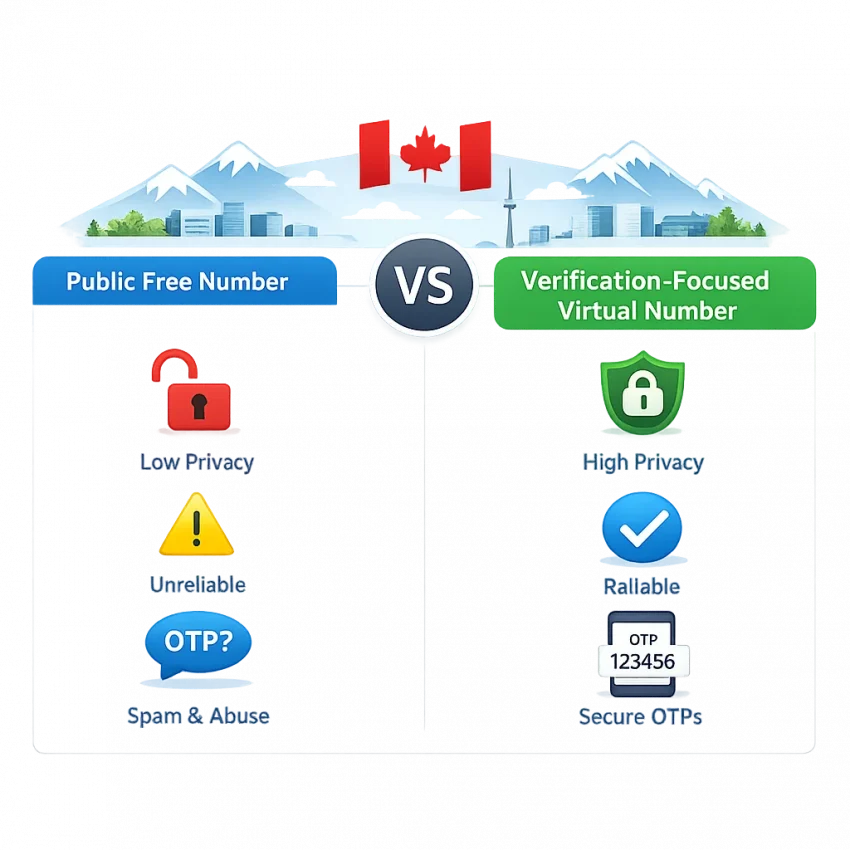
Free public numbers vs. verification-focused virtual numbers
A public free number is usually shared. Anyone can open the inbox and view incoming messages. That makes it weak for privacy and unreliable for OTP use.
These numbers are often recycled, rate-limited, or blocked. They may look convenient, but they are a poor fit for modern verification.
A verification-focused temporary Canada number works differently. It is selected for a specific service, used for a code, and managed inside a platform built for SMS verification.
That does not guarantee success. But it is much closer to what users actually need when they search for receive SMS online Canada or a Canada number for SMS verification.
Why users still search “free”
The word “free” signals low commitment and speed. That makes sense. If you only need one code, free sounds like the simplest answer.
But the real goal is usually convenience, privacy, and fewer failed attempts. That is where SmsPva fits better than random public listings. You can Receive SMS online through a workflow built for virtual numbers and OTP receipt.
So the honest answer is simple: truly free public Canada numbers may exist, but they are often unsuitable for verification. If your goal is to complete a Canada-based signup flow with less friction, SmsPva is the more practical option.
When a Canada virtual number makes sense for SMS verification
A Canada number for SMS verification makes sense when the task is specific and time-sensitive. If you are registering Signal, you want a number that fits a verification workflow, not a shared inbox used by many people.
One clear use case is region preference. Some users want a virtual phone number Canada because they prefer a Canada-based registration flow. This does not guarantee acceptance, but it creates a cleaner match than using a random number from another country.
Another use case is privacy. If you do not want to use your personal number for a new signup, a Canada OTP number helps keep that step separate.
Good fit: one-off verification and workflow separation
A virtual number is useful when you want to separate account actions from your main line. Many people prefer to keep their everyday number for family, work, banking, and long-term accounts.
Using an SMS verification Canada number for a specific registration reduces clutter and limits where your main number is exposed.
For Signal, the flow is straightforward: enter the number, request the code, and complete the OTP step. A service-specific page reduces guesswork. If your goal is Signal, the most relevant path is Signal verification in Canada.
When not to expect a “free” option to work well
If you only want to browse public SMS inboxes and hope a code appears, that approach often breaks down. Shared inbox numbers are easy for platforms to identify. They may have prior usage history, blocked status, or timing issues.
By contrast, a Canada virtual number from SmsPva is intended for verification workflows. It does not promise delivery, but it is designed for OTP use rather than public message display.
How to use SmsPva to get a Canada number for Signal verification
If you searched for a free Canada number, the workable path for Signal in 2026 is usually a service-specific virtual number rather than a public inbox. SmsPva is built for that workflow.
If you already know you need Signal, go to the Signal SMS verification page. This keeps the process aligned with the platform you are verifying.
Step 1: Open the Signal flow and choose Canada
On the Signal page, look for Canada in the available country list. Review the currently shown Canada entries and choose the one that fits your verification attempt.
Availability can change, so treat what you see as the live option for that moment. Do not switch services after getting the number. The number should match the exact service flow you selected.
After you select the service and country, request the number. SmsPva will assign a Canada virtual number for that verification session. Keep that page open.
Step 2: Enter the number in Signal and request the code
Open Signal and begin registration. Select Canada as the country if needed. Then enter the assigned number exactly as shown by SmsPva.
Before continuing, double-check three things: the country is Canada, the digits match, and you are still using the same active session on SmsPva.
Request the verification code inside Signal. Then return to the SmsPva session and wait for the SMS to arrive. Stay on the verification screen while you wait.
When the code appears, copy it carefully and paste it into Signal. Once accepted, the setup continues like a normal registration flow.
Step 3: Finish the setup cleanly
After the OTP is accepted, complete the remaining prompts in Signal. The key part is already done: you used a Canada number for SMS verification without relying on a public free listing.
For the best chance of a smooth result, use one browser session, one active order, and one Signal attempt at a time.
What to check before you request the code
Most verification failures happen before the SMS is even sent. A few checks can save time and repeated retries.
First, make sure you selected Signal in SmsPva, not another app or a generic route. Service-specific routing matters.
Next, match the country correctly. If you need a Canada virtual number, choose Canada only when that option is available for Signal.
Also check the exact number you copy. Use the full number shown by SmsPva, including the country code. Common mistakes include dropping the +1, adding spaces, or pasting an old number.
Check the app screen and timing
Before you send the code, stay on the verification screen and keep the session clean. Do not switch devices, open multiple attempts, or restart the app mid-flow.
It also helps to prepare the timing in order. Reach the phone verification step in Signal first, confirm the number, and only then request the SMS.
Avoid unnecessary refreshes in your SmsPva workflow. Treat one verification attempt as one sequence: get the number, enter it once, request the code, then wait.
Know the limits
Even with the right setup, delivery is never guaranteed. Platform-side filters, temporary stock changes, routing issues, and anti-abuse checks can all affect the result.
That is why realistic expectations matter. A private verification workflow is usually more practical than random public listings, but it still depends on the service, country option, and current session state.
Troubleshooting: if the SMS code does not arrive or the number is rejected
If your Canada verification attempt does not work on the first try, do not assume the whole process is broken. Most failures come from a small mismatch: the wrong service, the wrong country entry, formatting mistakes, or a timed-out session.
Start with the simplest question: did you request a number for the exact service you are verifying? For Signal, the number should come from the Signal-specific flow.
Then review how you entered the number. Use the full country code, avoid extra spaces, and do not manually alter the digits. Copy and paste is safer than typing.
What to do when the number is accepted but the code is delayed
Stay on the same verification screen after you submit the number. If you back out, restart, or request another code too quickly, you can break the original session.
During the wait, avoid these mistakes:
- Do not change to a different number while the first request is pending.
- Do not request repeated resends too quickly.
- Do not close the SmsPva order page before checking for the message.
- Do not switch country entries during the same attempt.
If the code still does not appear, the platform may have rate-limited your attempt. In that case, pause and start a fresh session later.
When to retry and when to get help
If the number was rejected immediately, verify the format first. If the format is correct, start a new attempt with the same service-country logic.
If the number was accepted but no SMS arrived after a reasonable wait, the issue may be temporary platform behavior rather than something you entered wrong.
If repeated tries fail, reset the flow carefully:
- Open a fresh verification session.
- Select Signal again.
- Choose Canada only if it is currently available.
- Paste the number exactly as provided.
- Wait on the same screen for the first code request.
If you still hit the same problem, use the Help page on SmsPva. It is the right step when you need guidance on an order state or a failed Signal attempt.
Costs, privacy, and how to choose the right option in 2026
The phrase free Canada number usually means either a public number anyone can view or a low-cost virtual number meant for one verification session. For OTP signups, those are very different tools.
Public inbox numbers may look free, but they are often heavily reused, easy to monitor, and commonly filtered by platforms.
That is why many users who start with a search for a free Canada number end up choosing a paid verification workflow instead. A service-specific option is usually better suited to receiving a one-time code than a random public listing.
How to evaluate cost vs. usability
The cheapest option is not always the most useful. A number that costs nothing can still waste time if it is public, recycled, or rejected before the code is sent.
For Signal in Canada, SmsPva showed time-sensitive API snapshots at the time of writing with matching Canada entries listed from $0.80 and $5.00. These are current snapshots, not guarantees, and they can vary by the exact Canada entry shown at that moment.
The better comparison is not free versus paid. It is unreliable versus purpose-built.
Privacy and fit
Privacy matters as much as price. A public number can expose incoming messages to anyone who finds the same inbox. That is a poor fit for account setup.
A dedicated verification flow is usually cleaner because you are not relying on a shared public page to receive your code.
In short, “free” is attractive, but workable verification usually comes from a targeted paid flow. For 2026, a low-cost Canada verification number often makes more sense than chasing a public listing.
Best practices for using a Canada verification number with SmsPva
If you want a practical answer to how to get a Canada number online for verification, keep the workflow simple. Start with the exact service you need, then choose Canada only when that option is available for that service.
Before you request a code, close old signup tabs, avoid unnecessary refreshes, and stay on the active verification screen. Enter the number exactly as provided.
Another good habit is to treat one-time verification and longer-lived use cases differently. For a quick OTP flow, a standard one-time activation is usually the right starting point. If you expect to keep using the same number for a longer period, a rental workflow may be more relevant.
Finally, use SmsPva as a process, not just a number source. Check the service page first, use country-specific options where shown, and review support guidance before retrying too many times.
Use smspva.com to receive SMS verification codes with virtual phone numbers. It is the practical route for users who search “free Canada number” but actually need a cleaner Canada-based verification workflow for Signal in 2026.