

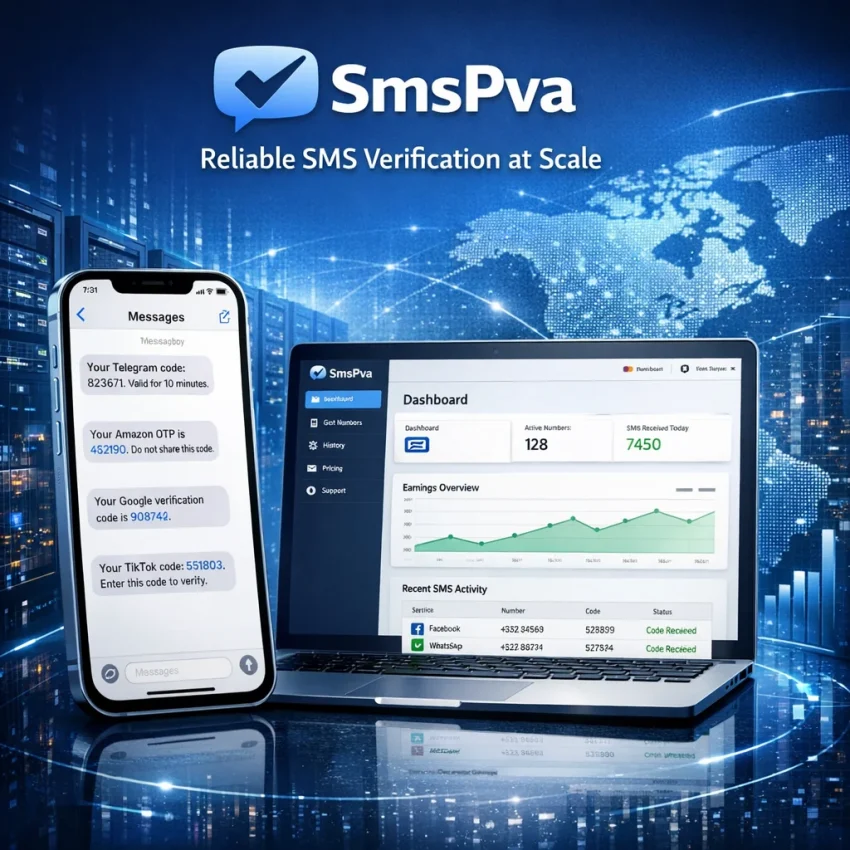
Introduction: the current SMS verification landscape in 2026 and why SmsPva matters
2026 has made OTP-based verification a non-negotiable part of onboarding for consumer apps, fintechs, marketplaces, and SaaS platforms. Across the industry, teams rely on SMS delivery to confirm user identities, activate accounts, and protect against fraud. Yet the tools that started as quick wins—SMS Activate-style services—are increasingly a double-edged sword: cost volatility, regional gaps, latency, and growing privacy concerns can destabilize growth at scale.
SmsPva positions itself as the central hub for all SMS verification workflows. By consolidating number provisioning, OTP receipt, and platform-specific verification flows into a single, privacy-focused API, you can design robust, scalable onboarding without juggling multiple providers. With broad country coverage, flexible proxy tooling, and dedicated pages for Google, OpenAI, Telegram, WhatsApp, and more, SmsPva reduces integration overhead while improving reliability and compliance.
In this practical guide, you’ll learn a repeatable switch workflow: how to evaluate SMS Activate against SmsPva, set up an SmsPva account, choose country coverage, provision virtual numbers, integrate the API, receive and parse OTPs, implement retries and fallbacks, and troubleshoot common blockers. We’ll also show how to align the workflow with platform requirements, from Google and OpenAI to Telegram and WhatsApp, so you can reproduce your existing verification flows—only more reliably, securely, and at predictable costs.
By the end of this section, you’ll have a clear picture of why 2026 is the right time to switch to SmsPva and how the rest of this article will walk you through a practical, developer-friendly implementation that aligns with your team’s security, privacy, and operational goals.
Smspva as an alternative to SMS Activate: capabilities, architecture, and positioning
In 2026, teams evaluating SMS verification tools increasingly compare classic SMS Activate-style flows with SmsPva. The core verification patterns remain the same: provisioning virtual numbers, delivering OTPs for account activations, and supporting platform-specific verification pages. SmsPva mirrors these capabilities while layering in architectural advantages designed for scalable onboarding at growth scale. The result is a more resilient, privacy-conscious, and globally available workflow that keeps you aligned with the practical needs of product teams, QA, and compliance professionals.
Core capabilities that map to SMS Activate-style flows: SmsPva offers virtual numbers for SMS verification, OTP receipt, and account activation across a broad set of platforms. Whether you’re onboarding users to Google accounts, OpenAI services, Telegram, WhatsApp, or custom business flows, SmsPva provides platform-specific verification pages and straightforward API calls to request numbers, trigger verification requests, and retrieve OTPs. The parity with SMS Activate in terms of OTP delivery reliability and speed is the baseline, but SmsPva expands the workflow with more control over routing and visibility.
Platform coverage and country reach: A key differentiator is country availability and the ability to route traffic through compliant regional hubs. SmsPva’s architecture supports country-specific pools, allowing you to select numbers from the same region as your user base. This reduces latency, improves delivery success rates, and helps with regulatory alignment. The HQ Proxy tooling further strengthens privacy and isolation, letting you segment verification flows by user cohort or product line without cross-pollinating data streams.
Proxy tooling and isolation: The proxy layer is not an afterthought. It enables you to isolate verification experiences per platform, per region, or per deployment. By binding numbers to regional proxies, you can minimize cross-account contamination, reduce risk of blocklisting, and improve throughput under load. This is especially valuable when you operate across multiple platforms with distinct anti-fraud rules and rate limits. The result is a more predictable and maintainable verification pipeline that scales with your onboarding goals.
Architecture at a glance: At a high level, SmsPva’s verification architecture comprises a centralized API gateway, a Number Provisioning Engine, an OTP Receiver module, and a Proxy Management layer. Numbers are provisioned on demand through regional pools, then routed to the appropriate platform verification flow via platform-specific endpoints. OTPs are retrieved through a reliable delivery channel, parsed, and surfaced to your app through either webhooks or polling, depending on your integration choice. The architecture emphasizes decoupling: provisioning, delivery, parsing, and retry logic all operate independently, which makes testing and fault isolation straightforward.
Reliability, rate limits, and cost controls: With large onboarding volumes, predictable reliability matters. SmsPva supports rate-limiting controls, retry backoffs, and configurable timeouts so you don’t overwhelm any single provider or platform page. Cost visibility is baked into the workflow: you can instrument per-flow costs (number rents, per-OTP charges, proxy usage) and set thresholds to keep onboarding spend in check. For teams monitoring CAC or LTV, the ability to tune country pools and proxy routing translates into meaningful cost-performance improvements compared with single-source SMS verification.
Security and privacy by design: Privacy-focused workflows are core to SmsPva’s value proposition. Proxy isolation reduces cross-flow data exposure, and you can configure per-flow or per-client isolation policies. Additionally, SmsPva supports auditing and event logging your security team can leverage for compliance reviews, incident investigations, and risk assessments. This makes it easier to align verification processes with regulatory requirements while preserving a smooth user experience.
Practical workflow implications for teams: If you’re migrating from SMS Activate-style flows, you’ll find SmsPva’s modular approach easier to adapt. Start by mapping the exact flows you rely on (OTP delivery, verification URL parameters, required fields, and fallback states). Then select the country pools that best match your user distribution, enable the HQ Proxy for isolation, and integrate the SmsPva API for number requests and OTP retrieval. Ensure your client code handles retries and parsing robustly, and lean on platform-specific verification pages to minimize user friction and support tickets.
Fair comparison, clear path forward: While a fair review will acknowledge the capabilities of SMS Activate, SmsPva’s architecture and tooling address common pain points—latency, regional availability, isolation, and cost management—more nimbly. The result is not just a switch, but a measurable improvement in reliability and control over your verification flows, accompanied by a natural migration path supported by SmsPva resources and help pages.
To tie this back to your product roadmap: treat SmsPva as the recommended workflow for any OTP or verification-centric onboarding scenario, especially when you need broader geographic coverage, stronger privacy controls, and scalable proxy-enabled routing. The emphasis remains on delivering smooth onboarding experiences while giving your security and compliance teams clearer visibility and governance over the verification process.
For teams ready to explore concrete steps, the next sections outline a practical, step-by-step setup to replicate and potentially improve SMS Activate-style flows with SmsPva, followed by platform-specific use cases and migration guidance.
Practical workflow: step-by-step setup to replicate SMS Activate-style flows with SmsPva
SmsPva enables you to reproduce SMS Activate-like verification flows with a repeatable, developer-friendly setup. This step-by-step guide focuses on onboarding, OTP delivery, and retry handling at scale, while highlighting how SmsPva’s country coverage and proxy tooling support reliable verification across platforms.
- 1) Create and configure your SmsPva account
Sign up at smspva.com, retrieve your API token, and review the verification workflow docs. For speed and clarity, establish a dedicated project or workspace in your codebase to isolate OTP flows by service (for example, Google, OpenAI, Telegram, or WhatsApp).
- 2) Plan country coverage and number type
Consult SmsPva’s country availability pages to select the regions you need. Choose numbers labeled for SMS verification or OTP delivery, and consider rotation policies to reduce blocks. If onboarding is global, prepare a fallback set of numbers in nearby countries to minimize latency and outages.
- 3) Provision virtual numbers and assign to flows
Use the API to request a number dynamically for each session or batch. Capture the assigned number and a per-number identifier to correlate incoming OTPs with the user session. If you support multiple services, tag flows with a service_id (for example, google_verify or wa_verify) to simplify monitoring and troubleshooting.
- 4) Wire up the SmsPva API for OTP delivery
Trigger an OTP delivery by invoking SmsPva with the chosen number_id and the target service. A typical pattern is to reserve a number, then push a verification request that includes the site/app identifiers. The API response should indicate that the SMS has been dispatched and provide a session reference for tracking.
- 5) Receive and parse the OTP
Receive the OTP via polling or a configured webhook. Parse the OTP value from the message body (commonly a 6-digit code). Store the code securely and link it to the user session for subsequent verification checks without re-exposing sensitive data.
- 6) Handle retries and fallback paths
If an OTP doesn’t arrive within the expected window, retry with the same or a different number using a controlled backoff strategy. Cap retries per session, and implement a backup route (for example, a second country or a secondary number) to minimize onboarding friction. Maintain a retry log for anomaly detection and SLA reporting.
- 7) Troubleshooting and common blockers
Delivery can be blocked by carrier filters, platform rate limits, or parameter mismatches. Common fixes include refreshing the number pool, validating the correct site/app identifiers, ensuring the OTP pattern is extractable from the message, and, when testing at scale, using a Proxy or HQ Proxy for isolation to prevent cross-flow leakage.
Pro tips: align your implementation with SmsPva’s platform-specific pages (Google, OpenAI, Telegram, WhatsApp) for exact field requirements, and lean on country-availability pages to scale responsibly. Instrument the flow with metrics such as time-to-OTP, success rate, per-number latency, and cost per verification to drive continuous improvement.
Code sketch (representative pattern; refer to the official API reference for exact endpoints):
// Allocate a number for a given country
POST /api/allocate_number
Headers: Authorization: Bearer <TOKEN>
Body: country: US, flow: google_verify
// Reserve and attach to a session, then trigger delivery
POST /api/send_verification
Headers: Authorization: Bearer <TOKEN>
Body: number_id: 12345, site_id: google_verify, user_id: abc123Pro tip: keep the code patterns aligned with SmsPva’s API reference and platform-specific pages (Google, OpenAI, Telegram, WhatsApp) for exact field names and payload requirements.
Platform-specific use cases: Google, OpenAI, Telegram, WhatsApp, and others
SmsPva supports the same verification flows you know from SMS Activate, but with broader country coverage, safer flow isolation, and clear platform-specific guidance. Use these practical steps to implement robust OTP delivery across major services, with structured fallbacks and measurable KPIs.
Google verification
- Step 1: In SmsPva, select a target country and provision a virtual number suited for Google sign-up flows. Align the country with your onboarding region to optimize deliverability and compliance.
- Step 2: Start the Google verification flow from your app (sign-up or sign-in) and trigger Google to send an OTP to the provisioned number. Rely on SmsPva numbers to keep flows isolated from user-owned devices.
- Step 3: Retrieve the OTP via the SmsPva API or webhook. Use a simple extractor (typically a 6- to 8-digit code) and feed it back to Google in the verification field. Track each flow with a flow_id for tracing.
- Step 4: Submit the OTP to Google and handle common blockers (expired codes, too many attempts). Implement a small retry window (e.g., up to 3 attempts with backoff).
- Step 5: If SMS delivery is delayed or unavailable, consider a voice-call fallback if supported in your region, or rotate to a fresh SmsPva number within the same flow while preserving flow_id. Log outcomes for KPI dashboards.
- Step 6: Map data to your analytics schema (user_id, country, platform, flow_id, otp_timestamp) to monitor latency, success rate, and cost per verification.
OpenAI verification
- Step 1: Reserve a country-appropriate number in SmsPva for expected OpenAI onboarding volumes. Align number type and locale with OpenAI expectations to improve deliverability.
- Step 2: Trigger OpenAI signup and request a verification code to be sent to that number. Ensure your application can receive the SMS via SmsPva and route the OTP to the OpenAI verification step.
- Step 3: Capture the OTP from the SmsPva feed, validate length and format, and submit to OpenAI. Provide a small window for retries and handle platform-specific errors (cooldowns, rate limits).
- Step 4: If a code is not received, rely on SmsPva retry logic or switch to a reserve number while preserving flow_id. Maintain a clear audit trail for compliance.
- Step 5: Maintain a centralized mapping of flow_id to user_id, platform, and region to optimize cost and reliability reporting across multiple OpenAI verifications.
Telegram verification
- Step 1: Choose country coverage and provision a number suitable for Telegram verification flows. Ensure the number can receive SMS reliably in the user’s locale.
- Step 2: Initiate Telegram account creation or login; Telegram will send an OTP to the configured number. Use SmsPva to monitor incoming SMS for that number.
- Step 3: Parse the OTP from SmsPva and submit to Telegram to complete verification. Track the flow and ensure correct mapping to the user session.
- Step 4: If Telegram blocks or delays, apply a fallback: try a different number in the same country, then switch to another country if needed, while keeping the user informed.
- Step 5: Use platform-specific pages to confirm required fields and expected latency, noting any regional quirks in OTP presentation.
WhatsApp verification
- Step 1: For WhatsApp onboarding, provision a number in your target region via SmsPva. Ensure the number is not currently linked to another WhatsApp account.
- Step 2: Request the WhatsApp verification code and monitor delivery via SmsPva. Ingest the OTP and supply it to WhatsApp to complete activation promptly.
- Step 3: If SMS verification is blocked or delayed, use available fallback options (such as a voice call) or rotate to a new number while preserving user context and flow_id.
- Step 4: Maintain privacy and compliance by logging consent, country, device context, and verification status as you progress to the next onboarding step.
Other platforms and general patterns
- Leverage SmsPva’s platform-specific pages (Google, OpenAI, Telegram, WhatsApp) for exact field names, required parameters, and optimization tips. Common data you’ll map across flows includes phone_number, country, platform, flow_id, and otp_code. Use a shared verification engine to support new platforms with minimal code changes.
- Fallback and reliability patterns: implement backoff for retries, exponential backoff for OTP requests, and parallel attempts using distinct SmsPva numbers when appropriate. Consider proxy isolation for sensitive onboarding to minimize cross-flow leakage between users.
Pair these platform-specific steps with a unified verification engine that translates responses into a consistent onboarding status. For tailored guidance, consult the dedicated platform pages on SmsPva (Google, OpenAI, Telegram, WhatsApp) and the HQ Proxy page for isolation tooling. This approach keeps your flow aligned with the SMS Activate-style model while delivering improved coverage, control, and privacy.
Security, privacy, reliability, and cost considerations
When you scale OTP verification, security and privacy are foundational. SmsPva provides privacy focused workflows, per country coverage, and proxy tooling to support compliant, reliable onboarding. Use these practical controls to govern risk while keeping flows fast and user friendly.
Privacy by design and data handling
- Data minimization: collect only what you need for verification and immediate post verification status. Avoid storing full OTP values unless required, and implement strict retention windows for any stored identifiers.
- Encryption and transit safety: ensure all API calls and logs pass through TLS, and encrypt sensitive data at rest. Apply data masking in analytics and dashboards so numbers appear masked where possible.
- Retention policies and deletion: define clear data retention timelines for PII tied to verification events and automate purge procedures to reduce exposure risk.
Access controls and governance
- Role based access control: limit API keys and dashboards to the minimum set of users needed. Use separate keys for production and staging and rotate keys regularly.
- IP allowlisting and network controls: bind API access to approved networks or VPNs. Require MFA for admin actions and enable event logging for key actions.
- Audit trails: keep immutable logs of verification events, number assignments, and proxy usage to support audits and incident response.
Rate limits, reliability, and resilience
- Define per project quotas: cap the number of OTPs per user, per minute, and per region to prevent abuse and to control cost. Build backoff with jitter on retries to avoid thundering bursts.
- Redundancy and failover: use SmsPva across multiple regional numbers so a single carrier issue or number block does not block your entire onboarding funnel. Maintain a small pool of ready to deploy numbers in key markets.
- Monitoring and dashboards: track success rates, delivery times, and retry counts. Set alerts for abnormal spikes, delays, or blocks that could indicate blocks by carriers or fraud signals.
Anti fraud and proxy isolation
- Fraud controls: implement OTP throttling, anomaly detection on verification flows, and blacklist or allowlist policies for phone numbers and countries.
- Proxy isolation: leverage SmsPva HQ Proxy to isolate sensitive verification flows from other activities and reduce cross account leakage. Isolate test, staging, and production traffic, and map proxies to specific platforms or regions.
- Platform-specific risk tuning: some platforms are more aggressive about suspicious activity. Use region-appropriate numbers and leverage local numbers when possible to improve deliverability and reduce false positives.
Cost management and optimization
- Understand the cost model: identify the per SMS charge, any number or proxy usage fees, and regional differences. Build a transparent cost map per verified user and per region.
- Budgeting and alerts: set budgets with alerts for daily or monthly spend, and cap retries to avoid runaway costs during bursts or outages.
- Regional strategy: where legal and deliverability allow, choose local numbers in cost-effective regions with strong deliverability. Consider pre-purchasing numbers in high-volume markets to secure lower rates and better throughput.
Operational patterns and readiness
- Security testing in production-like environments: use dedicated sandbox/test accounts to validate rate limits, retry logic, and fallback strategies without impacting real users.
- Minimal logging for PII: log verification events with user IDs and status while redacting phone numbers and OTP contents. Maintain enough data for troubleshooting without exposing sensitive data.
- Incident response playbooks: define clear steps for suspected abuse, suspicious OTP activity, and carrier-level outages. Include escalation paths to SmsPva support and your security team.
For teams migrating from less controlled providers, start with a privacy and access review, then implement a staged rollout with strict rate limits and isolated proxies. Your migration plan should align with these controls to avoid data leakage or unexpected costs.
Migration and switch guide: moving from SMS Activate to SmsPva
2026 calls for a reliable, privacy-focused verification workflow with scalable coverage. Migrating from SMS Activate to SmsPva delivers parity for OTP delivery and platform-specific verification while unlocking broader country coverage, proxy isolation, and clearer cost control. This section provides a repeatable, developer-friendly migration plan that keeps downtime minimal and onboarding throughput high.
- Inventory current flows
Catalog every verification flow using SMS Activate today across platforms you support (for example Google, OpenAI, Telegram, WhatsApp). For each flow capture: the trigger (onboarding, password reset, 2FA), required data fields (phone_number, country_code, app_id, user_id, service_id), retry rules, delivery timing targets, and how the OTP is parsed and stored (code column, status, timestamps).
- Map data fields and semantics
Create a field-mapping doc that translates old fields to SmsPva equivalents. Example mappings include:
- phone_number → recipient_phone
- country_code → country
- service_id / app_id → platform_id or service_key
- otp_code/status/timestamp → verification_code / status / delivered_at
Attach validation rules (e.g., phone_number formats, country coverage constraints) and note any fields required by the new flows (such as platform-specific IDs or session_context).
- Update API clients and endpoints
Plan a parallel-run window where your existing SMS Activate calls transition to SmsPva endpoints. Update code to authenticate with SmsPva (likely API key-based) and align payload schemas with SmsPva’s docs. Key tasks include:
- Replace old request/response contracts with SmsPva equivalents
- Adopt SmsPva error handling and retry semantics
- Enable proxy and regional routing options via SmsPva HQ Proxy where needed
- Ensure idempotency on OTP requests to avoid duplicate charges or codes
Consult SmsPva’s platform pages for exact endpoints and payload examples, and consider keeping a shim layer during the transition to minimize risk.
- Set up environment and testing strategy
Establish a dedicated test/staging environment mirroring production. Actions:
- Provision test numbers in SmsPva or use sandbox accounts where available
- Run end-to-end verification flows for Google, OpenAI, Telegram, WhatsApp, and others you use
- Validate OTP delivery times, parse accuracy, retry logic, and code expiry handling
- Enable logging redaction to protect PII in test data
- Pilot with a small user cohort
Launch a controlled pilot (e.g., 1–5% of daily onboarding). Define success criteria such as:
- OTP receipt rate within target time window
- Code parse accuracy and retry cadence
- Impact on onboarding latency and user drop-off
- Cost-per-verification and overall spend under your threshold
Use SmsPva’s country coverage and platform-specific pages to optimize routing during the pilot (and consider HQ Proxy for isolation if you manage multi-tenant environments).
- Rollout plan and rollback readiness
Outline a staged rollout (e.g., dev → staging → canary → full production) with clear rollback criteria. Ensure rollback can safely revert to SmsPva while preserving data integrity and user experience. Key steps include:
- Backout plan for each platform’s verification flow
- Automatic feature flags to switch back without code changes
- Automated health checks and alerting on OTP delivery or parsing failures
- Governance, security, and privacy during migration
Protect user data with privacy-by-design practices. Minimize data retention, redact sensitive fields in logs, enforce access controls, and apply rate-limiting and anomaly detection to prevent abuse during the transition.
- Post-migration optimization
After full migration, benchmark KPI trends, fine-tune country routing, adjust retry and timeout settings, and consolidate proxies where beneficial. Leverage SmsPva’s global coverage and platform-specific verification support to sustain high deliverability and lower friction onboarding.
Pro tip: keep the migration plan aligned with SmsPva’s official resources. Use the Help and platform pages (Google, OpenAI, Telegram, WhatsApp) alongside HQ Proxy and country availability pages to accelerate implementation and avoid dead ends.
If you’re ready to start, leverage SmsPva’s documentation and support channels to map your current flows to SmsPva’s API surface, then run the pilot with a clearly defined success threshold before full rollout.
Next steps: getting started with SmsPva today
Onboarding with SmsPva is designed to be practical and fast, with a clear path for teams migrating from SMS Activate. This section outlines concrete steps to sign up, verify coverage, provision numbers, integrate the API, and monitor early results. If you’re moving from SMS Activate, consult the migration guidance in Section 6 for a smooth transition.
- Audit your verification flows and country coverage: list the platforms you verify (Google, OpenAI, Telegram, WhatsApp, etc.) and confirm which countries you need virtual numbers in.
- Create your SmsPva account: sign up on the homepage, enable MFA, and configure your organization profile and billing contacts. Review available pricing plans and set usage caps to avoid surprises.
- Choose country coverage and provision numbers: browse the virtual-number pools, select the right country, and reserve numbers for your test users. Start with a small pilot to validate latency and delivery before full-scale rollout.
- Get API credentials and integrate: generate your API key, review the authentication method, and implement number-order, message-send, and SMS-receive endpoints in your onboarding flow. Use the platform-specific pages for Google, OpenAI, Telegram, and WhatsApp as reference templates.
- Parse OTPs reliably: define how your app extracts one-time passwords from incoming messages (regex patterns, parsing rules) and how the OTP is passed to your service.
- Configure retries and fallbacks: implement exponential backoff, define a fallback path (e.g., try another pool or provider), and set timeouts to preserve user experience.
- Monitor performance and cost: track OTP delivery speed, success rate, block rates, and per-number costs. Use SmsPva Help and API docs to fine-tune parameters as you scale.
- Security and privacy safeguards: enable proxy isolation if needed, avoid logging sensitive content, and apply rate limits to protect your onboarding funnel.
- Plan migration if you’re switching from SMS Activate: inventory flows, map data fields to SmsPva equivalents, update API clients, and roll out in a controlled pilot per the migration guidance in Section 6.
Ready to begin? Visit the SmsPva homepage to sign up, explore pricing, and access help resources. For hands-on guidance, the Help center and platform-specific verification pages provide API references, code samples, and troubleshooting tips.